Hi, I am a hacker, and I have successfully gained access to your operating system. I also have full access to your account. I've been watching you for a few months now. The fact is that your computer has been infected with malware through an adult site that you visited. If you are not familiar with this, I will explain. Trojan Virus gives me full access and control over a computer or other device. This means that I can see everything on your screen, turn on the camera and microphone, but you do not know about it. I also have access to all your contacts and all your correspondence. Why did your antivirus not detect malware? Answer: The malware I used is driver-based, I update its signatures every 4 hours. Hence your antivirus is unable to detect its presence. I made a video showing how you satisfy yourself in the left half of the screen, and the right half shows the video you were watching at the time. With one mouse click, I can send this video to all your emails and contacts on your social networks. I can also make public all your e-mail correspondence and chat history on the messengers that you use. If you don't want this to happen, transfer $950 in Bitcoin equivalent to my Bitcoin address (if you do not know how to do this, just search "buy bitcoin" on Google). My Bitcoin address (BTC Wallet) is: bc1qk34llhm32cmj8t3m652wdz884hy565d6skv2de After confirming your payment, I will delete the video immediately, and that's it. You will never hear from me again. I will give you 50 hours (more than 2 days) to pay. I will get a notice, when you open this email, and the timer will start. Filing a complaint somewhere does not make sense because this email cannot be tracked like my Bitcoin address. I never make any mistakes. If I find that you have shared this message with someone else, the video will be immediately distributed. Best regards!
Wednesday, August 19, 2026


Wednesday, June 17, 2026
Delivery Status Notification.
Hi there! I regret to inform you about some sad news for you. Approximately a month or two ago I have succeeded to gain a total access to all your devices utilized for browsing internet. Moving forward, I have started observing your internet activities on continuous basis. Go ahead and take a look at the sequence of events provided below for your reference: Initially I bought an exclusive access from hackers to a long list of email accounts (in today's world, that is really a common thing, which can arranged via internet). Evidently, it wasn't hard for me to proceed with logging in your email account (blaine1975.5mcckids@blogger.com). Within the same week, I moved on with installing a Trojan virus in Operating Systems for all devices that you use to login to email. Frankly speaking, it wasn't a challenging task for me at all (since you were kind enough to click some of the links in your inbox emails before). Yeah, geniuses are among us. Because of this Trojan I am able to gain access to entire set of controllers in devices (e.g., your video camera, keyboard, microphone and others). As result, I effortlessly downloaded all data, as well as photos, web browsing history and other types of data to my servers. Moreover, I have access to all social networks accounts that you regularly use, including emails, including chat history, messengers, contacts list etc. My unique virus is incessantly refreshing its signatures (due to control by a driver), and hence remains undetected by any type of antiviruses. Hence, I guess by now you can already see the reason why I always remained undetected until this very letter... During the process of compilation of all the materials associated with you, I also noticed that you are a huge supporter and regular user of websites hosting nasty adult content. Turns out to be, you really love visiting porn websites, as well as watching exciting videos and enduring unforgettable pleasures. As a matter of fact, I was not able to withstand the temptation, but to record certain nasty solo action with you in main role, and later produced a few videos exposing your masturbation and cumming scenes. If until now you don't believe me, all I need is one-two mouse clicks to make all those videos with everyone you know, including your friends, colleagues, relatives and others. Moreover, I am able to upload all that video content online for everyone to see. I sincerely think, you certainly would not wish such incidents to take place, in view of the lustful things demonstrated in your commonly watched videos, (you absolutely know what I mean by that) it will cause a huge adversity for you. There is still a solution to this matter, and here is what you need to do: You make a transaction of $1490 USD to my account (an equivalent in bitcoins, which recorded depending on the exchange rate at the date of funds transfer), hence upon receiving the transfer, I will immediately get rid of all those lustful videos without delay. After that we can make it look like there was nothing happening beforehand. Additionally, I can confirm that all the Trojan software is going to be disabled and erased from all devices that you use. You have nothing to worry about, because I keep my word at all times. That is indeed a beneficial bargain that comes with a relatively reduced price, taking into consideration that your profile and traffic were under close monitoring during a long time frame. If you are still unclear regarding how to buy and perform transactions with bitcoins - everything is available online. Below is my bitcoin wallet for your further reference: bc1qne2vc0mypu9ypp9flvapkhrnl69khs970w6u0z All you have is 48 hours and the countdown begins once this email is opened (in other words 2 days). The following list includes things you should remember and avoid doing: > There's no point to try replying my email (since this email and return address were created inside your inbox). > There's no point in calling police or any other types of security services either. Furthermore, don't you dare sharing this info with any of your friends. If I discover that (taking into consideration my skills, it will be really simple, because I control all your systems and continuously monitor them) - your nasty clip will be shared with public straight away. > There's no point in looking for me too - it won't result in any success. Transactions with cryptocurrency are completely anonymous and untraceable. > There's no point in reinstalling your OS on devices or trying to throw them away. That won't solve the issue, since all clips with you as main character are already uploaded on remote servers. Things that may be concerning you: > That funds transfer won't be delivered to me. Breathe out, I can track down everything right away, so once funds transfer is finished, I will know for sure, since I interminably track down all activities done by you (my Trojan virus controls all processes remotely, just as TeamViewer). > That your videos will be distributed, even though you have completed money transfer to my wallet. Trust me, it is worthless for me to still bother you after money transfer is successful. Moreover, if that was ever part of my plan, I would do make it happen way earlier! We are going to approach and deal with it in a clear manner! In conclusion, I'd like to recommend one more thing... after this you need to make certain you don't get involved in similar kind of unpleasant events anymore! My recommendation - ensure all your passwords are replaced with new ones on a regular basis.
Wednesday, June 04, 2025
5 Costly Crypto Investing Mistakes to Avoid in Choppy Markets

Crypto markets can be a wild ride, with exhilarating highs often followed by gut-wrenching lows. Many investors see massive gains during bullish trends only to watch them evaporate in sideways or bearish phases. The key to preserving your portfolio lies in avoiding common pitfalls that trap even seasoned traders. This article dives into five critical mistakes crypto investors make in choppy markets and offers actionable strategies to steer clear of them. Whether you're a beginner or a veteran, these insights will help you navigate the volatile crypto landscape with discipline and confidence.
The Perils of Slow Decision-Making
In crypto, hesitation can be costly. Opportunities often arise from compelling setups — whether it's a promising chart pattern, a groundbreaking technological innovation, or strong on-chain signals like whale wallet activity. However, in dull or sideways markets, investors often become lethargic, missing the window to act. By the time social media buzz ignites and FOMO (fear of missing out) takes over, they jump in late, buying at the peak.
How to Avoid It:
- Act Swiftly on Signals: Develop a system to identify opportunities early, using tools like technical analysis or on-chain data platforms (e.g., Glassnode or Nansen).
- Resist FOMO: If a token is already trending heavily on platforms like X, it's often too late to enter. Accept that you've missed the train and wait for the next setup.
- Fun Fact: According to a 2023 Chainalysis report, 60% of crypto trading volume occurs during periods of high market sentiment, often driven by FOMO, leading to overbought conditions.
Confusing Strength with a Trend Reversal
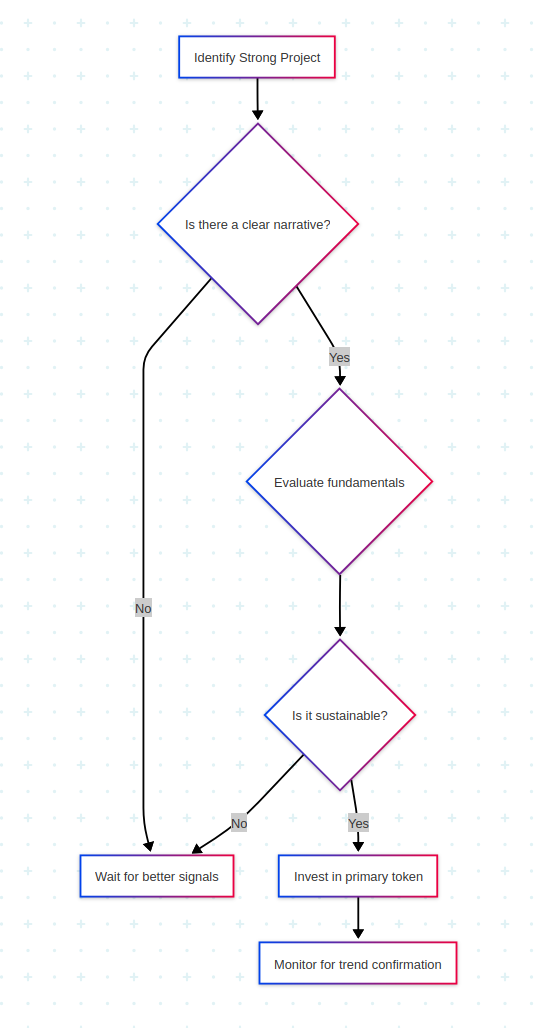
Three consecutive green candles on a chart can spark euphoria, but don't mistake short-term strength for a long-term trend reversal. A project may outperform a weak market due to a strong narrative or innovation, but without a robust thesis, it's unlikely to sustain a broader trend shift. For example, projects like Hyperliquid have shown exceptional strength due to unique narratives, but most tokens don't have that staying power.
How to Avoid It:
- Build a Thesis: Before investing, ask why a project is gaining traction. Is it a fleeting pump or a fundamental shift? Research its technology, team, and market fit.
- Focus on Established Tokens: In ecosystems like Virtuals, which recently pivoted to add utility to its token, stick to the primary token rather than chasing riskier, low-cap alternatives.
- Curious Data Point: A 2024 Dune Analytics study found that 70% of low-cap tokens in emerging ecosystems lose 80% of their value within three months of a pump.
Emotional Frustration and the Vicious Cycle
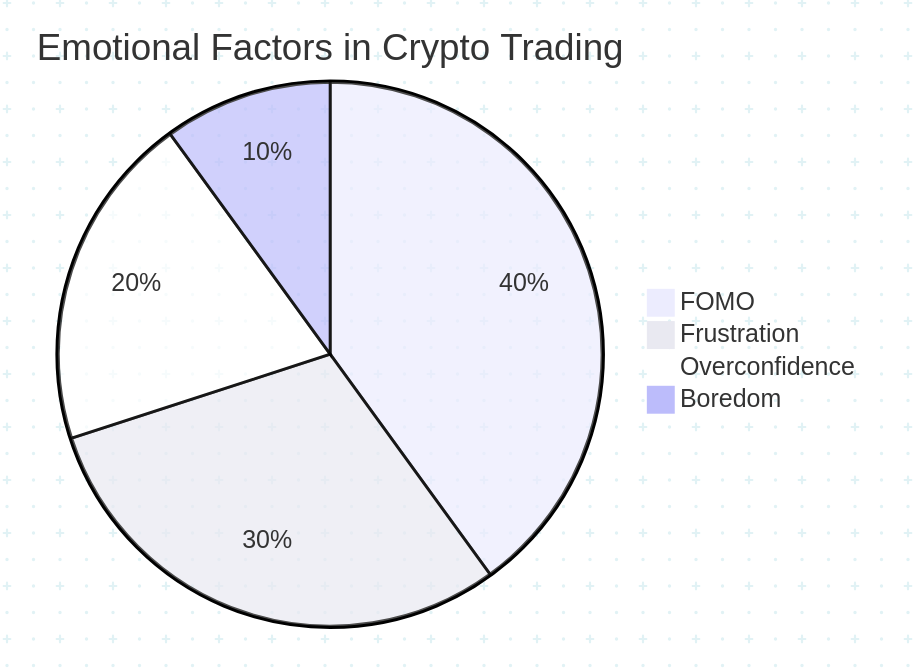
Sideways or bearish markets breed frustration. Missed opportunities and lower returns can erode confidence, leading to a vicious cycle: you doubt your skills, enter trades late, lose money, and spiral further into self-doubt. This emotional rollercoaster clouds judgment and amplifies losses.
How to Avoid It:
- Accept Lower Returns: Understand that choppy markets naturally yield lower profits. Focus on capital preservation over chasing unrealistic gains.
- Adopt a Rational Strategy: Create a rule-based system for entries and exits, using predefined price levels, timeframes, or on-chain metrics (e.g., whale wallet sell-offs tracked via Etherscan).
- Balance Intuition and Logic: Intuition plays a role in crypto, but anchor it with data-driven signals to avoid emotional trades.
Trading Out of Boredom
Boredom is a silent portfolio killer. In quiet markets, the lack of action tempts investors to make impulsive trades outside their comfort zone, chasing adrenaline rather than sound opportunities. These "boredom trades" often involve oversized positions in high-risk assets, leading to significant losses.
How to Avoid It:
- Stick to Your Strategy: Only trade when your predefined signals align, regardless of how long it's been since your last move.
- Manage Position Sizes: Avoid oversized bets on speculative trades, especially in unvetted projects.
- Interesting Stat: A 2022 Coinbase study revealed that 25% of retail traders admitted to making impulsive trades during low-volatility periods, with 80% of those trades resulting in losses.
Ignoring Liquidity
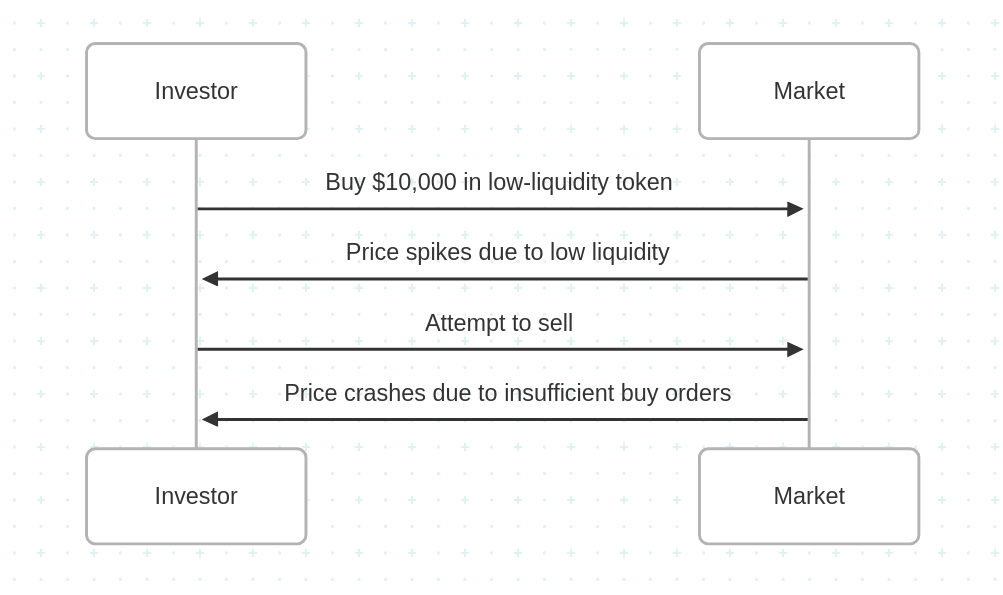
Liquidity is the lifeblood of crypto markets, yet many investors overlook it. A project's market cap doesn't tell the whole story. For example, investing $10,000 in a project with $2 million market cap but only $100,000 in liquidity can lead to extreme volatility. Low liquidity amplifies price swings — up during buys, down during sells — potentially wiping out your capital in minutes.
How to Avoid It:
- Check Liquidity Metrics: Use platforms like CoinMarketCap or DexTools to assess a token's trading volume and liquidity pool depth.
- Secure Early Profits: In low-liquidity projects, take initial profits quickly to minimize exposure to sharp drops.
- Quick Tip: Projects with liquidity below $500,000 often experience 50–90% price swings during sell-offs, per 2024 DeFiLlama data.
The Discipline Advantage: A Bonus Insight
In choppy or bearish markets, building large positions without a disciplined strategy is a recipe for disaster. The most successful investors in these phases aren't the smartest — they're the most disciplined. They stick to well-defined entry and exit plans, monitor market conditions closely, and avoid the "buy and forget" mentality.
Actionable Steps:
- Set Clear Rules: Define entry prices, exit targets, and investment timeframes.
- Stay Active: Choppy markets demand constant attention to avoid being caught off-guard by sudden shifts.
- Pro Insight: If you're not confident navigating flat markets, sit them out. Waiting for a bullish trend can yield higher returns with lower risk, as bull markets historically amplify gains for patient investors (e.g., Bitcoin's 2020–2021 rally saw 300% returns for holders).
Conclusion: Master Discipline to Protect Your Portfolio
Crypto investing is as much about avoiding mistakes as it is about seizing opportunities. By acting decisively, distinguishing strength from trends, managing emotions, resisting boredom, and prioritizing liquidity, you can safeguard your portfolio in choppy markets. Discipline, not intelligence, is the key to surviving and thriving in these conditions. Reflect on your own trading habits: Are you falling into these traps? Share your experiences or additional mistakes you've encountered in the comments below — let's learn from each other to build stronger portfolios.
source: https://raglup.medium.com/5-costly-crypto-investing-mistakes-to-avoid-in-choppy-markets-f969a5322eea?source=rss-f56f44caad34------2
Friday, May 30, 2025
Why I Lost Over $100,000 in Crypto: The Biggest Mistake to Avoid

The crypto market is a wild ride, full of dizzying highs and gut-wrenching lows. Like many, I've tasted the thrill of massive gains, only to watch them vanish due to a single, critical mistake: prioritizing being right over making money. This mindset cost me over $100,000 in 2022, and it's a trap countless investors fall into. I'll share the lessons I learned the hard way, why this error is so common, and how you can avoid it to become a smarter, more adaptable crypto investor. Buckle up — this is a story of loss, reflection, and redemption, with actionable insights to protect your portfolio.
The Harsh Truth About Crypto Losses
The crypto market doesn't care about your convictions or your carefully crafted investment theses. It's a brutal arena where adaptability trumps stubbornness. Most investors, myself included, have lost significant sums not because of market manipulation or lack of skill, but because we cling to the need to be right. We fall in love with projects, ignoring the market's signals, and end up holding losing positions far longer than we should.
This mindset stems from traditional investing wisdom, where long-term holding often pays off in stable markets like stocks or ETFs. But crypto is different — it's volatile, speculative, and driven by momentum. According to a 2023 study by Chainalysis, over 60% of crypto investors who lost money in bear markets cited "holding too long" as a primary reason. My story is a case study in this mistake, and it starts with two projects I believed in wholeheartedly.
My $100,000 Mistake: A Tale of Two Projects
In 2021, I was riding high on the crypto bull run. Two projects caught my eye: Luxo and Morpheus Network (XMW). Luxo was a blockchain focused on luxury, led by Fabian Westeller, the creator of Ethereum's ERC-20 protocol. Despite its potential, its market cap was under $1 billion, a fraction of competitors like Polkadot or Avalanche, which boasted valuations in the tens of billions. Morpheus Network, on the other hand, targeted logistics, with partnerships like the Argentine government and founders from major corporations. Both projects had stellar teams, ambitious roadmaps, and seemingly limitless potential.
Coming from a stock market and startup background, I was hooked. I analyzed their fundamentals — technology, team, and vision — and fell in love. I invested heavily, convinced these were the next big thing. Fast forward to 2022, the bear market hit, and both projects tanked alongside the broader market. My response? I doubled down, buying the dip at 15%, 25%, even 50% losses. I was certain the fundamentals would prevail. Spoiler: they didn't. By the end of 2022, I had lost nearly all my 2021 gains — over $100,000 — because I refused to adapt.
Why Did This Happen?
My mistake wasn't poor analysis; it was failing to understand crypto's unique dynamics. Unlike traditional markets, crypto is driven by speculation and liquidity, not just fundamentals. Projects with great teams can fail if they lose market attention. My conviction in Luxo and Morpheus Network blinded me to the market's signals, like declining prices and waning interest. I was trying to apply stock market logic — hold for the long term — to a market that rewards trading and momentum.
Fun Fact: A 2024 report by Glassnode found that 70% of altcoins from the 2021 bull run lost over 90% of their value by mid-2022, highlighting the crypto market's volatility and the dangers of blind holding.
The Core Lesson: Adaptability Over Conviction
The crypto market doesn't reward stubbornness; it rewards adaptability. The price is the ultimate truth, and fighting it is a losing battle. Markets are never wrong — only people are. To succeed, you must learn to read the market's signals and pivot when necessary, even if it means admitting you were wrong.
Take Berachain, a project I admire for its technology and community. Despite its strengths, its price action since launch has been lackluster. While Bitcoin, Solana, and even Ethereum gained traction in recent rallies, Berachain stagnated or fell. Holding onto it out of loyalty would have been a mistake. Instead, I exited my position, preserving capital for better opportunities. I still believe in Berachain's long-term potential, but I'm waiting for market signals — like renewed attention or price momentum — before re-entering.
How to Be Adaptable
To avoid my mistake, adopt these strategies:
- Follow the Price Action: The market's price movements are your best guide. If a project isn't gaining traction, don't fight the trend.
- Set Clear Entry and Exit Points: Define your investment thesis with specific triggers for buying and selling. For example, exit if a token drops 20% below your entry price or fails to follow a market rally.
- Document Everything: Keep a trading journal to record why you entered or exited a trade. Review it regularly to refine your strategy.
- Avoid the Hero Complex: Betting against the market, like Michael Burry in The Big Short, is tempting but risky. Most successful crypto investors, like MicroStrategy's Michael Saylor, buy during uptrends, not against them.
Pro Tip: Michael Saylor's Bitcoin purchases, as tracked by BitInfoCharts, show he bought heavily during bullish trends, capitalizing on momentum rather than fighting downturns.
Avoiding Emotional Traps
The crypto market thrives on emotion — fear of missing out (FOMO) and the urge to "be right" can cloud judgment. My $100,000 loss was fueled by emotional attachment to Luxo and Morpheus Network. I ignored red flags because I wanted my analysis to be correct. This is a common trap, especially for those transitioning from traditional markets.
To combat this:
- Don't Fall in Love with Projects: Treat investments as trades, not marriages. If a project underperforms, cut losses and move on.
- Embrace Being Wrong: Admitting a mistake isn't failure — it's growth. Exiting a losing trade frees up capital for better opportunities.
- Avoid Buying the Dip Blindly: Only buy dips if confirmed by positive price action or market trends. As the saying goes, "Don't catch a falling knife."
Building a Winning System
The key to long-term success in crypto is a disciplined system. Here's how to build one:
- Define Your Thesis: Outline why you're investing in a project, including price targets and risk levels.
- Track Your Trades: Use a journal to log every trade, including reasons for entry and exit. Tools like Notion or Excel work well.
- Review and Refine: Analyze your wins and losses to identify patterns. What worked? What didn't?
- Stay Liquid: Keep cash reserves to seize new opportunities, like emerging narratives (e.g., DeFi, AI, or memecoins).
By documenting and reviewing your trades, you'll spot mistakes and replicate successes. Over time, this system will make you a better investor.
Did You Know?: A 2022 study by the University of Cambridge found that traders who kept detailed journals improved their returns by an average of 15% compared to those who didn't.
Sources:
- Chainalysis 2023 Crypto Market Report: chainalysis.com
- Glassnode 2024 Altcoin Analysis: glassnode.com
- BitInfoCharts Michael Saylor Bitcoin Purchases: bitinfocharts.com
- University of Cambridge 2022 Crypto Trading Study: cam.ac.uk
source: https://raglup.medium.com/why-i-lost-over-100-000-in-crypto-the-biggest-mistake-to-avoid-6980110f62e3?source=rss-f56f44caad34------2
Friday, May 02, 2025
5 Proven Strategies to Master Your Investment Portfolio

Investing is a journey fraught with highs and lows, where even the savviest investors stumble. Yet, the difference between success and failure often lies in how we manage our portfolios and mindset. Over years of navigating markets — particularly the volatile world of cryptocurrencies — I've distilled five key strategies that transformed my approach to investing. These aren't just tactics; they're mental frameworks that can help you minimize errors, boost confidence, and maximize returns. Whether you're a seasoned trader or a cautious beginner, these strategies will empower you to take control of your financial future.
The Power of Perspective: Reassess Your Positions
Imagine you had all your capital in stablecoins, untouched by market swings. Would you pour it all into your current investments? This simple question is a game-changer. It forces you to detach from emotional biases like FOMO (fear of missing out) and evaluate your portfolio objectively.
In the crypto market, it's easy to get swept up when a coin skyrockets. Take my experience with a project I invested in at $1, which soared to $4. I held on, dreaming it could be "the one" to make me a fortune, only selling near $8. Had I asked myself the stablecoin question earlier, I'd have realized I wouldn't bet so heavily on that project at its peak. This exercise isn't just for when prices soar — it's equally vital when markets dip. Constantly reassess your positions, as clinging to pride or sunk costs can lead to costly mistakes.
Pro Tip: Perform this mental reset weekly. It keeps your portfolio aligned with your goals, not your emotions.
Fun Fact: Behavioral finance studies show that investors often hold losing positions 50% longer than winning ones due to loss aversion, costing them significant returns (Kahneman & Tversky, 1979).
Define Your Thesis and Exit Plan
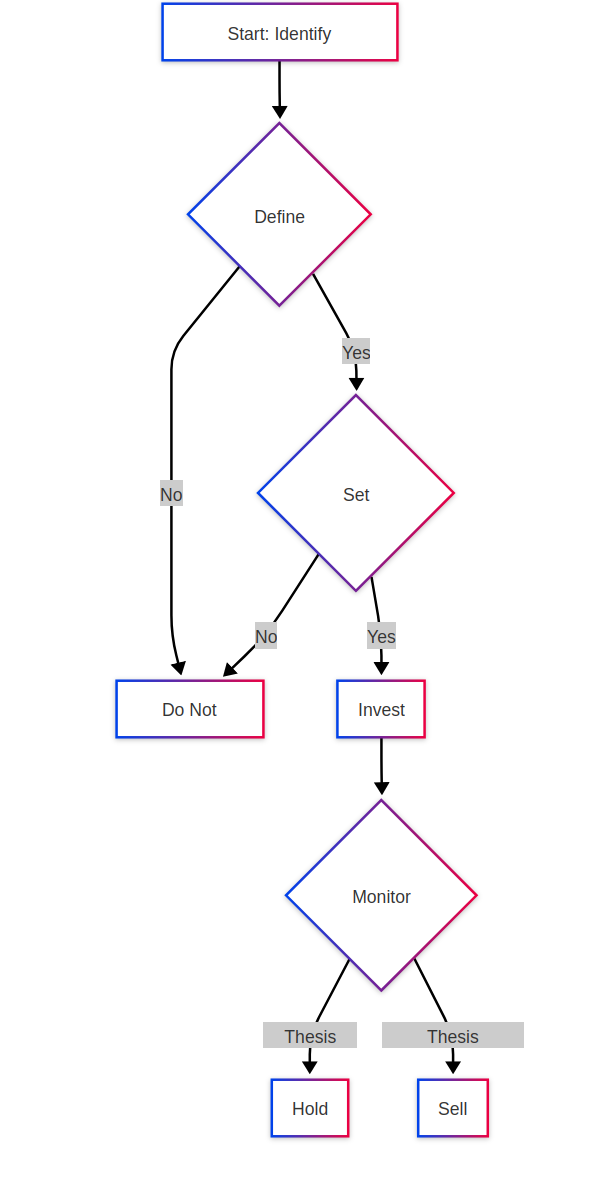
No investment should be a leap of faith. Before putting money into any project — be it stocks, crypto, or startups — establish a clear thesis (why you're investing) and an invalidation plan (when to exit). Without these, you're gambling, not investing.
Your thesis could be based on fundamentals (e.g., a company's strong revenue growth), technical analysis (e.g., a breakout pattern on a chart), or specific events (e.g., a product launch). For example, if you invest in a crypto token expecting a major partnership announcement, your invalidation might be: "If the announcement doesn't happen in two weeks, I sell." Or, if a stock drops below a key support level, like $50, that's your signal to exit.
This approach saved me from a disastrous crypto trade where I expected a token to surge after a rumored Elon Musk tweet. When the tweet didn't materialize, my predefined exit plan limited my loss to 10% instead of a potential 50% plunge.
Below is a chart to visualize the decision-making process for entering and exiting investments:
Concentrate Your Bets with Confidence
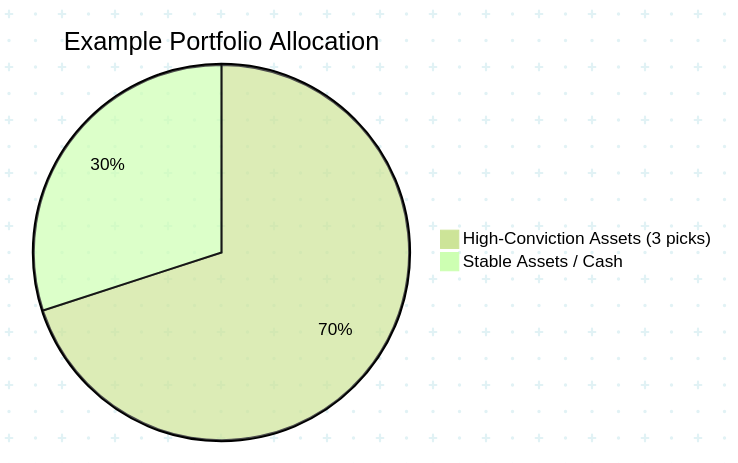
Once you've mastered crafting theses and invalidation plans, your confidence will soar. This is when you shift from scattering small bets across dozens of projects to concentrating capital in high-conviction opportunities.
In crypto, information asymmetry — where retail investors can spot opportunities before institutions — creates unique prospects. For instance, I once identified a project with a strong use case and upcoming catalyst. Instead of my usual $100 bet, I invested $1,000, knowing my thesis supported a potential 3x return with only a 10% downside risk. The trade paid off, doubling my capital. Such opportunities are rarer in traditional markets, where institutional dominance reduces retail edge.
Key Insight: Focus on 3–5 high-conviction investments rather than diversifying into 20+ low-confidence ones. Studies show concentrated portfolios outperform overly diversified ones when backed by robust research (Markowitz, 1952).
Know Your Investor Profile
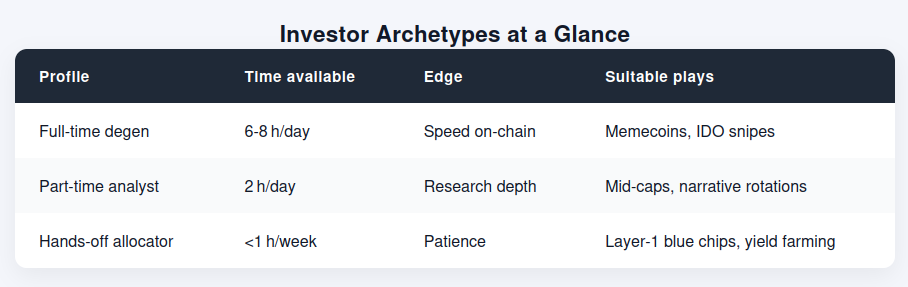
FOMO is the investor's worst enemy, luring us into trendy but unsuitable opportunities. To combat this, define your investor profile — your risk tolerance, time availability, and financial goals.
Are you a busy parent with limited time to track markets? Then chasing the latest Solana-based altcoin or day-trading meme coins isn't for you. Instead, opt for stable, long-term investments like blue-chip stocks or diversified ETFs. Conversely, if you're a young, risk-tolerant investor with hours to research, you might thrive in crypto's high-volatility environment.
I once met a father of two who lost thousands chasing a "hot" crypto token because it didn't match his risk-averse profile. Had he stuck to dividend-paying stocks, he'd have preserved his capital. Define your profile early to filter out noise and focus on opportunities that suit you.
Curious Fact: A 2021 Fidelity study found that 65% of retail investors regret impulsive trades driven by FOMO, with most citing a mismatch with their risk profile.
Embrace Market Momentum, Not Ego
You're not a market oracle, and neither am I. Predicting reversals — like calling a market top during a bull run — is a fool's errand for most. Instead, ride the wave. Markets can stay irrational longer than you can stay solvent, as John Maynard Keynes famously noted.
During the post-COVID bull run, skeptics called Bitcoin and Ethereum overvalued at $20,000 and $1,000, respectively. Yet, Bitcoin hit $69,000, and Ethereum soared past $4,800. Playing against momentum cost naysayers dearly. Focus on short-term gains, building capital while trends are in your favor.
Pro Tip: Use trailing stop-loss orders to lock in profits during uptrends without needing to time the market perfectly.
Bonus Strategy: Detach from Outcomes
Even with the best strategies, you'll make mistakes. The key is to focus on process, not results. If you've defined a thesis, set an invalidation, and managed risk, a losing trade isn't a failure — it's a learning opportunity. Analyze why you erred, refine your approach, and move on.
The goal isn't to win every trade but to ensure your wins outweigh your losses over time. As legendary investor Peter Lynch said, "In this business, if you're good, you're right six out of ten times. You're never going to be right nine out of ten."
Conclusion: Build Wealth with Discipline
Mastering your investment portfolio isn't about being a genius — it's about discipline, self-awareness, and adaptability. By reassessing positions, defining clear theses, concentrating bets, knowing your profile, riding momentum, and learning from mistakes, you'll minimize losses and amplify gains. Start applying these strategies today, and watch your confidence and capital grow.
What's your biggest investing challenge? Share in the comments below — I'd love to hear your story and offer tailored tips!
References:
- Kahneman, D., & Tversky, A. (1979). Prospect Theory: An Analysis of Decision under Risk. Econometrica.
- Markowitz, H. (1952). Portfolio Selection. The Journal of Finance.
- Fidelity Investments. (2021). Retail Investor Trends Study.
source: https://raglup.medium.com/5-proven-strategies-to-master-your-investment-portfolio-5afa5375ce15?source=rss-f56f44caad34------2
Tuesday, April 15, 2025
The MANTRA Meltdown: Unraveling a $6 to $0.50 Crypto Crash
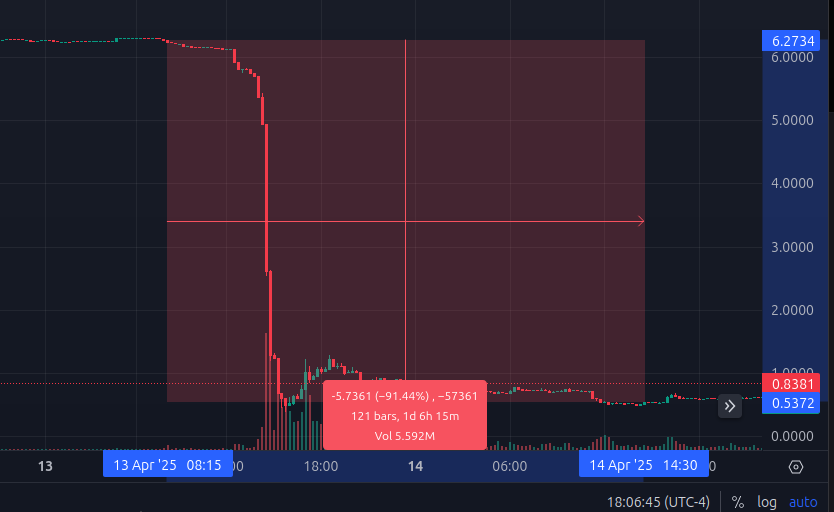
In the volatile world of cryptocurrency, few events have sparked as much controversy and speculation as the dramatic collapse of Mantra's OM token, plummeting from nearly $6 to $0.50 in a single day on April 13, 2025. This catastrophic 90% drop wiped out over $5 billion in market capitalization, leaving investors reeling and the crypto community scrambling for answers. Was it an insider dump, a cascade of reckless liquidations, or something else entirely?, this article dissects the Mantra meltdown, explores competing theories, and reflects on the broader implications for the crypto industry.
A Catastrophic Collapse: The Numbers Tell the Story
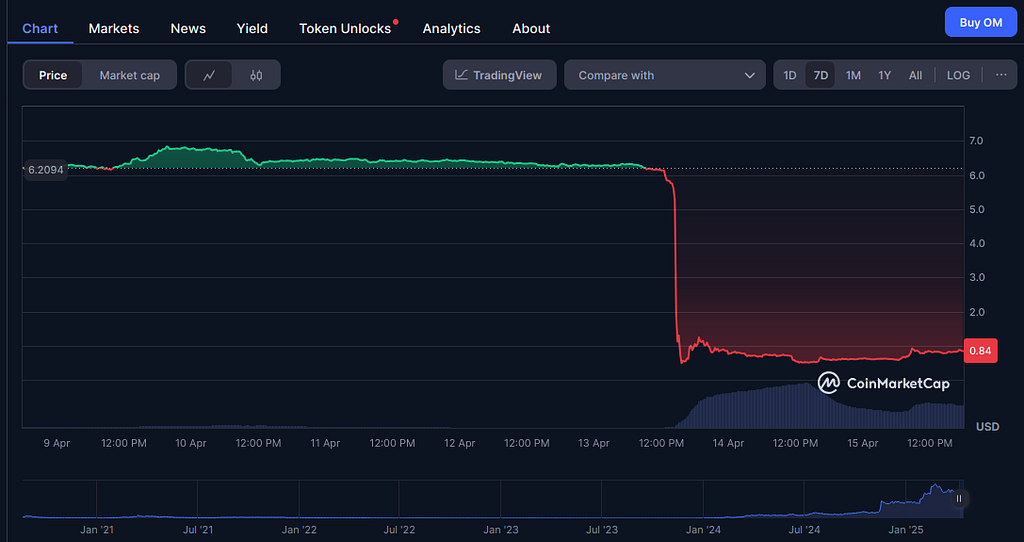
On April 13, 2025, Mantra's OM token, which had been trading at a high of nearly $7, experienced a freefall, bottoming out at $0.40 before stabilizing around $0.52. This represented a staggering loss of over 90% of its value in mere hours. For investors, the impact was devastating: a $10,000 investment was reduced to less than $1,000. The speed and scale of the crash raised immediate red flags, prompting intense scrutiny from the crypto community and media outlets alike.
Mantra, a project known for its ambitious plans to tokenize real-world assets (RWA) worth over $1 billion in collaboration with a firm from the United Arab Emirates, had been a darling of the crypto world. Its market cap had propelled it into the top 50 projects, and its community was buzzing with optimism. So, what went wrong?
Theory 1: Insider Dumping and a Potential Rug Pull
The first theory to emerge pointed fingers at insiders. Social media erupted with accusations that team members or early investors orchestrated a massive sell-off, dumping millions of OM tokens onto exchanges like Binance and OKX. This speculation was fueled by data from blockchain analytics platforms Lookonchain and Arkham Intelligence, which identified 17 wallets moving 43.6 million OM tokens — worth approximately $227 million — before the crash. Notably, wallets allegedly linked to Laser Digital, a Nomura-backed investor in Mantra, and Shorooq Partners, another investor, were flagged for transferring significant sums.
The optics were damning: Mantra's social media accounts went silent during the crash, and the token's price tanked in a low-liquidity window on a Sunday afternoon, a time when trading activity is typically minimal. To many, this resembled a classic rug pull — a scenario where insiders cash out, leaving retail investors holding worthless tokens.
However, Mantra's CEO, John Mullin, swiftly denied these allegations in a Cointelegraph AMA on April 14, 2025. Mullin insisted that neither the Mantra team, its key investors, nor its advisors had sold tokens. He claimed Arkham Intelligence had "mislabeled" the wallets, asserting that the company had provided a transparency report on April 8 detailing its key wallet addresses. Laser Digital and Shorooq Partners echoed Mullin's denials, with Laser stating, "Assertions linking Laser to 'investor selling' are factually incorrect," and Shorooq emphasizing its long-term equity stake in Mantra, not just token holdings.

Theory 2: Cascading Liquidations in a Low-Liquidity Market
The second theory, which gained traction as more details emerged, attributes the crash to a cascade of liquidations triggered by over-leveraged positions in a low-liquidity environment. Mantra's team, in a statement on X, described the event as "reckless liquidations," pointing to exchanges like Binance and OKX. Mullin suggested that a single large sale — possibly not even insider-driven — sparked a domino effect, liquidating leveraged positions and driving prices lower.
Binance's official statement on April 14 supported this narrative, noting that "cross-exchange liquidations" were responsible. The exchange explained that in a low-liquidity window, such as a Sunday afternoon, a single sale can trigger rapid price declines, especially when many traders are using high leverage. For example, a liquidation at $6.50 could push prices to $6.00 in a low-liquidity market, triggering further stop-loss orders and liquidations at $6.10, $6.00, and below.
Adding weight to this theory, Binance revealed it had imposed leverage limits on OM trading since January 2025, suggesting other exchanges may not have been as cautious. OKX, meanwhile, flagged "suspicious activity" across multiple platforms and noted significant changes in Mantra's tokenomics since October 2024, hinting at underlying vulnerabilities.
Curious Fact: The Sunday Effect
The crash's timing on a Sunday afternoon underscores a lesser-known vulnerability in crypto markets. Unlike traditional markets, crypto trades 24/7, but liquidity often dips on weekends, particularly Sundays. A 2023 study by CryptoCompare found that trading volumes on Sundays are, on average, 30% lower than on weekdays, making markets more susceptible to sharp price swings from large orders.
The Regulatory Elephant in the Room
Beyond the immediate causes, the Mantra crash exposes deeper issues in the crypto industry: a lack of standardized regulation and transparency. Unlike traditional markets, where insider trading is heavily monitored and public companies must disclose financial details, crypto projects operate with minimal oversight. Tokenomics, insider allocations, and wallet activities are often opaque, leaving investors vulnerable to manipulation or misinformation.
Noting that while Mantra's high-profile partnerships and top-50 status inspired confidence, the lack of uniform reporting standards made it difficult to assess risks. For instance, the absence of mandatory disclosures about insider token holdings or vesting schedules meant investors had little insight into potential sell-off risks. This opacity contrasts sharply with regulated markets, where such information is public, and insider sales are tracked.
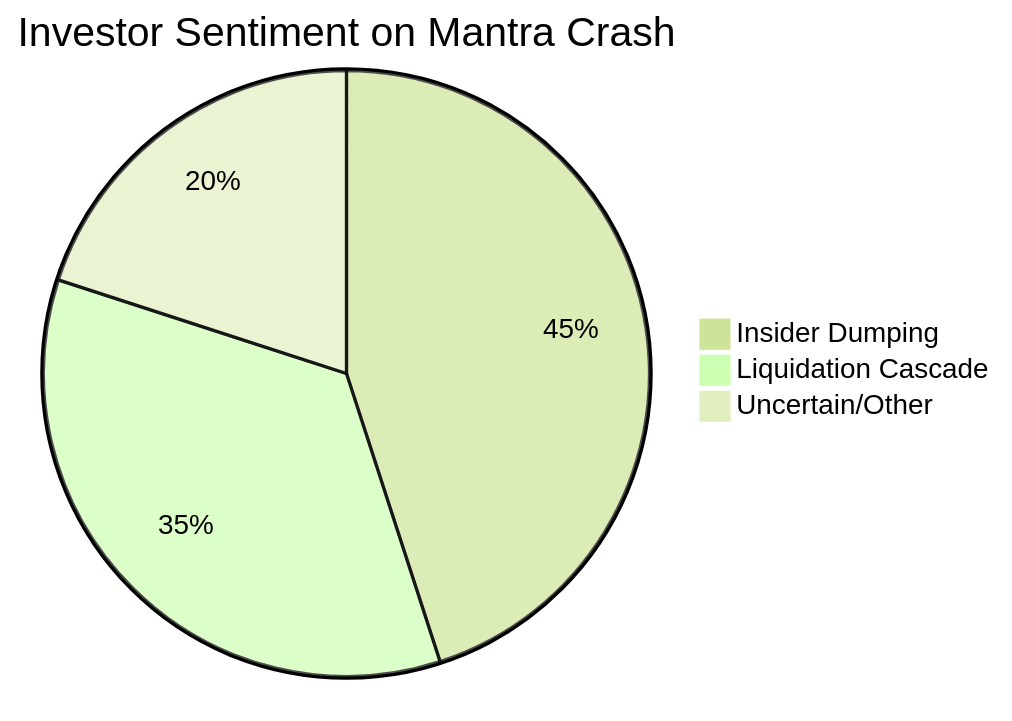
Pie Chart: Investor Sentiment Post-Crash
To capture the community's divided opinions, a pie chart illustrates sentiment based on social media reactions:
Lessons for the Crypto Industry
The Mantra meltdown serves as a wake-up call for the crypto industry. While decentralization is a core tenet, the absence of regulatory frameworks leaves investors exposed to risks that traditional markets have mitigated through decades of oversight. This "uncomfortable conversation" about regulation is inevitable, particularly for projects beyond Bitcoin, which lack a centralized team. Ethereum and other altcoins, with their development teams and token allocations, face similar scrutiny.
Mantra's case also underscores the dangers of over-leveraged trading. High leverage amplifies gains but also magnifies losses, and in low-liquidity scenarios, it can trigger catastrophic cascades. Investors must approach such markets with caution, prioritizing risk management over speculative bets.
Conclusion: A Call for Transparency and Reflection
The Mantra crash of April 13, 2025, remains an unresolved mystery, with investigations ongoing as of April 14. Was it an insider dump, as early data suggested, or a liquidation cascade amplified by low liquidity and reckless leverage? Perhaps the truth lies in a combination of factors. Regardless, the incident highlights the crypto industry's growing pains, from inadequate transparency to the perils of unregulated markets.
As the crypto space matures, stakeholders — projects, exchanges, and investors — must advocate for clearer standards and better risk management. For readers, the question remains: What do you think caused Mantra's collapse? Was it a calculated insider move, a market misstep, or something else? Share your thoughts in the comments below, and let's keep this critical conversation alive.
Sources:
- Cointelegraph: Mantra CEO denies insider OM token dump
source: https://raglup.medium.com/the-mantra-meltdown-unraveling-a-6-to-0-50-crypto-crash-af56cf47b76d?source=rss-f56f44caad34------2
Tuesday, March 25, 2025
The Web3 Revolution Unveiled: Scalable Business Models and the Future of Tokens

The crypto world is in flux — a seismic shift that's rewriting how we invest, innovate, and think about value. If you've ever wondered why some Web3 projects soar while others crash spectacularly, you're not alone. The secret lies in understanding how crypto mirrors traditional markets and where it boldly diverges. Drawing from cycles of liquidity, startup dynamics, and tokenomics, this article unpacks the future of Web3 business models — those that scale, those that don't, and why it matters to you.
Imagine a market where speculation once ruled, now pivoting toward sustainable value creation. That's where we're headed in 2025. Whether you're an investor, a founder, or just crypto-curious, stick around — I'll break it down with clarity, a touch of wit, and a few surprises along the way.
The Crypto Mirror: Reflecting Traditional Markets
Crypto isn't an alien frontier; it's a distorted reflection of what we already know — stock exchanges, startups, and venture capital (VC). Crypto replicates traditional market cycles but with a twist. These cycles — expansion, peak liquidity, contraction, and depression — drive everything.
- Expansion: Capital floods in, fueling growth.
- Peak Liquidity: Speculation peaks, valuations soar.
- Contraction: Reality bites, prices adjust.
- Depression: New ideas emerge from the ashes.
In traditional private markets, startups bootstrap or secure modest funding to create value (think bootstrapped founders or angel investors). As they grow, VC firms pour in cash during the "inflation and speculation" phase — think Uber or Airbnb in Web2, burning money to dominate markets. Most fail, but the winners deliver big. Crypto? It's the same playbook, just faster and wilder, thanks to instant liquidity from tokens.
Fun Fact: Did you know Airbnb's early funding came from selling cereal boxes during the 2008 election? Web2 giants weren't always VC darlings — they started scrappy, just like some Web3 gems today.
Web3's Wild Ride: Liquidity and Speculation on Steroids
Here's where crypto diverges: liquidity hits from day one. Unlike traditional startups waiting for an IPO, Web3 projects launch tokens that trade instantly. This turbocharges speculation — think absurd valuations and meme coin frenzies. Retail investors, lured by hype, often bear the brunt when bubbles burst.
Historically, Bitcoin's halving cycles (every four years) synced with altcoin bull runs, peaking six months post-halving. But in 2024–2025, something's off. Bitcoin's price has soared, yet altcoins lag. Why? Two culprits:
- No Clear Liquidity Surge: Traditional markets (NASDAQ, S&P 500) thrived, but crypto didn't get the same juice.
- Attention Dilution: Too many projects — hundreds of Layer 1s, Layer 2s, and AI-spawned tokens — split focus. Meme coins stole the spotlight, leaving innovation in the dust.
The result? Founders ask: "Why bust my ass on a groundbreaking product when a dog-themed token gets more love?" It's a fair question — and a market flaw.
The Value Zone: Web3's Quiet Winners
Amid the chaos, some projects thrive by generating real capital. The video highlights standouts like:
- Stablecoins: Tether and Circle, the backbone of crypto finance.
- DeFi Giants: Uniswap (profitable since 2021), PancakeSwap, Jupiter, Lido, Aave, Hyperliquid (a derivatives star).
- Blockchains: Tron, Binance Smart Chain.
- Real-World Assets (RWA): Maker, tokenizing tangible value.
These aren't flash-in-the-pan hype machines. They're stable, transaction-driven, and often tied to decentralized finance (DeFi). Uniswap's $1.5 billion in annual fees (source: DeFiLlama) or Lido's staking dominance prove it: value beats vaporware.
Contrast this with OpenSea (NFT boom gone bust) or Friend.tech (social hype faded fast). They shone briefly but lacked staying power. Web3 rewards longevity over fleeting trends.
Visual Suggestion: Place a Pie chart here showing the revenue split between DeFi, stablecoins, and RWAs in 2025 — e.g., 60% DeFi, 25% stablecoins, 15% RWAs — to highlight their dominance.
Web2 vs. Web3: The Scalability Conundrum
Web2 mastered scale — think Instagram serving millions with near-zero marginal cost. Web3? Not so much. Blockchain's clunky UX and high fees limit mass adoption. The video argues that Web3's edge lies in higher ticket sizes — fewer users, bigger transactions. DeFi thrives here, profiting from volume (e.g., Uniswap's 0.3% swap fee).
To scale, Web3 must borrow Web2's playbook — simplicity and reach — while leveraging its unique strength: capital-driven revenue. The future? Hybrid models blending Web2's accessibility with Web3's high-value transactions.
Here's a Mermaid flowchart to illustrate:

Tokenomics 2.0: From Memes to Meaning
Most tokens today are worthless — meme-driven hype with no utility. But change is brewing. Regulatory shifts in the US and Europe are pushing projects to offer real value via:
- Dividends: Tricky legally, but possible.
- Buybacks: Repurchasing tokens to reduce supply and boost value.
Think Amazon reinvesting profits to grow, not just paying out. Web3 startups like Sky, Ronin, Jito, and Kaito are already tweaking tokenomics — burning tokens or sharing profits via governance. This shift separates builders from grifters.
Data Point: In 2024, Binance burned $1.6 billion in BNB tokens, boosting holder value (source: Binance Blog). Expect more of this in Web3.
Investing Smart: Spotting the Next Big Thing
So, how do you pick winners in Web3? Focus on:
- Transaction-Based Models: Projects thriving on volume (DeFi, stablecoins, RWAs).
- Web2 Integration: Scalability meets blockchain.
- Sane Valuations: Avoid overhyped launches — early Uniswap or Lido had modest starts.
- Token Value: Buybacks or utility over speculation.
These traits signal long-term potential. Hyperliquid, bootstrapped and profitable, is a poster child for this approach.
Visual Suggestion: Add a comparison table here — e.g., Uniswap vs. a meme coin — showing revenue, valuation at launch, and holder benefits.
The Road Ahead: A Call to Action
Web3's future hinges on sustainable business models. The era of blind speculation is fading; value-driven projects will rise. As investors, we must dig deeper — beyond the hype, into the numbers and mechanics.
What do you think — can Web3 marry Web2's scale with blockchain's promise? Drop a comment below and let's debate. If you found this dive into Web3's evolution eye-opening, clap for it on Medium and share it with your crypto crew. The next big winner might be one click away.
source: https://raglup.medium.com/the-web3-revolution-unveiled-scalable-business-models-and-the-future-of-tokens-d9decdbe8f88?source=rss-f56f44caad34------2
Wednesday, March 12, 2025
5507 Interesting News
- Can China smash the Airbus-Boeing duopoly?
- A wave of international rule-making threatens Caribbean tax havens
- Another attack on a Japanese local points to a big problem in China
- South Korea's ban on praising the North is ridiculous
- The Kremlin is rewriting Wikipedia
- What Happens Now That TikTok's Gone Dark?
- Stopping the spiral of murder and violent crime
- George Orwell's horticultural sensibilities
- What can the world's most walkable cities teach other places?
- America's Gen Z has got religion
- Joan Didion's radical curiosity
- Blighty newsletter: Why phone signal in Britain is awful
- This week's covers
- What Russia's budget reveals about the war in Ukraine
- Who could replace Narendra Modi?
- Are British voters as clueless as Labour's intelligentsia thinks?
- AI could accelerate scientific fraud as well as progress
- Los Angeles against the flames
- Why Louis Vuitton is struggling but Hermès is not
- Casinos are booming in South-East Asia
- Little Richard died on May 9th
- Disputes over pay are hobbling Britain's public sector
- After 50 years, Wole Soyinka has returned to fiction
- Can Israel's economy survive an all-out war with Hizbullah?
- Politics
- Digital twins are making companies more efficient
- Economic data, commodities and markets
- Why are Remainers so weak in post-Brexit Britain?
- Helping America's hawks get inside the head of Xi Jinping
- Hassan Nasrallah, leader of Hizbullah
- TSMC walks a geopolitical tightrope
- Mexico and Canada brace for Donald Trump's tariff thrashing
- How to beat jet lag
- The Belt and Road, as seen from China
- Trump's FEMA Disaster Aid Freeze Threatens 'Acute Harm,' Judge Rules
- Mark Carney, the Liberal who will lead Canada
- The power and limits of Emmanuel Macron's diplomatic charm
- Wrath and sorrow rule in Israel on the anniversary of October 7th
- Congo-Brazzaville has lost a big chunk of its oil revenue
- Like people, elephants call each other by name
- Economic bright spots are getting harder to find in Thailand
- How the mad, bad Maduro regime clings to power
- Politics
- Ennio Morricone died on July 6th
- The IEA warns much more ambition is needed to curb global warming
- The AI Future Is Here
- Checks and Balance newsletter: Why can't politicians just admit when they're wrong?
- Africa's EV revolution has two wheels not four
- There are risks but also big potential benefits from digital payments
- Keeping tabs on China's murky maritime manoeuvres
- Armed groups are terrorising Colombia's border with Venezuela
- How Bob Dylan broke free
- Why a drone war in Asia would look different from the one in Ukraine
- Economic data, commodities and markets
- A gruesome corpse scandal sparks outrage in China
- Javier Milei will be Argentina's first libertarian president
- Why cooking causes 4m premature deaths a year
- The allure of the company town
- Hizbullah seems to have miscalculated in its fight with Israel
- Why skipping ropes are so expensive in China
- The weekly cartoon
- As Germany's defence stocks go ballistic, armsmakers are tooling up
- What does China want from Latin America and the Caribbean?
- The temptations of deferred removals
- Will interest-rate cuts turbocharge oil prices?
- How a tide of tech money is transforming charity
- Will artificial intelligence transform school?
- Politics
- The WIRED Guide to Commercial Human Space Flight
- On energy and climate, Trump and Harris are different by degrees
- The weekly cartoon
- How the Rosetta Stone was deciphered
- Carbon-dioxide-removal options are multiplying
- Politics
- Narendra Modi ramps up the Muslim-baiting
- The first week of COP26 was less substantive than it seemed
- Big Business Backs Away from Tackling Climate Change as Trump Axes Environmental Efforts
- Most electric-car batteries could soon be made by recycling old ones
- Business
- Economic data, commodities and markets
- What The Economist thought about solar power
- Economic data, commodities and markets
- From hypersonic missiles to undersea drones, the PLA is making leaps
- North Korea is arming Russia and threatening war with South Korea
- Why is Thai health care so good?
- Mice have been genetically engineered to look like mammoths
- China is talking to Taiwan's next leader, just not directly
- The business of businesses is climate-change adaptation
- Basic Materials Roundup: Market Talk
- Jovenel Moïse's widow is accused of being party to his murder
- Can Britain's "mission-led" government defy gravity?
- Gianni Infantino and Donald Trump have taken the 2026 World Cup for themselves | Leander Schaerlaeckens
- France seeks a new government
- Backing Heathrow expansion suggests Labour is serious about boosting growth
- Microsoft's and Google's Quantum Computing Claims Add to Consumer Confusion
- How artificial intelligence is changing baseball
- A trial in New York exposes US-Mexican counter-narcotics tensions
- Economic data, commodities and markets
- Blighty newsletter: A country trapped in zero-sum thinking
- US relies on rare foreign policy provision to try to deport Mahmoud Khalil
- Martial law in South Korea—and then not. What comes next?
- Fathers are doing more child care in East Asia
- How the best British employers find and promote their staff
- Israeli strikes on Beirut and Tehran could intensify a regional war
- Economic data, commodities and markets
- Economic data, commodities and markets
- Everyone wants to meet Syria's new rulers
- Republicans finally win the coveted trifecta
- Trade unions have their eye on Britain's tech sector
- 14 Best Sleep Week Deals on Mattresses, Sheets, and More (2025)
- Ukraine confronts a future without America, and perhaps Zelensky
- What would Elon Musk do in government?
- Why Japan needs more forceful defence
- Economic data, commodities and markets
- If Ukraine Loses Starlink, Here Are the Best Alternatives
- Vast amounts of the world's shipping sails unseen
- Bong Joon Ho Will Always Root for the Losers
- Why is Canada's economy falling behind America's?
- Why 2024 could become the hottest year on record
- Singapore has achieved astounding economic success
- Which cities have the worst overtourism problem?
- Sources and acknowledgments
- T.S. Shanbhag died of coronavirus on May 4th
- Beijing Signals Readiness to Talk to Trump's Team, Even Old Foes
- The Philippines bans some genetically modified foods
- Donald Trump turns an angry gaze south
- Sources and acknowledgments
- How Taiwan still hangs on to property in bits of China
- Winemakers are building grape-picking robots
- The King of Ozempic Is Scared as Hell
- Narendra Modi faces a new threat: his Hindu-nationalist patrons
- Central-bank digital currencies are talked about more than coming to fruition
- The world's most unlikely safe haven
- The best books of 2021
- AI Thinks It Cracked Kryptos. The Artist Behind It Says No Chance
- Brazil's new president is visiting Joe Biden to boost relations
- Lawrence Wong will be only the fourth PM in Singapore's history
- Gloria Allen ran a charm school for young trans women
- The economics of the climate
- Thailand's top court tramples over the country's democracy
- Microsoft at 50: An AI Giant. A Kinder Culture. And Still Hellbent on Domination
- Venezuela's Supreme Court tests President Joe Biden
- Hamas's pick of Yahya Sinwar as leader makes a ceasefire less likely
- Why Central Americans migrate to the United States when they do
- Latin America is set to become a major oil producer this decade
- Engineered dust could help make Mars habitable
- Car firms are trying out new ways to sell mobility
- Tell us: how you have been impacted by the change to US student loan repayments?
- China Signals It Is Open to a Deal Keeping TikTok in U.S.
- Mahmoud Khalil's Detention Is a Trial Run
- P.J. O'Rourke hoped to make life hell for do-gooders everywhere
- Bill Gates Traumatized His Parents—and Other Stories of a Wild, Wonky Youth
- China's new age of swagger and paranoia
- Young Americans are getting happier
- Britain is a world leader in pet health care
- Amnon Weinstein turned grief into music again
- Footage shows coral bleaching at Western Australia's Ningaloo Reef – video
- Why have markets grown more captivated by data releases?
- Mark Carney must keep an expansionist America at bay
- Lessons from the pandemic
- Larry McMurtry died on March 25th
- Why young men and women are drifting apart
- China has chilling plans for governing Taiwan
- Swiss franc, Japanese yen Rise as DeepSeek News Boosts Safe Havens
- Scientists can help fetuses by growing tiny replicas of their organs
- The perils of expanded balance-sheets
- Nukes and King Charles—but no door key
- What has four stomachs and could change the world?
- Ancient, damaged Roman scrolls have been deciphered using AI
- Where British MPs should look before the vote on assisted dying
- France's new prime minister is trying to court the left
- Economic data, commodities and markets
- Buyers of Russian crude are exporting refined oil to the West
- Europe today is a case of lots of presidents yet nobody leading
- Video: How we studied the lessons of Ukraine
- Who is Mahmoud Khalil? The detained Columbia graduate praised as steady negotiator
- Demand for chocolate causes more illegal deforestation than people realise
- The Young Thug trial could be Fani Willis's last big act
- A new technique to work out a corpse's time of death
- South Africa election poll tracker, results and guide to the parties
- Economic data, commodities and markets
- Ross Ulbricht, pardoned by Donald Trump, was a pioneer of crypto-crime
- Mourid Barghouti died on February 14th
- How Yahya Sinwar's death will change the Middle East
- Songs, pandas and praise for Xi: how China courts young Taiwanese
- Economic data, commodities and markets
- KAL's cartoon
- The world needs a more active Germany
- Economic data, commodities and markets
- Politics
- The sudden demise of Indian vultures killed thousands of people
- The Lilo & Stich Remake's First Full Trailer Is Packed With Adorable Alien Action
- Building an African multinational
- Europe could become Trump's geopolitical roadkill
- German business is being suffocated by high costs and red tape
- Britain's obsession with baked beans
- The alarming foreign policies of France's hard right and hard left
- Fifteen notable lives lost in 2022
- Alexei Navalny didn't just defy Putin—he showed up his depravity
- Why the Arab world has an identity crisis
- Is it cheaper to rent or buy property?
- Why the 2024 Chicago convention is not the 1968 convention
- Trump Still Considering Tariffs on Taiwanese Chips, Despite $100 Billion TSMC Deal
- Ron Galella, the original paparazzo, died on April 30th, aged 91
- Here's how to pre-order the new Apple iPad and iPad Air M3
- Taiwan is a vital island that is under serious threat
- Russia's Crude Exports Fairly Stable Despite U.S. Sanctions, Goldman Says
- The Republicans gain control of the Senate
- Huawei's new made-in-China software takes on Apple and Android
- In Catholic Argentina, Javier Milei embraces Judaism
- Anti-war parties are set to clean up in eastern German elections
- Just how frothy is America's stockmarket?
- Albert Woodfox found his true self in prison
- Extrude - Analyse Binaries For Missing Security Features, Information Disclosure And More...
- Nicolás Maduro, Venezuela's autocrat, is winning
- Are video games really addictive?
- Economic data, commodities and markets
- A new biography explains the genius of John von Neumann
- Europe prepares for a mighty trade war
- Global firms are tapping India's workers like never before
- KAL's cartoon
- Five charts that show why the BJP expects to win India's election
- Tech, Media & Telecom Roundup: Market Talk
- Britain halves its foreign-aid budget
- Millions of Chinese people play guandan. Is that good or bad?
- Britain is a home but not a haven for Hong Kongers
- How China became a car-exporting juggernaut
- France is confronting its history in Algeria
- Business
- Can Japan's toilet technology crack global markets?
- From Congo to the Capitol, conspiracy theories are surging
- After banning cinema for decades, Saudi Arabia is making movies
- New railways could transform South-East Asia
- Donald Trump's chokehold on Ukraine
- This week's cover
- This week's covers
- An unusual museum in China is dedicated to Vinegar Joe
- Meet the maharajas of the world's biggest democracy
- A copycat insurrection in Brazil, and its troubling aftermath
- High-tech antidotes for snake bites
- Joe Biden, master oil trader
- Africa Inc is ready to roar
- Quantifying the rise of America's far right
- Why young Russian women appear so eager to marry Chinese men
- Imran Khan is convicted. Pakistan's generals are content
- Why big oil is wading into lithium
- The end of cricket's Indian monopoly
- After a dramatic week in Gaza, where does the war stand?
- Mauro Morandi needed to abandon consumer society
- The world's population has reached 8bn. Don't panic
- Economic data, commodities and markets
- American men are getting back to work
- Economic data, commodities and markets
- An anatomy of hard times in the city
- Mexico has become a testing ground for psychedelic therapies
- The AirFish is a fast ferry that will fly above the waves
- Why Warren Buffett has built a mighty cash mountain
- How an amateur football league in China took off
- Who Lives, Who Dies, Who Tells Watto's Story?
- Economic data, commodities and markets
- Economic data, commodities and markets
- Henry Kissinger and Eric Schmidt take on AI
- Baby-boomers are loaded. Why are they so stingy?
- Will Donald Trump's bros turn out?
- China's Communist Party has co-opted ancient music
- Meet Europe's Gaullists, Atlanticists, denialists and Putinists
- Checks and Balance newsletter: Trump's mass-deportation fantasy
- Canada to Provide $720 Million to Canada Post to Avoid Insolvency at Mail Service
- Best Smart Scale for 2025
- Egypt and Jordan are struggling to make themselves useful to Donald Trump
- Prescription rules for obesity drugs may unfairly exclude non-whites
- Ethiopia is in the midst of a kidnapping epidemic
- Why judges were wrong to block the Kroger-Albertsons merger
- Kash Patel, Donald Trump's wizard, wants to reform the FBI
- Can Jeff Bezos match Elon Musk in space?
- Shirley Chisholm is still winning
- Manmohan Singh was India's economic freedom fighter
- NASA insists that two astronauts are not "stranded" in space
- BP is underperforming and under pressure
- Canada's miserly defence spending is increasingly embarrassing
- Why avocados are driving another sort of green economy in Kenya
- Syria's Bashar al-Assad is in mortal danger
- Business
- The King of Java inflames an Indonesian "democratic emergency"
- Trumponomics would not be as bad as most expect
- What Narendra Modi's third term may look like
- South Korea's suicide rate fell for years. Women are driving it up again
- Military and financial support to Ukraine hits a record high
- America, Israel and Hamas are trapped in a dangerous impasse
- Howard Lutnick, Donald Trump's pick for commerce secretary
- Politics overshadows a conference to raise money for Ukraine
- The Labour government picks up a bad Tory habit
- 5 Years After Covid Closed the Theaters, Audiences Are Returning
- What the world thinks of Trump, Ukraine and Chinese supremacy
- DOGE Has Deployed Its GSAi Custom Chatbot for 1,500 Federal Workers
- Physicists are reimagining dark matter
- Peter Magyar is reinvigorating Hungary's struggling opposition
- India's diaspora is bigger and more influential than any in history
- A biographer explores Greta Garbo's glamour and vacuity
- What Trump's new antitrust enforcers mean for business
- Why Volodymyr Zelensky may welcome Donald Trump's victory
- Where is Kamala Harris's convention bounce?
- John Parker, one of The Economist's finest correspondents, was a polymath journalist
- Bolivia's slow-motion economic crisis is accelerating
- Economic data, commodities and markets
- The slow death of a Labour buzzword
- North Korea's fanatical regime just got scarier
- Iran attacks Israel, risking a full-blown regional war
- Could supersonic air travel make a comeback?
- Brazil's gangsters have been getting into politics
- Israel and Hamas are not that far from a ceasefire agreement
- Economic data, commodities and markets
- A clue to China's true covid-19 death toll
- A dream deferred
- The flesh-eating worms devouring cows
- This Russian Tech Bro Helped Steal $93 Million and Landed in US Prison. Then Putin Called
- DOGE shutters the government's in-house tech consultancy
- Champions League Soccer: Livestream Lille vs. Borussia Dortmund From Anywhere
- What does Labour's win mean for British foreign policy?
- Why Kamala Harris's chances of victory just jumped
- European gangs are getting better at making their own illegal drugs
- China develops a divorced dating scene
- Italy starts outsourcing its migrant crisis to Albania
- Swedish businesses are being bombed
- Autherine Lucy was an unlikely pioneer
- This week's covers
- Rolls-Royce Strikes Contract to Supply Nuclear Reactors for U.K. Submarines
- China's new GDP figures may restore faith in its economy
- Britain's government plans drastic changes to local democracy
- Could the next pope come from Africa or Asia?
- Trump's FDA Cuts Are Putting Drug Development at Risk
- Scientists want to tackle multiple sclerosis by treating the kissing virus
- Many mental-health conditions have bodily triggers
- Business
- The path ahead for China's Belt and Road Initiative
- Will a new "pact" of ten laws help Europe ease its migrant woes?
- Life and death in a Christmas tree
- The weekly cartoon
- Sources and acknowledgments
- Ukraine's Roma have suffered worse than most in the war
- New treatments are emerging for type-1 diabetes
- Daniel Brush's drive to understand beauty led him to the life of a hermit
- Kamala Harris is outspending Donald Trump. Will it matter?
- Obituary: Yuri Luzhkov died on December 10th
- What the war on tourism gets wrong
- Can shooting some elephants save many others?
- Tech Leaders Pledge Up to $500 Billion in AI Investment in U.S.
- Germany's Social Democrats narrowly escape disaster in Brandenburg
- What is Elon Musk getting up to with America's payment system?
- Hindenburg widens its attack on Adani
- Moonvalley releases a video generator it claims was trained on licensed content
- Australia needs to rethink its approach to its Pacific island neighbours
- Can Gaming Save the Apple Vision Pro?
- Green protectionism comes with big risks
- Vietnam's head of state leaves under a cloud
- Donald Trump's defining decade
- The pandemic made the world realise the importance of human contact
- How to make India richer
- Naval drills in the Indian Ocean give bite to the anti-China "Quad"
- What German business makes of France's leftward turn
- Justin Trudeau is killing Canada's liberal dream
- Why are VPNs getting slower in China?
- Wegovy hits the People's Republic, at last
- Canada has finally decided where to store its nuclear waste
- Business
- The hidden cost of Chinese loans
- How to provoke the fury of Xi Jinping
- How a Spanish province became the world's truffle leader
- Nicaragua shows how poor countries can reduce domestic violence
- Business
- The weekly cartoon
- Our new forecast for America's presidential election
- The Middle East's bizarre waiting game: ceasefire or Armageddon?
- Sources and acknowledgments
- Why the hype for hybrid cars will not last
- What does the Australian submarine deal mean for non-proliferation?
- How to train your large language model
- When will remote workers see their pay cut?
- How to pay for the poor world to go green
- Emmanuel Macron has yet another stab at finding a prime minister
- Spotify Pulls Down Andrew Tate's Podcast About 'Pimping Hoes' Amid Criminal Probe
- Birubala Rabha fought to end the stigmatisation of women
- Climate change and the next administration
- The pandemic has broken a closely followed survey of sentiment
- Places ravaged by opioids are giving Republicans the upper hand
- Kenneth Kaunda died on June 17th
- Xi Jinping's chaos-loving friends
- Hamas talks a big game but is in chaos
- A search for roots is behind a surge in Scottish tourism
- Russia sentences Evan Gershkovich to 16 years on bogus spying charges
- American long-range missiles are coming back to Europe
- SpaceX is NASA's biggest lunar rival
- Much keener on Trump, less sure about Charles III
- Economic data, commodities and markets
- Why your company is struggling to scale up generative AI
- The Economist's final prediction points to a Tory wipeout in Britain
- Robert Fico's pleas for cheap Russian gas bring Slovaks onto the street
- Does made in Mexico mean made by China?
- Two new books explore the impact of accelerating technology
- Economic data, commodities and markets
- Emmanuel Macron faces heavy losses after a short campaign
- The trial of Lucy Letby has shocked British statisticians
- A battle is raging over the definition of open-source AI
- Yes sir: a bizarre initiation ritual for Indonesia's cabinet
- Ninja Swirl by Creami Soft Serve Machine Review: Joy in Every Cup
- This week's cover
- The School Shootings Were Fake. The Terror Was Real
- From Greenland to Panama and Mexico, leaders are in shock
- Invading Taiwan would be a logistical minefield for China
- How ransomware could cripple countries, not just companies
- Baby formulas now share some ingredients with breast milk
- Censorious governments are abusing "fake news" laws
- The Man Who Owned 181 Renoirs
- Britain has many levers for controlling migration. Which ones should it pull?
- Why Iranian dissidents love Cyrus, an ancient Persian king
- Israel's prime minister does not know where to go
- The clock is ticking on an old deal between America and China
- Tesla, Intel and the fecklessness of corporate boards
- What's Really Happening With Elon Musk and Those 'Stranded' Astronauts?
- A horrific killing spree shakes Syria
- Bolivia's left wing is at war with itself
- South-East Asian Muslims are incensed by the war in Gaza
- Latin American cities are struggling in the liveability ranking
- Who are the main contenders to be Iran's next president?
- Italy's oddest political party is splitting
- Are ice baths good for you?
- China is overhauling its company law
- Would you really die for your country?
- Machine translation is almost a solved problem
- Sammy Basso led research into his own rare disease
- Is Argentina's new president too divisive to fix a broken economy?
- A new film is breaking box-office records in China
- Economic data, commodities and markets
- The economy sees repeated boom and bust cycles
- What would Europe do if Trump won?
- This week's cover
- Sony demos an AI-powered PlayStation character
- The former president of Honduras is tried for drug trafficking
- The Middle East braces for wider war as Iran weighs its response
- Astronomers have found a cave on the moon
- How to harvest moisture from the atmosphere
- Economic data, commodities and markets
- India is turning into an SUV country
- Can Europe afford to be the world's last free-trader?
- Chinese women are making themselves heard on the big screen
- The early days of the Trump administration, as viewed from China
- Lavender extract makes excellent mosquito-repellent
- Inflation in Britain looks irritatingly persistent
- Lab-grown models of embryos increasingly resemble the real thing
- James Lovelock changed the way human beings look at the Earth
- The rebuilding of Berlin's Pergamon Museum is 40 years behind schedule
- Economic data, commodities and markets
- China's push to create a single national identity
- Russia's plunging currency spells trouble for its war effort
- Daylight Saving Time and Early School Start Times Cost The Economy Billions
- Hong Kong's property slump may be terminal
- Will bond vigilantes come for America's next president?
- At Columbia, Tension Over Gaza Protests Hits Breaking Point Under Trump
- This week's cover
- A banking raid in Europe kicks up an unseemly nationalist defence
- Blighty newsletter: Labour changes Britain's policy towards Israel, carefully
- Why chocolate is becoming much more expensive
- Rolls-Royce cars push the pedal on customisation
- The four worst words in British politics
- Mahmoud Khalil Has Not Been Allowed to Speak Privately With Lawyers
- Volunteers with Down's syndrome could help find Alzheimer's drugs
- How Labour learned to love rearmament
- A flailing economy has left the EU exposed to Trumpian outbursts
- Syrian rebels sweep into Aleppo in an embarrassing rout for Bashar al-Assad
- The Islamic State's branch in Afghanistan is at war with the world
- Rwanda's reckless plan to redraw the map of Africa
- Gay voters are smitten with Kamala Harris
- In Texas, vaccine-choice activists are ascendant
- Business
- What is behind China's perplexing bond-market intervention?
- Economic data, commodities and markets
- Elon Musk's SpaceX has achieved something extraordinary
- Abuse by priests in Italy can no longer be tolerated by the Vatican
- Our Carrie Bradshaw index: where Americans can afford to live solo in 2024
- KAL's cartoon
- KAL's cartoon
- Israel's ground assault hits Gaza's communication network
- Politics
- Germany's conservatives choose the country's probable next leader
- Britain's oldest newspaper is a treasure trove of trivia
- Economic data, commodities and markets
- The women vying to make conservatism fashionable online
- Chinese cars are taking over the global south
- The US tax code will change next year; the presidential election will determine how
- What if South Korea got a nuclear bomb?
- Victoria Amelina explored a land of atrocities and secrets
- Airships may finally prove useful for transporting cargo
- KAL's cartoon
- Adolfo Kaminsky saved thousands of Jews by changing their identities
- Donald Trump Jr. has been boosting MAGA-related startups
- The fall of Syria's dictator
- Andriy Pilshchykov pleaded for F-16s to be sent to Ukraine
- South-East Asia's stodgy conglomerates are holding it back
- H5N1 avian flu could cause a human pandemic
- The Telegram: our new guide to a dangerous world
- Geert Mak takes stock of the past 20 years of European history
- Will services make the world rich?
- The race for the Bundestag
- Woman Imprisoned and Starved Stepson for 20 Years, Police Say
- How wrong could America's pollsters be?
- Who is ahead in the race for Germany's next parliament?
- Ginni Thomas, battle-hardened conservative and bugaboo of Democrats
- After the president's arrest, what next for South Korea?
- China's slowing economy, seen from ground level
- Economic data, commodities and markets
- The spread of mariachi tells a very American story
- Remembering the Normandy landings
- Xi Jinping wants China to have better toilets
- The Economist's science and technology internship
- Why east Germany is such fertile ground for extremists
- China rounds up Batman, Donald Trump and the Buddha
- Is coal the new gold?
- Government by social media in Somalia
- What taxes might Labour raise?
- A new play stages excerpts from the Grenfell Tower fire inquiry
- Checks and Balance newsletter: Trump revives McKinley's imperial legacy
- Economic data, commodities and markets
- The fall of Libya's central banker triggers a new struggle
- Why China's companies are recruiting their own militias
- Policymakers are likely to jettison their 2% inflation targets
- Economic data, commodities and markets
- Trees alone will not save the world
- The promise of crypto has not lived up to its initial excitement
- Jimmy Carter was perhaps the most virtuous of all America's presidents
- New Zealand's biggest pivot since the 1980s
- Donald Trump is preparing an assault on America's immigration system
- Steve Borthwick may use three fly-halves for Six Nations finale in Wales
- Shyam Saran Negi never failed in his democratic duty
- Who is really in charge of Lebanon?
- Nicolás Maduro, Venezuela's dictator, thumbs his nose at Joe Biden
- Business
- Beyond France, the European elections will deliver more of the same
- Nokia Put a 4G Cellular Network on the Moon but Couldn't Make a Phone Call
- Sergei Shoigu's sacking points to yet more attrition in Ukraine
- Jimmy Carter reshaped his home town
- This week's cover
- How DeepSeek will upend the AI pecking order
- Politics
- The smiling new face of German big business
- Thich Nhat Hanh believed that Buddhism should be a force for change
- Warlord, jihadi or nation-builder?
- Economic data, commodities and markets
- Should euthanasia be allowed for those with mental illnesses?
- Drones spotted on America's east coast highlight a bigger problem
- Bangladesh's dictator flees—leaving behind a dangerous vacuum
- Surrogacy reform is spreading in the rich world
- How lower American interest rates will boost Africa
- Which countries provide the most, and least, support to Ukraine?
- Can America afford its debts?
- China has become a scientific superpower
- America keeps Ukraine fighting with its hands tied
- Economic data, commodities and markets
- England's school reforms are earning fans abroad
- Tracking the Ukraine war: where is the latest fighting?
- AI and globalisation are shaking up software developers' world
- Leon Fleisher died on August 2nd
- Venezuela's autocrat launches a massive corruption probe
- The scourge of stolen bikes in Britain
- A backlash against gender ideology is starting in universities
- Stocks are on an astonishing run. Yet threats lurk
- Economic data, commodities and markets
- The Americas face a historic opportunity. Will the region grasp it?
- The public wants to refund, not defund, the police
- J.D. Vance, an honorary Frenchman, sends Europe into panic mode
- Israel's relations with America reach breaking point
- Tulsi Gabbard, Sean Penn and the hunt for an American hostage
- The excitement of 70,000 Swifties can shake the Earth
- The EU's best-laid plans for expansion are clashing with reality
- The best British companies to work for to get ahead
- "Barbie" and "Oppenheimer" show that blockbusters could save the cinema
- Fortnum & Mason caters to a demand for festive fun
- How Boston became the safest big city in America
- Economic and financial indicators
- Sir Keir Starmer's elevator pitch for investment
- Spirit's woes reveal the dismal state of America's budget airlines
- Myanmar's junta chief finally goes to China
- These are the world's most expensive cities
- Can Colombia's mercurial president bring "total peace"?
- iOS 18.4 introduces a new default navigation app choice, but only in Europe
- Economic data, commodities and markets
- A dispute over old war crimes strains Polish-Ukrainian relations
- Ganga Stone died on June 2nd
- The US Army's chief of staff has ideas on the force of the future
- Russ Vought: Donald Trump's holy warrior
- Two new books assess the geopolitical lessons of covid-19
- Chinese firms are expanding in South-East Asia
- Covid-19 has stymied governments' efforts to collect data
- Europe vows to defend Ukraine, but prays for Trump's support
- China's economic model retains a dangerous allure
- Over a billion have voted in 2024: has democracy won?
- At last, Wall Street has something to cheer
- The Kremlin is close to crushing Pokrovsk, a vital Ukrainian town
- Efforts to teach character bring promise and perils
- DockerSpy - DockerSpy Searches For Images On Docker Hub And Extracts Sensitive Information Such As Authentication Secrets, Private Keys, And More
- Germans are world champions of calling in sick
- An adult fruit fly brain has been mapped—human brains could follow
- Yuan Longping died on May 22nd
- Andrew Cuomo plots a comeback in New York
- What investors expect from President Trump
- Meet one of Britain's most influential, least understood people
- The culture wars have come to Canada
- Economic data, commodities and markets
- Britain's aid budget is less generous than it looks
- A pay rise for government workers sparks anger and envy in China
- Which countries have the best, and worst, living standards?
- How blood-sucking vampire bats get their energy
- Freeman Dyson died on February 28th
- Economic data, commodities and markets
- Florida is the first state to reject an abortion-rights measure
- Europe is set to start cutting red tape—lightly
- Tim Walz is the most popular candidate on either ticket
- America and Ukraine prepare for brutal negotiations
- Regulators have private markets in their sights
- Singapore's foreign admirers see only the stuff they like
- Would you put Pete Hegseth second in America's chain of command?
- Floods in Nigeria's north-east are aggravating a humanitarian crisis
- Why Larry Hogan's long-odds bid for a Senate seat matters
- A neutrino telescope spots the signs of something cataclysmic
- Video games, power and diplomacy
- Politics
- Business
- Paris could change how cities host the Olympics for good
- Why migration is in such a mess once more
- Kamala Harris completes her reinvention
- A changing car industry should result in more choice and better motoring
- Thomas Neff's idea rid the world of a third of its nuclear warheads
- The G7 sketches a development-finance initiative to counter China's
- Kansas Tuberculosis Outbreak Emphasizes the Importance of Public Health Infrastructure
- NATO's race against Russia to re-arm
- The rise of the hard right threatens Europe's political stability
- Nicaragua's ruling couple tighten their grip
- Australia wants to lead the big tech crackdown
- Cristina Calderón was the only full-blooded member of her people
- Economic data, commodities and markets
- Cuba's Communist government taps the diaspora for cash
- Samuel Paty was killed on October 16th
- The movement of capital globally is in decline
- How China uses 'salami-slicing' tactics to exert pressure on Taiwan – video
- What a 472-year-old corpse reveals about India
- As stock prices fall, investors prepare for an autumn chill
- Politics
- Gulf governments are changing, but not how they talk to citizens
- China's government is badgering women to have babies
- The Hollywood Foreign Press Association does penance for its sins
- Chinese weapons are taking over in Africa
- Economic data, commodities and markets
- Donald Trump's immigration problem in five charts
- Meet the Peruvian indigenous singer inspired by K-pop
- Mike Sadler guided the first SAS raiders through the North African desert
- Politics
- Zvi Zamir oversaw a programme of Israeli assassinations
- Bernard Madoff died in prison on April 14th
- Narendra Modi is struggling to boost Indian growth
- Labour sweet-talks the public sector
- Business
- A D-Day commemoration that was not just about beating Hitler
- What the Paris agreement of 2015 meant
- What to expect at the NVIDIA GTC 2025 keynote with CEO Jensen Huang
- Politics
- Assessing the theory that covid-19 leaked from a Chinese lab
- Aid cannot make poor countries rich
- The energy transition will be expensive
- Economic data, commodities and markets
- Labour lacks good ideas for improving Britain's schools
- Gazans are rapidly losing access to the internet
- Russia continues to advance in eastern Ukraine
- After 15 months of hell, Israel and Hamas sign a ceasefire deal
- China needs its frightened officials to save the economy
- Why everyone wants to lend to weak companies
- Wikipedia is 20, and its reputation has never been higher
- China and the EU risk a trade war
- Economic data, commodities and markets
- The death penalty is disappearing in America
- Celeste Caeiro's small gesture named a revolution
- Kurdish rebels in Turkey declare a ceasefire
- Economic data, commodities and markets
- The stockmarket rout may not be over
- Will India's new government turbocharge the fight against poverty?
- What is the least liveable city in the world?
- Does Dallas offer a vision of America's future?
- Antarctic sea ice has shrunk by an area nine times the size of Britain
- Obituary: Steve Sawyer died on July 31st
- Upper legislative houses tend to be biased and malapportioned
- The sweet story of Peru's blueberry boom
- Aland is lovely, weapon-free and too close to Russia
- Wanted: new business, finance and economics interns
- Why America keeps building corrupt client states
- Economic data, commodities and markets
- SafeLine - Serve As A Reverse Proxy To Protect Your Web Services From Attacks And Exploits
- Congo brings back the death penalty
- The threat of war is empowering the Islamic republic's hardliners
- Acknowledgments
- Ángeles Flórez Peón, "Maricuela", made sure Spain did not forget its history
- After a year of war, Sudan is a failing state
- DeepSeek Won't Sink U.S. AI Titans
- China's new plan for tracking people online
- 10 Best Android Phones of 2025, Tested and Reviewed
- This week's covers
- David Kirke believed safe sport repressed people's imaginations
- Paul Alexander lived longer than anyone in an iron lung
- Hong Kong is struggling to restore its image as a global city
- Countries need to pull more carbon dioxide out of the air
- This week's covers
- Economic data, commodities and markets
- Our footloose index: the most attractive countries for graduates
- Solar geoengineering is becoming a respectable idea
- Lawrence Wong in his own words
- Why robots should take more inspiration from plants
- The world's oldest cheese sheds light on ancient Chinese culture
- Ukraine surprises with a high-stakes raid into Russia
- Racial tensions boil over in New Zealand
- The Biden administration pursued a mistaken policy on LNG exports
- Lula cosies up to Nicolás Maduro, Venezuela's autocrat
- Netflix's first gaming boss has left the company
- Will Giorgia Meloni turn out to be Europe's Trump card?
- America has never had state media like it does today
- Vladimir Putin is dragging the world back to a bloodier time
- Economic data, commodities and markets
- Intel is on life support. Can anything save it?
- Donald Trump's new trade war with China is also an opioid war
- The ceasefire between Israel and Hizbullah holds, for now
- Economic and financial indicators
- Jiang Zemin oversaw a wave of economic change, but not much political reform
- Hizbullah's decline is a boon for Lebanon's new government
- A death, an illness, and an uncertain Middle East
- Germany is going nuts for Dubai chocolate
- Kamala Harris's closing argument
- Sheikh Hasina faces her biggest crisis in years
- A surprise new twist in Putin's currency wars
- The secret to taking better penalties
- Macau, China's sin city, wants to be more like Las Vegas
- China's firms are taking flight, worrying its rulers
- Hong Kong convicts 14 pro-democracy activists
- Trinidad and Tobago calls new UK visa requirement 'disproportionate move'
- Donald Trump's Not-So-Strategic Crypto Reserve
- More Americans than ever report a disability
- Dominant languages can spread even without coercion
- The world this week
- Why is Mark Zuckerberg giving away Meta's crown jewels?
- Aaron Beck turned the world of psychiatry upside down
- Britons vote according to feelings of economic security
- Huge anti-Russian protests in Tbilisi echo Ukraine's Maidan
- Thief Raccoon - Login Phishing Tool
- Japan lands on the Moon
- Europeans are hoping they can buy more guns but keep their butter
- Does the tank have a future?
- What Is Quantum Computing? The Complete WIRED Guide
- China's property crisis claims more victims: companies
- Why most battery-makers struggle to make money
- European banks are making heady profits in Russia
- Habitat loss and climate change increase the risk of new diseases
- Poor countries struggling with debt fight to get help
- Why catastrophe bonds are failing to cover disaster damage
- Muhammad Amir Muhammad Khan fought India's government for five decades
- László Bogdán died on July 14th
- Canada has adopted assisted dying faster than anywhere on Earth
- Can Europe confront Vladimir Putin's Russia on its own?
- A deadly new strain of mpox is raising alarm
- In China, a Cat-and-Mouse Game to Rein In Crypto
- What Europe's comeback politicians can teach American voters
- How bosses should play politics: the cautionary tale of Elon Musk
- The great-man theory of Wall Street
- This week's covers
- A ports strike shows the stranglehold one union has on trade
- Britain's government pulls the plug on a superfast computer
- Prince of Persia: The Lost Crown highlights March's PS Plus lineup
- The drug-overdose capitals of Europe
- Worlds apart
- Politics
- Should every schoolchild eat free?
- Investors panicked after Mexico's election. Were they right?
- An ageing country shows others how to manage
- South Korea's writers and directors play Squid Game
- Ukrainian advances on Donetsk and Zaporizhia can be seen from space
- Want to win an argument? Use a chatbot
- Economic data, markets and commodities
- Los Angeles decides it is sick of scandal
- How to get rich in 2025
- England may soon become the world's best cricket team
- Economic data, commodities and markets
- Iran's leader must choose how to fight his war with Israel
- The culture war over the Gaza war
- Latin America is under authoritarian threat
- Move fast and mend things
- Wasps stole genes from viruses
- Latin America's armed forces have increasing clout
- This week's covers
- After Dobbs, Americans are turning to permanent contraception
- We're hiring a global correspondent
- Economic data, commodities and markets
- Japan's strength produces a weak yen
- Shrinking populations mean less growth and a more fractious world
- The deep sea is home to "dark oxygen"
- Scientists are building a catalogue of every type of cell in our bodies
- The global financial system is in danger of fragmenting
- Donald Trump's America will not become a tech oligarchy
- Making trade greener
- The West struggles to respond forcefully to Russia's war in Ukraine
- How Iran covered up the damage from Israel's strikes
- Will Joe Biden's new plan bring relief to Gaza?
- Syrian rebels have dealt a blow to Vladimir Putin's naval ambitions
- The world's rules-based order is cracking
- Lessons in risk-taking from buccaneering BBVA
- The rich country with the worst mobile-phone service
- Automakers brace for higher costs as steel and aluminum tariffs kick in
- Europe drastically cut its energy consumption this winter
- Why do the Japanese love CDs?
- Anne Innis Dagg devoted her life to the world's tallest creature
- Must Leeds always lose?
- New cures for Africa's most gruesome diseases
- Mexico's president and his family are fighting claims of corruption
- This Russian Tech Bro Helped Steal $93 Million and Landed in US Prison. Then Putin Called
- Meet the world's new arms dealers
- America's departure from the WHO would harm everyone
- Donald Trump and the art of the quid pro quo
- Can the stain of forced and child labour be removed from cotton?
- Changes to China's gaokao exam are about politics, not fairness
- Producing fake information is getting easier
- Do children in England talk too little?
- How China's delivery drivers quietly fight to improve their lot
- Mike Johnson has his old job back, for now
- The Qatar World Cup shows how football is changing
- The study of ancient DNA is helping to solve modern crimes
- Even before covid-19, nightclubs were struggling
- Why China takes young Tibetans from their families
- David Lammy's plan to shake up Britain's Foreign Office
- Checks and Balance: Fires, Greenland and the systematic organisation of hatreds
- Climate change will alter where many crops are grown
- The Liberal Democrats could become the main opposition in Britain
- Italy needs to learn from other countries on structural changes
- The Polish restaurants that dare to be dairy
- A new class struggle is brewing in China
- Julian Bream died on August 14th
- Can churches fix America's affordable-housing crunch?
- Colm Toibin's new novel brings Thomas Mann to life
- One of the world's longest conflicts may be ending
- Rural Colombia welcomes gangs that mete out vigilante justice
- To revive the economy, China wants consumers to buy better stuff
- NATO is drafting new plans to defend Europe
- A Private Space Mission Just Successfully Landed on the Moon for the First Time
- Economic data, commodities and markets
- Afghans are suffering. Don't expect any tears from the Taliban
- Guatemala's elite may try to scupper the presidential election
- How African churches are keeping the faith alive abroad
- American politicians are the oldest in the rich world
- Pioneers of Reinforcement Learning Win the Turing Award
- Instead of luxury condos, Gaza faces a resumption of war
- Joe Biden lifts sanctions on Venezuela, but not without conditions
- Should investors just give up on stocks outside America?
- In Xi Jinping's China, central planners rule
- Economic data, commodities and markets
- Following Trump's pardons, the Proud Boys are back in the game
- The weekly cartoon
- Mexico's government has attacked the country's electoral watchdog
- Ukraine fears being cut out of talks between America and Russia
- Time could be running out for TikTok
- Reid Hoffman Raises $24.6 Million for AI Cancer-Research Startup
- It's not just Paris. Bedbugs are resurgent everywhere
- Politics
- File-Unpumper - Tool That Can Be Used To Trim Useless Things From A PE File Such As The Things A File Pumper Would Add
- Business
- KAL's cartoon
- No-strings philanthropy is giving charities more decision-making power
- UK general election: live results and analysis
- Art of a deal: how UK and France led dogged effort to repair US-Ukraine ties – for now
- McDonald's v Burger King: what a price war means for inflation
- The Americans who think Trump is anointed by God
- Simon Verity believed in working the medieval way
- Kamala Harris's cost-of-living plan will end in failure
- Why Britons pay so much for electricity
- YIMBY cities show how to build homes and contain rents
- Florida comes to Washington, DC
- Trump's CDC Firings Will Gut Public Health at the State and Local Level
- Kamala Harris makes Donald Trump look out of his depth
- This week's covers
- Republicans ramp up efforts to court Amish voters in Pennsylvania
- India must make much deeper changes if it is to sustain its growth
- Can Elon Musk's xAI take on OpenAI?
- China's government launches a campaign against medical corruption
- Two charts assess Donald Trump's distinctive debate style
- Educational technology is coming of age during the pandemic
- After a chaotic scramble, Congress strikes a budget deal
- China's financial system is under brutal pressure
- Farewell, Don Draper: AI is coming for advertising
- Right-wing Britons are turning to e-petitions
- Three principles are at play in the cases concerning DOGE
- Australians are no longer united on Aboriginal rights
- Is the world sleepwalking into another gas crisis?
- From Apple to Starbucks, Western firms' China dreams are dying
- Economic data, commodities and markets
- French bulldogs are taking over America
- Getting into the vanguard of the Chinese elite
- A new study finds that 47,000 Russian combatants have died in Ukraine
- How to send a cake from New Jersey to Accra
- Gustavo Petro, Colombia's left-wing president, is floundering
- Wang Fuchun died on March 13th
- Where Are Trump and Musk Taking Us?
- A shadowy wartime economy has emerged in Gaza
- European millionaires seek a safe harbour from populism
- Roxie, one of China's few lesbian bars, closes its doors
- Economic data, commodities and markets
- Britain's review body for criminal convictions is struggling
- The fight over meat-free meat pits Europe's traditionalists against foodie innovators
- Why is Brazil a hotspot for financial crime?
- North Sea collision: foul play, technical fault or human error?
- Netflix has big ambitions for live sport
- Mexico's foreign policy is unambitious and erratic
- Sources and acknowledgments
- Barry Lopez died on December 25th
- New research uncovers polygamy and intermarriage in ancient Eurasia
- Most Ukrainians now want an end to the war
- Blighty newsletter: Will Britain's Trump trauma repeat itself?
- Is China really a nation of slackers?
- The attempt on Trump's life is shocking, but not surprising
- India has proved to be a popular—and clever—investor in poor countries
- What Is Cyberwar? The Complete WIRED Guide
- Is India's economy slowing down?
- Eero Pro 7 review: Paying to be sold a subscription
- America's foreign aid pause puts lives at risk
- Canada Is Becoming a Fentanyl Exporter, and a Target for Trump
- This week's covers
- Mississippi Passes Bill Banning Lab-Grown Meat
- Who owns your genes?
- Obituary: A.Q. Khan was the world's biggest nuclear proliferator
- Your conference-survival handbook
- Elon Musk's Starship reaches space successfully
- Why meal-replacement drinks are shaking up the British lunch
- America's growing profits are under threat
- The prospect of a Trump presidency looms over Mexico's elections
- Can Benetton be patched up?
- Erdogan's empire
- Robots can learn new actions faster thanks to AI techniques
- America's marijuana industry is wilting
- As Syria's new leaders settle in, life in the capital resumes
- The inflation problem will get better before it gets worse
- What parents, teachers and school choice groups think of Education Department cuts
- Pokemon Go, Monster Hunter Now and Pikmin Bloom Sold to Monopoly Go Owner Scopely
- How Russia is trying to win over the global south
- Obituary: Judith Kerr died on May 23rd
- Are India's corruption police targeting Narendra Modi's critics?
- A new archive preserves the creative legacy of the East Village
- Economic data, commodities and markets
- Canadians: how is the Trump administration affecting politics in Canada and in your community?
- Argentina's Javier Milei begins his radical experiment in libertarian rule
- The return of a mask stolen by Belgium is stoking violence in Congo
- Agitu Gudeta was killed on December 29th
- Vladimir Putin fires a new missile to amplify his nuclear threats
- Politics
- Sinéad O'Connor hated the very idea of being a pop star
- Donald Trump would leave Asia with only bad options
- Investors should not fear a stockmarket crash
- Recent special elections bode well for Democrats
- Kim Jong Un Is Doing Everything He Can to Keep North Korea's Youth in Line
- After pushing its economy to the brink, Egypt gets a bail-out
- Shane Warne believed that cricket should always be fun
- Ancient artistic loot will finally make its way back to Cambodia
- The big city that is also pleasant to live in
- No one gains from American tariffs on cars from Mexico and Canada
- Alzheimer's disease may, rarely, be transmitted by medical treatment
- Film-makers are finding horror, not comfort, in the natural world
- Economic data, markets and commodities
- Ten charts reveal Narendra Modi's actual record in office
- Economic data, commodities and markets
- Why silver is the new gold
- Canada's security complex has woken up to Trump's menace
- The Economist's science and technology internship
- Corruption is surging across Latin America
- What Defines Artificial Intelligence? The Complete WIRED Guide
- Trump's brutal tariffs far outstrip any he has imposed before
- Why New Zealanders are emigrating in record numbers
- What if China and India became friends?
- Trump officials to reconsider whether greenhouse gases cause harm amid climate rollbacks
- Should rich countries pay for climate damage in poor ones?
- This week's cover
- Snuffing out the flame of freedom in Hong Kong
- Sacking Tucker Carlson has put a dent in Fox News's ratings
- ICE Isn't Delivering the Mass Deportation Trump Wants
- A by-election loss puts Justin Trudeau on the ropes
- Only connect
- Some of the new king's realms may become republics
- Business
- KAL's cartoon
- Formula One 2025: team-by-team guide to the cars and drivers
- Argentina is wasting the vast opportunities China offers it
- America's university graduates live much longer than non-graduates
- A peace conference over Ukraine is unlikely to silence the guns
- Heard on the Street's Stock-Picking Series
- Marvin Creamer died on August 12th
- The dark side of growing old
- Wind turbines are friendlier to birds than oil-and-gas drilling
- Leading a Meaningful Life through Storytelling Skills
- Chatbots, Like the Rest of Us, Just Want to Be Loved
- A tardy, scathing report on the Grenfell Tower fire in London
- Does Trump really want a weaker dollar?
- Britain's Labour government has declared war on NIMBYs
- Canada, China, Mexico and the art of retaliation
- At last, China pulls the trigger on a bold stimulus package
- This week China could rethink its economic policy
- NASA's Voyager Probes Lose One Instrument Each as Power Wanes
- In a dictator's palace, Syrians debate a new constitution
- Germans are growing cold on the debt brake
- The search for the world's most efficient charities
- What Florida can teach America
- What could kill the $1trn artificial-intelligence boom?
- Damn-Vulnerable-Drone - An Intentionally Vulnerable Drone Hacking Simulator Based On The Popular ArduPilot/MAVLink Architecture, Providing A Realistic Environment For Hands-On Drone Hacking
- Economic data, commodities and markets
- How the Gaza war affected the British election
- America's recession signals are flashing red. Don't believe them
- Taiwan is beefing up its military exercises to counter China
- Why crypto mania is reaching new heights
- Korea Zinc Shares Rally After Adopting New Investor Protection Rules
- The super-rich are trying new approaches to philanthropy
- Jonathan Sacks died on November 7th
- Elon Musk could earn more at Tesla than other company bosses
- French election tracker: Marine Le Pen's hard-right falters
- China unites America and Europe in alarm
- A $500bn investment plan says a lot about Trump's AI priorities
- Economic data, commodities and markets
- Covid-19 is fuelling a Zoom-boom in cosmetic surgery
- America's self-isolating president
- Narendra Modi and Xi Jinping meet and resolve a border row
- Obituary: Clive Sinclair foresaw the future too soon
- Donors are already mulling a Marshall Plan for Ukraine
- Soaring food-price inflation is hurting Nigeria's poor
- What's Driving Tesla's Woes?
- Another win for geology's Theory of Everything
- Economic data, commodities and markets
- Sahra Wagenknecht is Germany's rising political star
- Jerome Powell, chairman of the Federal Reserve
- As seas rise, the relocation of Caribbean islanders has begun
- Amid turmoil in China's property market, the public seethes
- TikTok wants Western consumers to shop like the Chinese
- Chinese feminists are rebuilding their movement abroad
- Economic data, commodities and markets
- Ukraine is winning the economic war against Russia
- Inside Europe, border checks are creeping back
- Would an artificial-intelligence bubble be so bad?
- KAL's cartoon
- Our Favorite Robot Vacuum and Mop Is $300 Off
- Javier Milei finally lugs key reforms through Argentina's Senate
- Economic data, commodities and markets
- A short history of Syria, in maps
- How much do Palestinians pay to get out of Gaza?
- China heaps pressure on Taiwan ahead of a big election
- Shein and Temu are in Donald Trump's cross-hairs
- How to make cash in Africa's coup belt
- Economic data, commodities and markets
- Economic data, commodities and markets
- What to make of a surprise shake-up in China's nuclear force
- Homero Gómez was apparently murdered on January 13th
- Illegal fishing fleets plunder the oceans
- Donald Trump is now the oldest candidate to run for president
- Peter Schickele and P.D.Q. Bach were sides of the same coin
- A new generation of music-making algorithms is here
- The Art of the Deal: global edition
- Turkey has a newly confrontational foreign policy
- Britain's army chief fears war may come sooner than anyone thinks
- Earth May Soon Get Early Solar Flare Warnings
- As the death penalty becomes less common, life imprisonment becomes more so
- After Merkel
- A new diplomatic struggle is unfolding over Taiwan
- Five charts show how Trump won the election
- El Salvador's authoritarian president is becoming a regional role model
- Airplanes of the Future Could Be Fitted With Feather-Like Flaps
- Checks and Balance newsletter: Donald Trump's pick-and-choose federalism
- China's relationship with Africa is growing murkier
- Business
- What's New This Tax Season That Can Save You Money
- Hopes for a truce in Gaza give way to fears of a long stalemate
- Why Xi Jinping is making nice with China's tech billionaires
- The weekly cartoon
- A weakened Narendra Modi subsidises jobs and doles out pork
- India's startup scene is picking up speed again
- The taboos around sexual health are weakening
- Elon Musk is failing to cut American spending
- To catch up economically, Africa must think big
- Economic data, commodities and markets
- Jensen Huang says Moore's law is dead. Not quite yet
- Justin Schmidt made a lifetime study of insects that attack us
- Can Burberry put its chequered past behind it?
- China's fishing fleet is causing havoc off Africa's coasts
- Jair Bolsonaro still shapes Brazil's political right
- Mud, sweat and deers: a poetic view on gender transition – in pictures
- How one pandemic made another one worse
- Economists need new indicators of economic misery
- Brazil's new president wants to reduce the number of hungry people
- Economic data, commodities and markets
- Loons and the Tory leadership battle in Britain
- Mozambique's opposition leader flies home into chaos
- The PayPal Mafia is taking over America's government
- A shock election result in India humbles Narendra Modi
- At long last, Europe's economy is starting to grow
- Dobbs electrified supporters of abortion rights
- Blighty newsletter: British MPs are more radical than we thought
- Young Latin Americans are unusually open to autocrats
- Eric Freeman hoped to save the Gloucestershire of old
- Under Joe Biden, America struggles to reassert itself in Africa
- Our guide to how Trump or Harris might win the election
- Obituary: I.M.Pei died on May 16th
- No room left for negotiation with Canada and Mexico on tariffs, says Trump – video
- The Big Mac index: where to buy a cheap hamburger
- Computers unleashed economic growth. Will artificial intelligence?
- Could war in the Gulf push oil to $100 a barrel?
- Why so much of the world won't stand up to Russia
- Spain's government marks 50 years since Franco died
- What the world can learn from Botswana
- Blighty newsletter: Labour's twin pivots
- The growing global movement to restrain house prices
- Economic data, commodities and markets
- China's yuan is nowhere close to displacing the greenback
- An interview with Javier Milei, Argentina's president
- As payments systems go digital, they are changing global finance
- How to stop the killing
- The obesity capitals of the world
- What happens when it is too hot to work?
- Russia's brutal mercenaries probably won't matter much in Ukraine
- What is Britain's Labour government for?
- African elites should align themselves with their countries' needs
- Jessamine Chan's gripping debut novel sends up modern parenting
- KAL's cartoon
- Greenland faces one of history's great resource rushes—and curses
- Earth's Oldest Impact Crater Discovered in Australia
- A fraying system
- Donald Trump's eye-popping plan to make Gaza American
- How scientists capture a polar bear – video
- AI can catalogue a forest's inhabitants simply by listening
- Pity the superstar fashion designer
- Kash Patel is a crackpot
- Ukrainian scientists are studying downed Russian missiles
- An alternative use for The Economist's Big Mac index
- Imran Khan comes under further pressure in Pakistan
- The cost of the global arms race
- The trouble with Elon Musk's robotaxi dream
- How vulnerable is Israel to sanctions?
- America has had a Cuban agent in its midst for 42 years
- Cheap solar power is sending electrical grids into a death spiral
- How India can compete in labour-intensive manufacturing
- Natural Gas Falls on Shifting Weather Forecasts
- Politics
- Sources and acknowledgments
- Economic data, commodities and markets
- Xi Jinping plays social engineer
- Sterling makes his mark against PSV as Arsenal stroll into quarter-finals
- Donald Trump Bought a $90,000 Tesla With 37 Recall Notices Against It
- Business
- Duelling arguments take shape in the TikTok-ban case
- An Ivy League graduate is charged over Brian Thompson's murder
- Kazakhstan's referendum on nuclear energy could benefit Russia
- Costly food and energy are fostering global unrest
- Britain's ban on arms sales to Israel mixes politics and legalism
- Ukraine Ceasefire Deal Relies on Critical Minerals That Will Be Difficult to Access
- China's ties with America are warming, a bit
- Where will the next coup be in Africa?
- The builder of the Titanic is struggling to stay afloat
- The Federal Reserve's interest-rate cuts may disappoint investors
- How Turkey plans to expand its influence in the new Syria
- This week's covers
- Nvidia GTC 2025: What to expect from this year's show
- Politics
- Three reasons why oil prices are remarkably stable
- Mexico could elect its first female president next year
- Selfies, tickets and perfect angles: tourism and smartphones in Barcelona – in pictures
- Economic data, commodities and markets
- Indian cities are utterly unprepared for what is about to hit them
- MAGA's war on talent frightens CEOs—and angers Elon Musk
- Why you should repay your mortgage early
- Vietnam's new ruler: hardman, capitalist, hedonist
- Small climate projects cannot take the place of all large ones
- As a rich-world covid-vaccine glut looms, poor countries miss out
- The world is (still) failing to come close to its climate goals
- Finding aliens means studying new sorts of planet
- China is tightening its grip on the world's minerals
- India cannot fix its problems if it pretends they do not exist
- Eric Adams, New York's mayor, is indicted on bribery charges
- KAL's cartoon
- The Killing of an Infowars Reporter Was Likely a Random Attack, Police Say
- Politics
- The Economist's office agony uncle is back
- Commercial ties between the Gulf and Asia are deepening
- Can Haiti's police hold on?
- Could weight-loss drugs eat the world?
- Can Germany's economy stage an unexpected recovery?
- The next threat to commodity supplies will be El Niño
- The old have come to dominate American politics
- How many people died after China lifted its zero-covid policy?
- Two presidents compete over the worst abuse of the pardon power
- Oil bosses have big hopes for the AI boom
- Checks and Balance newsletter: Trump is embracing a shift in Republican priorities
- How to get money from Ebenezer Scrooge
- Trump Says Colombia Will Accept Deportees, Ending Tariff Standoff
- Joe Biden and Xi Jinping rediscover the joy of talking. Good
- Pakistan rolls out the red carpet for China's prime minister
- The Whistleblower for the Whistleblowers
- Why are Latin American workers so strikingly unproductive?
- Checks and Balance newsletter: Michelle Obama spotlights reproductive rights and women's role in America
- Politics
- A war correspondent's intimate portrait of an embattled minority
- Economic data, commodities and markets
- Does China welcome—or dread—an Iran-Israel war?
- Judges Are Pushing Back on Trump's Actions. Here's a Look at Key Rulings.
- Britons should brace for more travel chaos
- The British state is blind
- Some Labradors have a predisposition to obesity
- Africa's young "generation hustle" hits the big time
- Daniel Ellsberg leaked the Pentagon Papers to try to stop the Vietnam war
- South Africa's future is in the hands of a divided ANC
- Trump Official Who Tried to Downplay Major Climate Report Now Will Oversee It
- Taiwanese politics faces a crucial election in early 2024
- The tech bros selling drugs by drone
- Financial markets are betting on a Trump victory
- COP26 ends with a pact that is neither a triumph nor a trainwreck
- America recreates a warfighting command in Japan
- The pandemic's indirect effects on small children could last a lifetime
- Can Ecuador free itself from the grasp of the drug lords?
- Trying to heal the party's wounds
- The business of nicknames
- An assassination attempt against Slovakia's prime minister, Robert Fico
- Will Prabowo Subianto cosy up to Donald Trump or to China?
- Expensive energy may have killed more Europeans than covid-19 last winter
- Ingenious medicine
- Volodymyr Zelensky faces a power struggle in 2025
- How to Track the Flood of Bullshit Coming From Trump's White House
- Booming cocaine production suggests the war on drugs has failed
- What betting markets got right and wrong about Trump's victory
- Pedro Sánchez clings to office at a cost to Spain's democracy
- Intuitive Machines' Athena Lander Reaches the Moon Lopsided—Just Like Its Predecessor
- Armies are re-learning how to fight in cities
- Poker Face Season 2's First Teaser Gives Us Murder, Mayhem, and Multiple Cynthias Erivo
- The evolution of forced labour in Xinjiang
- Africa's coups are part of a far bigger crisis
- A WHO report shows that pregnancy is killing 800 women a day
- Javier Milei, an Argentine libertarian, is rising in the polls
- China's AI boom is reaching astonishing proportions
- The president of Somaliland is bargaining for recognition
- This week's covers
- The Putin Show
- Economic data, commodities and markets
- Inflation is down and a recession is unlikely. What went right?
- Donald Triplett was autism's "Case 1"
- Keir Starmer wants to reset relations between Britain and Europe
- Has Sequoia Capital outgrown its business model?
- Fewer babies are born in the months following hot days
- Saleemul Huq lobbied ceaselessly to make poor countries heard
- The signal and the noise
- How to inspire people
- NATO's boss wants to free Ukraine to strike hard inside Russia
- The IDF is accused of military and moral failures in Gaza
- What next for US Steel?
- Economic data, commodities and markets
- AMLO's dangerous last blast threatens Mexico
- Economic data, commodities and markets
- Is Ukraine losing the war against Russia?
- Japan's economy is stronger than many realise
- The Trump Administration Is Deprioritizing Russia as a Cyber Threat
- The tiny statelet of Transnistria is squeezed on all sides
- Disney+ Hulu Duo Basic deal: Get four months of access for only $12
- This week's covers
- Economic data, commodities and markets
- Women's March Madness 2025: How to Watch Selection Sunday, Every Game Without Cable
- Politics
- Google wants a piece of Microsoft's cyber-security business
- What will Donald Trump do about legal immigration?
- Blighty newsletter: Starmer's silence puts the assisted-dying bill at risk
- Economic data, commodities and markets
- NASA's 'Stranded' Astronauts Are About to Come Home to Earth
- Anger abounds as China raises its strikingly low retirement age
- Disney will cut 7,000 jobs as it restructures its business
- Economic data, commodities and markets
- Blighty newsletter: Can Labour fix the British state?
- What is Virtual Reality (VR)? The Complete WIRED Guide
- A nationalist effort to rebrand the Chinese dragon
- Abe Shinzo believed that Japan should assert itself in the world
- Another attempt to kill Trump raises fears of political violence
- Why Britain has fallen behind on road safety
- Romania is now a magnet for the world's medical students
- How Asia is crucial in the battle against climate change
- What a Serbian cave tells you about the weather 2,500 years ago
- New technology can keep whales safe from speeding ships
- Vladimir Putin says the world's energy infrastructure is "at risk"
- Fine-tuned acoustic waves can knock drones out of the sky
- In America, school test results are still lagging behind pre-covid levels
- Chinese authorities try to stop parents gaming the exam system (again)
- Tech, Media & Telecom Roundup: Market Talk
- Economic data, commodities and markets
- Can Andrea Orcel, Europe's star banker, create a super-bank?
- Politics
- Visualising India's record-breaking rainfall
- "Homeland economics" will make the world poorer
- Poland's new modern-art museum wants to give the capital a fresh look
- Why are British beach huts so expensive?
- Self-Driving Cars: The Complete Guide
- Politics
- Donald Trump wants states and cities to do as they are told
- Economic data, commodities and markets
- Donald Trump's first 100 days
- Pioneers of Reinforcement Learning Win the Turing Award
- Repressive regimes are tightening their grip on their citizens abroad
- The poisonous global politics of water
- Blighty newsletter: Why Trump's tariffs might spare Britain
- How Ants May Save You from Future Traffic Jams
- What does Xi Jinping want from Vladimir Putin?
- The Guardian view on US-Europe relations: Britain is coming to a fork in the road | Editorial
- Not all European business is a profitless wasteland
- Sticking together makes bacteria nearly invincible
- Squeaky-clean Europe is more corrupt than you think
- Gigafactories and dashed dreams: the parable of Blyth
- Checks and Balance newsletter: J.D. Vance and the politics of storytelling
- A new generation of Argentine musicians is topping the charts
- China's young people are rushing to buy gold
- Two private companies reach the Moon within four days
- Vivian Silver knew no good could ever come of war
- Will America's crypto frenzy end in disaster?
- A protest against America's TikTok ban is mired in contradiction
- The mystery of India's female labour-force participation rate
- After an unsuccessful boycott, women's tennis is back in China
- Economic data, commodities and markets
- Pakistan is furious with the Afghan Taliban
- 2024 is a giant test of nerves for democracy
- People are splurging like never before on their pets
- The Latest Gaza Hostages Freed: Women Whose Hamas Warnings Were Ignored
- Germany's party system is coming under unprecedented strain
- Donald Shoup knew how to get cities going
- Has China reached peak emissions?
- The warm glow
- Scotland's failure to build homes is mainly due to its government
- iRobot has new Roombas, but it doesn't sound confident it'll be around to sell them
- How many Ukrainian soldiers have died?
- In Japan, festivals are boldly taking art into the countryside
- Economic data, commodities and markets
- Will it be Ukraine today, Taiwan tomorrow?
- Israel and Hizbullah play with fire
- Could seaweed replace plastic packaging?
- Economic data, commodities and markets
- Outrage at a strike in Rafah is unlikely to change policy
- Blighty newsletter: The wonk verdict on British growth
- Donald Trump is poised to smash Mexico with tariffs
- Vladimir Zhirinovsky's highly methodical madness
- How China will strike back at Trump
- Why Canada should join the EU
- The urge to protect
- Why fewer university students are studying Mandarin
- America's giant armsmakers are being outgunned
- Dommaraju Gukesh's win will accelerate India's chess ambitions
- Ukraine's desperate draft-dodgers drown in the river of death
- Rossana Banti fought to free Italy with laughter as well as weapons
- The pope and Italy's prime minister tussle over Donald Trump
- Communist rappers are luring young disgruntled Chinese
- Can teenagers outwit Australia's social-media ban?
- What to make of China's massive cyber-espionage campaign
- This week's covers
- Xi Jinping is struggling to stamp out graft in the PLA
- Economic data, commodities and markets
- Can Friedrich Merz get Europe out of its funk?
- Pasha Lee went from Ukrainian screen idol to volunteer
- British farms are luring the Instagram crowd
- Today's NYT Connections Hints, Answers and Help for March 13, #641
- This week's cover
- Donald Trump is junking the transatlantic alliance
- Waymo expands to more cities in the Bay Area
- When central banks become one-stop policy shops
- Democrats Demand Answers on DOGE's Use of AI
- Gene-editing drugs are moving from lab to clinic at lightning speed
- A variety of new batteries are coming to power EVs
- Insert coin
- Economic data, commodities and markets
- Obituary: Okjökull was declared dead in 2014
- Sean Baker's films bring sex work into the light
- Nvidia is fighting both Trump and China
- Xi Jinping wants to be loved by the global south
- Some corals are better at handling the heat
- Nostalgia for China's boom years drives a TV hit
- Pentagon Cuts Threaten Programs That Secure Loose Nukes and Weapons of Mass Destruction
- How Trump's tariff turbulence will cause economic pain
- University protests about Gaza spread to the Middle East
- In some areas of military strength, China has surpassed America
- Germany's urgent need for greater public investment
- The Way of the Gun
- Can scientists save your morning cup of coffee?
- Economic data, commodities and markets
- Why Spanish firms have cooled towards Latin America
- Will the trouble ever end for Volkswagen and its rivals?
- AI will not fix Apple's sluggish iPhone sales any time soon
- Moldova's pro-EU president has won re-election
- Academia Needs to Stick Up for Itself
- Sources and acknowledgments
- Two journalists who have exposed human-rights abuses win the Nobel peace prize
- Young people are having less fun
- Private markets are less rewarding than they used to be
- An advocate of sustainable capitalism explains how it's done
- Why Latin America is the world's trade pipsqueak
- Economic data, commodities and markets
- Dengue fever is surging in Latin America
- Helen Fisher found out the science behind romance
- Will Labour be better at tackling dirty money than the Tories?
- His Daughter Was America's First Measles Death in a Decade
- Can anything spark Europe's economy back to life?
- Gina Lollobrigida's ambition was her strength and her weakness
- Indonesia's new capital is built on vanity
- How Murderbot Saved Martha Wells' Life
- Nvidia is now the world's most valuable company
- Economic data, commodities and markets
- Paul Crutzen died on January 28th
- Beware, global jihadists are back on the march
- Football clubs' revenues rebound from covid—especially in England
- The Arctic: climate change's great economic opportunity
- Economic data, commodities and markets
- Economic data, commodities and markets
- How many books will you read before you die?
- Kishida Fumio, Japan's prime minister, stands down
- The shale revolution helped make America's economy great
- China's ties with Russia are growing more solid
- Illegal gold is booming in South America
- Measure less, but better
- Crunch time for Xi Jinping at China's annual political meeting
- The Dutch are getting a half-populist, half-pragmatist government
- Dreams of asteroid mining, orbital manufacturing and much more
- An ancient rice bowl complicates the story of civilisation in India
- Sources and acknowledgments
- Guatemala is grappling with a globetrotting Jewish "cult"
- Economic data, commodities and markets
- The perils of appeasing a warlike Russia
- Israel's leaders are watching America's election closely
- How China's communists fell in love with privatisation
- Issey Miyake saw clothes in a completely new way
- Russian exiles are making a mark in the Caucasus and Central Asia
- India's YouTubers take on Narendra Modi
- Can women-only factories help more Indian women into work?
- Crypto bros v cat ladies: gender and the 2024 election
- F.W. de Klerk had to abandon what his ancestors had believed in
- The race to become leader of Britain's Conservatives
- The nationalism of ideas
- One way to turbocharge the Chinese economy
- Blighty newsletter: Is Britain going cold on America?
- Indian state capitalism looks to be in trouble
- Colonies of bacteria could save the Pentagon billions
- Douglas Lenat trained computers to think the old-fashioned way
- Latin America's left-wing presidents risk stoking inflation
- Ten charts compare Joe Biden's record with Donald Trump's
- Why Uruguayans rejected a government splurge
- India's consumers are changing how they buy
- A Case for Turning Tulsa Into the Next Big Tech Hub
- How to make Elon Musk's budget-slashing dreams come true
- Isolated communities are more at risk of rare genetic diseases
- Wall Street Banks Prepare to Sell Billions of Dollars of X Loans
- Checking out early: who is going to die in this season of The White Lotus?
- Can big food adapt to healthier diets?
- Federal judge hears challenge to Mahmoud Khalil's detention
- Russia's bloody summer offensive is hurting Ukraine
- The global importance of Rodrigo Duterte's arrest
- Treasure-hunting on England's Jurassic Coast
- Economic data, commodities and markets
- A future, but with Chinese characteristics
- How to end the nightmare of Asia's choked roads
- Crypto cowboys have found paradise in Paraguay
- Cancer vaccines are showing promise at last
- The 42 Best Shows on Netflix Right Now (March 2025)
- This week's cover
- Like human armies, army ants trail crowds of hangers-on
- How to fix palliative care in Britain
- "The Traitors", a reality TV show, offers a useful economics lesson
- How Europe's cities stack up in the cost-of-living index
- Climate talks at last lead to a deal on cutting fossil-fuel use
- AMLO's austerity has hurt Mexico
- Climate change could reawaken harmful invasive plants
- Michel Roux died on March 11th
- Brexit was wrong, say 57% of British voters
- Another African war looms
- Frank Drake believed that the universe had to contain other intelligent beings
- Obituary: Bob Hawke died on May 16th
- The Sue Gray saga casts doubt on Keir Starmer's managerial chops
- Ukrainian troops celebrate a grim Christmas in Kursk
- Michael Collins died on April 28th
- The EU should be the world's heat-pump pioneer
- Digital nomads are a force for good in Latin America
- Green-lit or greenlighted? Gaslighted or gaslit?
- Economic data, commodities and markets
- Donald Trump once tried to ban TikTok. Now can he save it?
- The Caribbean is awash with illegal American guns
- Le Pen's hard right looks set to crush Macron's centrists
- China will struggle to meet its new growth target
- These are the most expensive cities in North America
- The bid to make Florida's most famous city a tech hub
- Stocks Sink in Broad AI Rout Sparked by China's DeepSeek
- A historian brings to life a 17th-century witchcraft panic
- Many AI researchers think fakes will become undetectable
- Deaths in Gaza surpass 14,000, according to its authorities
- New York City commits to involuntary commitment
- The dominant model of the universe is creaking
- China makes love and war with Taiwan
- What is the effect of the Supreme Court's affirmative-action ban?
- Champions League Soccer: Livestream Atlético Madrid vs. Real Madrid From Anywhere
- Economic data, commodities and markets
- If the world loves forests, it should put a price on their carbon
- South Korea's president is impeached
- Mario Terán was the man sent to kill Che Guevara
- It increasingly looks as if Lucy Letby's conviction was unsafe
- The world's religions face a post-pandemic reckoning
- Assisted dying and the two concepts of liberty
- The scandal-hit market for passports and long-term visas is booming
- Academic writing is getting harder to read—the humanities most of all
- Economic data, commodities and markets
- How Chinese is Shein?
- This week's covers
- Sources and acknowledgments
- The hard right takes Germany into dangerous territory
- The shortfall in British adoptions
- A short history of Hollywood's poison-pen letters to itself
- Asian "nepo babies" are dominating its politics
- Big oil may be softening its stance on climate-change regulation
- The disease that most afflicts England's National Health Service
- A Kenyan-led security mission finally starts to arrive in Haiti
- Harold Evans died on September 23rd
- Could Japan and South Korea finally become friends?
- Latin Americans are worryingly relaxed about authoritarianism
- 8 Best Cheap Phones (2025), Tested and Reviewed
- Britain has agreed to cede the Chagos Islands to Mauritius
- A private Moon mission hopes to succeed where others have failed
- Can anyone besides Nvidia make big bucks from chips?
- Samsung's new March Madness TV bundle pushes the boundaries of reason — and walls
- Business
- Obituary: Robert McClelland died on September 10th
- Economic data, commodities and markets
- Wild boar hybrids are raising hell on the Canadian prairies
- Despite its sympathies, Egypt is unlikely to help Palestinian refugees
- Economic data, commodities and markets
- Tracking Israel's war in Lebanon, in maps
- A tie-up between Honda and Nissan will not fix their problems
- Why the Trump campaign is spending heavily on ads on trans issues
- A religious revolution is under way in the Middle East
- European countries are banding together on missile defence
- Dictators and utopians are fond of fiddling with constitutions
- The cracks in America's ultra-strong labour market
- Poland's ruling coalition divides over women's rights
- Lithium-ion batteries are remaking Google's data centers
- America's missing doctors
- China mulls a bold test of taxation without representation
- Obituary: David Esterly died on June 15th
- Pakistan's army puts a former intelligence chief on trial
- Germany's populist superstar demands peace with Russia
- Messaging services are providing a more private internet
- Nigeria seeks to restore pride in its artefacts, ancient and modern
- Ofir Libstein had extraordinary dreams for his small patch
- Canada's Conservatives are crushing Justin Trudeau
- The death of the president changes the power dynamic in Iran
- Death and destruction in a Russian city
- 'Stand Up for Science' Must March On to Mean Anything
- Covid-19 has persuaded some parents that home-schooling is better
- The Los Angeles fires will be extraordinarily expensive
- How wild horses sparked a culture war in Australia
- Economic data, commodities and markets
- Throw Elon Musk Out of the Royal Society
- 'A ribbon dancer': captive baby sea lion performs acrobatics with artificial kelp
- Is America giving Narendra Modi an easy ride?
- Economic and financial indicators
- A Chinese dispute with the Philippines is a test of America
- Is America approaching peak tip?
- Why any estimate of the cost of climate change will be flawed
- Good evening, Ms Bond. We've been expecting you
- Economic data, commodities and markets
- Trump Still Considering Tariffs on Taiwanese Chips, Despite $100 Billion TSMC Deal
- Autonomous vehicles are coming, but slowly
- Why everyone should think like a lawyer
- The pandemic has eroded democracy and respect for human rights
- Business
- 30 Hours in a Hurricane, on a Race With No Course
- Do Israel's assassinations work?
- This week's cover
- Donald Trump issues fresh tariff threats
- Gary Gensler is the most controversial man in American finance
- Smoke blackens the air in America's north-east
- A short history of the Arab-Israeli conflict
- Israel and Hamas look close to some kind of deal
- China has freed an American pastor. Does it want anything in return?
- What Israel and Hamas can learn from past ceasefires
- China and America trade blame for a world on fire
- Which countries would be most affected by a second Trump term?
- A Wall Street state of mind has captured America
- Scientists have trained an AI through the eyes of a baby
- Iran is vulnerable to a Trumpian all-out economic assault
- How successful is egg-freezing at preserving fertility?
- How Russian casualties in Ukraine compare with other wars
- KAL's cartoon
- The world this week
- How many Russian soldiers have been killed in Ukraine?
- China wants to export education, too
- To hold the Senate, Democrats have to do something extraordinary
- Economic data, commodities and markets
- Trump Adds Fuel to Claims That Big Banks Discriminate Against Conservatives
- Bans on dog meat sweep across Asia
- How to make sense of 2024's wild temperatures
- China is exerting greater power across Asia—and beyond
- How popular is Joe Biden?
- To make their numbers work, Republicans must slash health spending
- Ocean-surface temperatures are breaking records
- Business
- States are becoming more brazen about killing foes abroad
- Germany's new strategy for dealings with China
- These countries could lure manufacturing away from China
- Donald Trump also won a reprieve from justice
- European regulators are about to become more political
- Many Britons are waiting 12 hours at A&E
- How bond investors soured on France
- Can the Philippines keep Donald Trump on its side?
- Brother Andrew secretly carried Bibles behind the Iron Curtain
- How to make money on the Super Bowl
- Iran's attack has left Israel in a difficult position
- India's government implements a controversial citizenship law
- The fall of Goma heralds more bloodshed in eastern Congo
- The economics of thinness (Ozempic edition)
- Missionary creep
- A prime minister, a plotter and others say farewell as British MPs
- Angela who? Merkel's legacy looks increasingly terrible
- Economic data, commodities and markets
- A new book explores the symbiosis of espionage and entertainment
- Introducing Analysing Africa, our latest newsletter
- The story of one NHS operation
- Checks and Balance newsletter: Joe Biden's farewell shot at the oligarchy
- Vienna's social housing, lauded by progressives, pushes out the poor
- A 40-year-old nuclear-fusion experiment bows out in style
- Pennsylvania, the crucial battleground in America's election
- America remains Asia's military-exercise partner of choice
- A new psychological history of the cold war
- An interview with Lawrence Wong, Singapore's next PM
- China seeks a world order that defers to states and their rulers
- Governing the atmosphere
- Obituary: Jacques Chirac died on September 26th
- A region caught between stagnation and angry street protests
- Economic data, markets and commodities
- SpaceX's Latest Starship Explosion Marks Two Consecutive Failures
- Israel bombs the Hamas military mastermind behind the October 7th attack
- 'I'm the Villain': Recording Reveals Head of Social Security's Thoughts on DOGE and Trump
- On shame, Liz Truss and the turnip Taliban
- Severe drought is constraining the Panama Canal
- China is infiltrating Taiwan's armed forces
- Inside a Fusion Startup's Insane, Top-Secret Opening Ceremony
- Olivia de Havilland died on July 26th
- Will Elon Musk scrap his plan to invest in a gigafactory in Mexico?
- American women go to Mexico for abortions
- Britain's big squeeze: middle-class and minimum-wage
- Eleanor Coppola recorded how a cinematic triumph almost came unstuck
- Taiwan, the world's chipmaker, faces an energy crunch
- Trump wastes no time in reigniting trade wars
- Why food is piling up on the edge of Gaza
- Merz wins a messy election then calls for independence from America
- Is It Electric or Magnetic? Depends on Where You Stand
- China's government is surprisingly redistributive
- Kobe Bryant died on January 26th
- The trouble with MAGA's chipmaking dreams
- Economic data, markets and data
- The systemic bias Kamala Harris must overcome in order to win
- Elon Musk's $1 Spending Limit Is Paralyzing Federal Agencies
- KAL's cartoon
- The race to lead Canada's Liberal Party hinges on handling Trump
- Is the age of American air superiority coming to an end?
- How plundered Gaulish silver ended up in Roman coins
- Lebanon's army is less useless than its reputation suggests
- Having a bawl: why Avatar 3 will reduce you to a sobbing husk (just ask James Cameron's wife)
- Antony Blinken swoops into a violent hotspot close to home
- China's stunning new campaign to turn the world against Taiwan
- Economic data, commodities and markets
- Investors think the Russia-Ukraine war will end soon
- A new gonorrhoea drug was developed by a non-profit foundation
- What a Japanese gold mine says about its approach to history
- How the right is taking culture war to culture itself
- Tesla is not the only winner under Donald Trump
- Blighty newsletter: Three takeaways from Starmer's first conference speech as prime minister
- A difficult new world
- YouTube in Africa offers a new kind of news
- Knowing what your colleagues earn
- Food delivery startup Wonder acquires media company Tastemade for $90M
- Quincy Jones ruled popular music for half a century
- A battle rages for a key city in Sudan's ravaged western region
- Snap introduces AI Video Lenses powered by its in-house generative model
- America and China are talking. But much gets lost in translation
- The Plight of Migrants Is Deeply Misunderstood. Can a Video Game Help?
- Trump's Revenge on Law Firms Seen as Undermining Justice System
- Have Israel's far-right religious nationalists peaked?
- The best Xbox Series X and Series S accessories for 2025
- The skyrocketing demand for minerals will require new technologies
- The Economist's agony uncle returns
- India wields cricket as a geopolitical tool against Pakistan
- Donald Trump's Washington reaches a new partisan peak
- The deadly journey to the Gulf
- America's internet giants are being outplayed in the global south
- The drug lords' side-hustle: smuggling macaws, jaguars and frogs
- The urgent need to reform political systems
- Business
- Tunisia's strongman president looks set to win another term in office
- Can Nintendo's new console propel it to even greater heights?
- Comcast rolls out its free annual Xfinity internet speed boosts
- Can tech tackle the global crisis of depression and anxiety?
- Britain's government may be about to waste its best chance of success
- How Vladimir Putin created a housing bubble
- Matt Gaetz v the ethics committee
- Global temperatures have broken records three times in a week
- Parents of Alexei Navalny join hundreds of mourners on the anniversary of his death – video report
- America is losing South-East Asia to China
- Economic data, commodities and markets
- Israel has these four options for attacking Iran
- The US-Russia dogfight to sell India fighter jets
- A hard-right 28-year-old could soon be France's prime minister
- The new American imperialism
- 'Baby jails' and first steps behind bars: Trump's immigration agenda embraces family detention again
- 14 Best Soundbars We've Tested and Reviewed (2025): Sonos, Sony, Bose
- The Taliban is removing every shred of freedom from women
- An interview with Ahmed al-Sharaa, Syria's president
- The bloodshed in Gaza is set to rage through Ramadan
- There's lots of gold in urban waste dumps
- Trump is trying to remake the presidency. Here's why
- Trump has faced down Republican dissidents in Congress
- Our favorite Bluetooth tracker for Android is on sale for 42 percent off
- Business
- 'OpenAI's metafictional short story about grief is beautiful and moving' | Jeanette Winterson
- How to make your smartphone last longer
- The job of Iran's president is a study in humiliation
- India's attempt to save the tiger has been a remarkable success
- AI researchers receive the Nobel prize for physics
- What a second Trump presidency will bring
- South-west England has become a three-way political battleground
- What a buzzy startup reveals about Britain's biotech sector
- The murder that aroused a nation
- Our Big Mac index can predict the future (sort of)
- Henry ("Hank") Aaron died on January 22nd
- Labour's budget has given the bond market indigestion
- How to Watch March Madness 2025
- How to survive a superpower split
- China is using an "anaconda strategy" to squeeze Taiwan
- An American purchase of Greenland could be the deal of the century
- Obituary: Jennie Litvack died on June 27th
- Artificial intelligence is losing hype
- China's giant solar industry is in turmoil
- OpenAI's new fundraising is shaking up Silicon Valley
- Anybody in Britain can call themselves a therapist
- Which States Have the Most Climate-Friendly Transportation
- A price war breaks out among China's AI-model builders
- Who shaved $250bn from Kweichow Moutai's market value?
- Throughout the rich world, the young are falling out of love with cars
- How will business deal with Donald Trump this time?
- Joe Biden wound up serving Donald Trump
- Politics and technology are pushing oil firms to cut methane
- Carolyn Bryant's was the testimony that doomed Emmett Till
- Columbia Activist's Case Goes to Court
- Asia's commercial heft helps keep Russia's war economy going
- Pål Enger never quite knew why he had to steal "The Scream"
- Economic data, commodities and markets
- Xi Jinping wants to stifle thinking at a top Chinese think-tank
- Britons are keener than ever to bring back lost and rare species
- Short of cash, Brazil's government may end its gambling prohibition
- Iran needs a new national-security strategy
- America returns to containment to deal with Russia and China
- KAL's cartoon
- Economic data, commodities and markets
- Some Australians are increasingly sceptical of AUKUS
- Inside Bashar al-Assad's dungeons
- The war in Ukraine shows how technology is changing the battlefield
- Ukrainians are settling down in Britain. That creates a problem
- A day of drama in the Bundestag
- Business
- Can Google or Huawei stymie Apple's march towards $4trn?
- Why Republicans have failed to scrap the Department of Education
- Katherine Johnson died on February 24th
- Joss Naylor never let any mountain defeat him
- Geopolitics helps reignite New Caledonia's anti-colonial unrest
- Cuts in American aid are crippling groups promoting rights in China
- The inheritance awaiting Britain's next government
- NATO is agonising over whether to let Ukraine join
- New yeast strains can produce untapped flavours of lager
- A court says Google is a monopolist. Now what?
- A palatial museum of Edvard Munch's art opens in Oslo
- Introducing El Boletín, our new weekly newsletter on Latin America
- What next after Ukraine's shock invasion of Russia?
- This week's covers
- Donald Trump's foreign-aid cuts threaten his rural voters
- Is South Africa ready for a change in government?
- Schools in rich countries are making poor progress
- This week's covers
- Venezuela's autocrat, Nicolás Maduro, threatens to annex Guyana
- Donald Trump's trade hawk is plotting behind bars
- Germany's mind-bending electoral maths
- Workouts for the face are a growing business
- Politics
- How China sees Gaza
- The US Supreme Court appears likely to uphold a medical ban affecting trans youth
- Is the revival of Paris in peril?
- Finland's shrinking high schools are importing pupils from abroad
- How to predict the outcome of a coin toss
- Shein attempts to mend its public image before its London debut
- The never-Trump movement has leaders. What about followers?
- Economic data, commodities and markets
- Health-care reform is upending the lives of China's doctors
- A growing industry is emerging to make philanthropy simpler
- Lata Mangeshkar was the soundtrack of newly independent India
- 'The 1980s turned out to be magic': David Bailey on the era of excess – in pictures
- Latin America's left-wing experiment is a warning to the world
- LISA is BLACKPINK's latest member to crack the top 10
- India's economic policy will not make it rich
- India has undermined a popular myth about development
- Freed Israeli Hostages Still Had Shrapnel in Their Bodies From Oct. 7 Attack
- Argentina's Javier Milei is betting big on an oil gusher
- 'They turned our home into a cemetery': the high price of El Salvador's Bitcoin City dream
- The best MacBook for 2025: Which Apple laptop should you buy?
- Off the Charts newsletter: Why R is the best coding language for data journalism
- Lily Ebert lived to share her story of Auschwitz
- Are manufacturing jobs really that good?
- Elon Musk is feuding with Brazil's powerful Supreme Court
- Don't blame "quiet quitting" on Gen-Z
- China's leaders are less popular than they might think
- NASA's PACE satellite will tackle the largest uncertainty in climate science
- In China's "median city" people are surprisingly risk-averse
- From Taylor Swift to Star Trek, niche cruises are on the rise
- Why China's government is hushing up court rulings
- India throws another opposition leader in jail as elections loom
- How a Russia-linked mine may keep the ANC in power
- Could America and its allies club together to weaken the dollar?
- Economic data, commodities and markets
- What the remaking of Labour reveals about Sir Keir Starmer
- Do bans on smartphones in schools improve mental health?
- How Ukraine is using AI to fight Russia
- An angry culture war surrounds Australia Day
- History will judge Joe Biden by Kamala Harris
- Chiung Yao taught the Chinese all about romantic love
- Business
- Taiwan's dominance of the chip industry makes it more important
- Complexities of moderating and classifying video games
- Personal Data Collection: The Complete WIRED Guide
- European governments struggle to stop rich people from fleeing
- The team behind Trump's economic shock therapy
- If Ukraine Loses Starlink, Here Are the Best Alternatives
- Britain's budget choices are not as bad as the government says
- When will China's GDP overtake America's?
- Archaeologists identify the birthplace of the mysterious Yamnaya
- Guatemala's election produces a pleasant surprise
- Economic data, commodities and markets
- Robots are suddenly getting cleverer. What's changed?
- Mikhail Gorbachev did not mean the Soviet Union to end that way
- Why do Australians live so long?
- Germany needs a reforming government
- Can anything rouse Germany from its economic slumber?
- Array Collective, a group from Belfast, wins the Turner prize
- Five Years after the COVID Pandemic Began, Fatigue and Frustration Remain
- Why logistics are too important to be left to the generals
- Strong Scientific Leaders Must Speak Out against the Trump Administration's Science Denial
- How AI will divide the best from the rest
- The surprising stagnation of Asia's middle classes
- Sources and acknowledgments
- John Hare devoted his life to saving the Gobi's wild camels
- It's a bird, it's a plane…it's a Chinese flying car
- Who's the big boss of the global south?
- X-Recon - A Utility For Detecting Webpage Inputs And Conducting XSS Scans
- Common sense is not actually very common
- The future of philanthropy will involve a mix of different approaches
- The mystery surrounding China's missing defence minister
- The 53 Best Shows on Disney+ Right Now (March 2025)
- Foxconn and other gadget-makers are expanding their empires
- How Amos Vogel changed American film culture
- Moviemaking and gamemaking are converging
- Has private credit's golden age already ended?
- A sophisticated civilisation once flourished in the Amazon basin
- Failure to prepare for climate change is costing Honduras dear
- Saotome Katsumoto insisted that Japan should not forget
- Gustavo Petro, Colombia's president, wants to smother the gig economy
- Mexico's gangs are becoming criminal conglomerates
- Elon Musk's Starlink Is Keeping Modern Slavery Compounds Online
- China's robotaxis are racing ahead of Tesla's
- The Pentagon is hurrying to find new explosives
- Rivian's latest update offers hands-free highway driving
- Could the war in Ukraine go nuclear?
- How geopolitical tensions could disrupt the global car industry
- Britain's House of Lords purges itself
- Parts of Colombia are now awash with cocaine
- Business
- America is concerned about social media. China is, too
- Hail China's new "ice-and-snow economy"
- Economic data, commodities and markets
- Donald Rumsfeld died on June 29th
- Glaciers on volcanoes could serve as early-warning systems
- Why have Britain's bond yields jumped sharply?
- What Donald Trump and Bernie Sanders get wrong about credit cards
- Natural-Gas Firm Diversified Energy Strikes Deal for Permian Basin Player
- Do rising methane levels herald a climate feedback loop?
- Trump Administration Likely to Drop Chloroprene Lawsuit. Here's What That Means
- Why house prices are surging once again
- The US Is Considering a TP-Link Router Ban—Should You Worry?
- Economic data, commodities and markets
- Who will rule Syria now the Assad regime has been toppled?
- Xi Jinping's campaign against gambling is a failure
- Even as traditional globalisation has slowed, a new kind has sped up
- Can an App Replace a Personal Trainer? I Tested Nearly a Dozen to Find Out
- An encounter with the reception desk
- London's pie-and-mash shops are disappearing
- Airplanes of the Future Could Be Fitted With Feather-Like Flaps
- Southern Italy needs private enterprise and infrastructure
- Nikolai Antoshkin died on January 17th
- The flight from southern Lebanon has been swift
- Donald Trump's potential SCOTUS picks
- How to prepare your phone for trade-in
- South-East Asia learns how to deal with China
- A crisis in prisons gives Britain's new government its first test
- Does Donald Trump have unlimited authority to impose tariffs?
- This week's cover
- Can artificial intelligence rescue customer service?
- Rumours of the trade deal's death are greatly exaggerated
- Blighty newsletter: What Westminster gets wrong about Elon Musk
- Two new books shed light on the plight of the Uyghurs
- Will Hurricane Helene tip the vote in North Carolina?
- Economic data, commodities and markets
- Economic data, commodities and markets
- Politics
- Europe must beware the temptations of technocracy
- 'We're on the edge of chaos': families with trans kids fight for care as bans take hold
- Britain's birth rate has crashed. It is likely to recover
- Environments can affect language—just not how you think
- FA Cup shock and City's managerial shake-up – Women's Football Weekly podcast
- Why China needs to fill its empty homes
- Australia's enthusiasm for immigration is being tested
- Israel's hardliners reckon Gaza's chaos shows they must control it
- The one thing Israelis agree on: rescuing the hostages
- This week's covers
- This week's cover
- Sonos reportedly scraps its long-expected streaming video device
- Israel has seen arms embargoes before
- How Are Microplastics Getting into Our Brain?
- Ko Jimmy was determined to make Myanmar free
- Is Arkadag the world's greatest football team?
- The war in Sudan, in maps and charts
- Zany ideas to slow polar melting are gathering momentum
- Britain prepares for its third defence review in four years
- Blighty newsletter: Luxury beliefs (Kemi Badenoch edition)
- Private markets have grown exponentially
- KAL's cartoon
- Why Hong Kong is sending its old people to Guangdong
- What will Great British Energy do?
- India's civil society is under attack
- Bindeshwar Pathak realised that India's future depended on toilets
- Battlefield lessons
- The broken business model of British universities
- The 23 Best Shows on Amazon Prime Right Now (March 2025)
- The man picked as defence secretary wants to purge the Pentagon
- A new Suez crisis threatens the world economy
- Internalising the externalities
- "Don't Look Up", Adam McKay's political farce, is bleakly realistic
- Our Carrie Bradshaw index: Where Americans can afford to live solo
- The Arab League has done little for its members in nearly 70 years
- China's leaders face miserable economic-growth figures
- Politics
- Exit polls point to a crushing victory for Narendra Modi
- Donald Trump has rewritten the history of January 6th
- What Scott Bessent's appointment means for the Trump administration
- Marianne Faithfull battled labels all her life
- From Gaza to Ukraine, wars and crises are piling up
- This week's covers
- The world's richest countries in 2024
- Which parts of the world are becoming more prone to wildfires?
- The European Union will badly miss Angela Merkel
- A tonne of public debt is never made public
- Ian Hamilton masterminded one of the most daring heists of the last century
- Does Stopping Ozempic Cause Rebound Weight Gain and Health Problems?
- Checks and Balance newsletter: The post-post-Watergate era
- Violent jihadists are getting frustrated by the new Syria
- The race to prevent satellite Armageddon
- Climate change is making the monsoon more dangerous
- China and Australia are beefing up their Pacific policing
- Ace of bases
- Radio Modi: How India's prime minister sweet-talks the nation
- Andrés Manuel López Obrador puts his stamp on Mexico's schools
- 'Johnny Rotten tore my record off the deck': the superfan at the centre of disco and punk
- Comb-Over No More: Why Men's Hair Transplants Are Flourishing
- How older French women are redefining the aesthetics of ageing
- Japan and South Korea are struggling with old-age poverty
- Russia's friends are a motley—and shrinking—crew
- Peruvians are debating how to protect isolated tribes
- As countries scramble for minerals, the seabed beckons. Will mining it be a disaster? – visual explainer
- Who was the best CEO of 2024?
- China's ruling party sets out its vision of economic reform
- Maya Widmaier-Picasso helped to revive her father's creativity
- Ishiba Shigeru will become Japan's next prime minister
- Liverpool dumped out by perfect PSG after Anfield thriller – Football Weekly
- Alex Salmond went from the fringes to the mainstream and back again
- Workers love Donald Trump. Unions should fear him
- Fernando Botero became famous for his over-size people and animals
- Loretta Lynn gave all struggling women a voice
- Scientists have published an atlas of the brain
- Business
- Britain's general election was its least representative ever
- An election that could make the global internet safer for autocrats
- Israel's ultra-Orthodox still won't fight, invoking scripture
- Sttr - Cross-Platform, Cli App To Perform Various Operations On String
- Dr Ruth aimed to shake America out of its puritan ways
- Audiobooks are booming, thanks to streaming subscriptions
- Checks and Balance newsletter: Donald Trump's scheming is costing America
- Economic data, commodities and markets
- Taiwan braces for America's election
- Economic data, commodities and markets
- No wonder Macron's gambling: Europe is home to the high-roller
- Nvidia is in danger of losing its monopoly-like margins
- Hard-right populists are pushing their way into the mainstream
- Peru's crazy drivers offer a data deluge for self-driving cars
- The success of "Succession" proves the virtue of hateful characters
- Today's NYT Strands Hints, Answers and Help for March 13, #375
- The disappearance of China's defence minister raises big questions
- How to win Nevada
- Economic data, commodities and markets
- Can Donald Trump's Iron Dome plan keep America safe?
- Europe will need to pull all the levers to up its defence spending
- The next American president will be a China hawk
- Business
- Did sexism propel Donald Trump to power?
- Three reasons why Donald Trump might outperform the polls
- Homeland Economics
- Blighty newsletter: Three takeaways from an interview with Sir Keir Starmer
- Britain's Supreme Court considers what a woman is
- Why has the flu been so bad this year?
- Has Narendra Modi lost his mojo?
- Americans are fretting over their body odour
- Best Pillow for Every Sleeper in 2025
- Sources and acknowledgments
- Is America's economy heading for a consumer crunch?
- Do women make better doctors than men?
- What can stop the American economy now?
- The division of Cyprus looks indefinite
- The world is losing the fight against international gangs
- Where is it actually cheaper to drive an electric car?
- The world this year 2023
- The forgotten importance of the War of Jenkins' Ear
- A country that is on the front line
- KAL's cartoon
- This week's covers
- Ukraine is scrambling to find fresh fighters
- A culture of conspiracy haunts Arizona's elections
- Taiwan's new president faces an upsurge in Chinese coercion
- If Nigeria cannot end fuel shortages, disaster beckons
- After 12 years of blood, Assad's Syria rejoins the Arab League
- Two groups are least happy about Labour's budget
- DOGE Has Deployed Its GSAi Custom Chatbot for 1,500 Federal Workers
- Why Germany's watchmakers are worried about the AfD
- The promise Donald Trump is sure to keep
- Where to sell your used and unwanted gadgets
- Cronyism is a problem. But not always an economic one
- How to See the Total Lunar Eclipse and Blood Moon This Month
- Annual inflation of 114% is pushing Argentina to the right
- Checks and Balance newsletter: Depending on America is a vulnerability
- Maggie Smith, the dowager countess of comic timing
- The lessons of Africa's tax revolts
- Southwest Airlines Just Axed This Travel Perk, but There Are Still Ways to Get It for Free
- Poor areas suffered 3.5 times more damage in Turkey's earthquake
- Can markets reduce pollution in India?
- Are bosses right to insist that workers return to the office?
- Canada's Liberals are surging
- Paraguay and Taiwan strengthen their embrace, for now
- Narendra Modi cuddles up to Vladimir Putin in Moscow
- Checks and Balance: The 50-year plan
- Parliament is advertising for a new Black Rod
- Milkha Singh died on June 18th
- Who is responsible for feeding Gaza?
- Recep Tayyip Erdogan's relatives are becoming increasingly powerful
- Toriyama Akira was probably Japan's greatest manga master
- Somaliland's camel herders are milking it
- The 2023 crony-capitalism index
- After 50 years, the Residents are still on the road
- Chinese fast-food insurgents are beating McDonald's and KFC
- How South Africa has changed 30 years after apartheid
- The Love and Sex Edition
- Israel mounts an attack on Palestinian intellectual life
- Marco Rubio will find China is hard to beat in Latin America
- Has Japan truly escaped low inflation?
- The age of the grandparent has arrived
- Business
- Yahya Sinwar will hold sway over Hamas from beyond the grave
- Turkey could soon strike a historic peace deal with the Kurds
- Emmanuel Macron shows off the gloriously restored Notre Dame
- If a China and America war went nuclear, who would win?
- Private tutoring is booming across poorer parts of Asia
- Xi Jinping worries that China's troops are not ready to fight
- Peru's political chaos looks likely to persist
- Time for China to get serious about its methane emissions
- At a UN review, China basks in the flattery of friendly countries
- Ukraine hopes its ceasefire offer will turn the tables on Russia
- How the war split the mafia
- What is The Economist's word of the year for 2021?
- Europe's economic growth is extremely fragile
- The battles of Greg Jackson, Britain's clean-energy disrupter
- How India's imports of Russian oil have lubricated global markets
- Trump condemned for using 'Palestinian' as slur to attack Schumer
- Inside the unrest disfiguring English cities
- Will Donald Trump unleash Wall Street?
- Volana - Shell Command Obfuscation To Avoid Detection Systems
- Why Microsoft Excel won't die
- Why are Arab armed forces so ineffective?
- David Lynch mesmerised filmgoers with mystery, beauty and horror
- Obituary: Bernard Tapie, a colourful and controversial French businessman
- Ditch the Fake Stuff. These 6 Natural Sweeteners Taste Way Better
- Revisiting the work of Donald Harris, father of Kamala
- America's banks are more exposed to a downturn than they appear
- Pioneers of Reinforcement Learning Win the Turing Award
- Can Japan's zombie bond market be brought back to life?
- Business
- Ukraine's embrace of drone warfare has paid off
- U.N. and Congolese Troops Struggle to Halt Lightning Rebel Attack
- Politics
- Robert Badinter persuaded France to abolish the guillotine
- Economic data, commodities and markets
- Politics
- When Fires Rage, Millions Turn to Watch Duty. Meet the Guy Who Made It
- Ebrahim Raisi was obsessed with the security of the people
- Streaming services are helping Arab producers liven up television
- How to charge more
- Wanted: a Britain economics writer
- Checks and Balance newsletter: Trump and Harris's duel over EVs
- Giorgia Meloni has grand banking ambitions
- A new type of jet engine could revive supersonic air travel
- The weekly cartoon
- Obituary: Franco Zeffirelli died on June 15th
- Who was behind the arson attacks on railways before the Olympics?
- Economic data, commodities and markets
- Confused and dirty: Claudia Sheinbaum's energy plan
- Economic data, commodities and markets
- How the last mammoths went extinct
- DOGE Has Deployed Its GSAi Custom Chatbot for 1,500 Federal Workers
- A different way to measure the climate impact of food
- Ukraine's counter-offensive is speeding up
- Business
- Reassessing Obama's biggest mistake
- Taiwan's political drama is paralysing its government
- The AfD's unusual China connection
- 'Global weirding': climate whiplash hitting world's biggest cities, study reveals
- Le Pen's hard right looks set to dominate the French parliament
- How pop culture went multipolar
- How Moana 2 Introduced One of the Best New Disney Villains in Years
- The economic recklessness of both France's hard left and hard right
- Canadians are taking dramatic steps to avoid more ruinous firestorms
- The pandemic has changed the shape of global happiness
- Economic data, commodities and markets
- Comrade Duch died on September 2nd
- Britain's budget is heavy on spending but light on reform
- Europe has lots of lithium, but struggles to get it out of the ground
- This week's cover
- Economic data, commodities and markets
- The Trump tariff saga offers Canada's Liberals a lifeline
- Taiwan wants to prove that it is serious about defence
- Can Mytheresa make luxury e-commerce a success?
- Private firms are driving a revolution in solar power in Africa
- Can IKEA disrupt the furniture business again?
- The Israel-Iran standoff in maps
- BookTok has passion—and enormous marketing power
- Silicon Valley Is Raving About a Made-in-China AI Model
- Nicaragua's dictator goes after Miss Universe
- Don't Trust the Trumpsplainers
- A horrific Christmas attack in Germany is weirder than first thought
- The best podcasts of 2021
- Chinese loans and investment in infrastructure have been huge
- A flower's female sex organs can speed up fertilisation
- How independent is India's Supreme Court?
- Tubeworms live beneath the planetary crust around deep-sea vents
- Just inside Lebanon, Israeli soldiers debate how far to go
- Latin America
- Why your portfolio is less diversified than you might think
- André Watts took both Liszt and Schubert to his heart
- This week's covers
- China's tin-eared approach to the world
- Meet the ambitious wolf cubs of Wall Street
- Climate change is slowing Earth's rotation
- The Worst 7 Years in Boeing's History—and the Man Who Won't Stop Fighting for Answers
- Joe Brown died on April 15th
- Latin America's prisons are overcrowded and violent
- The CEO's alternative summer reading list
- The military draft is making a comeback
- The notable obituaries of 2023
- What does it mean to wear a poppy today?
- Women's (in)justice in India
- The case against "Russia's Mark Zuckerberg" will have lasting effects
- It is not the economic impact of tariffs that is most worrying
- How to invest in chaotic markets
- Many of the world's new mpox cases are in China
- The War Room newsletter: "Be quiet, small man"—diplomacy, Musk style
- An expert on civil war issues a warning about America
- The soldiers of the silicon supply chain are worried
- Franz Mohr was the man who made great concerts possible
- Elon Musk spells danger for Accenture, McKinsey and their rivals
- Syria's next steps towards a new order
- Russia's vast stocks of Soviet-era weaponry are running out
- Evangelicals may soon rival Catholics in Latin America
- Donald Trump returns to New York for a bombastic closing pitch
- Tensions mount between China and the Philippines
- Economic data, commodities and markets
- Lai Ching-te aims to strengthen Taiwan but maintain the status quo
- The woman who will lead Chile's counter-revolution
- Saba Capital wages war on underperforming British investment trusts
- How countries rank by military spending
- Economic data, commodities and markets
- Economic data, commodities and markets
- The US's plutocrats and politicians want more, more, more. Matt LeBlanc shows us a better way | Arwa Mahdawi
- Moon landing apart, Indian science punches far below its weight
- Mexico's mighty diaspora punches below its weight in elections
- Rwanda tightens its grip over eastern Congo
- Muhsin Hendricks fought homophobia with the Koran
- Business
- Does America have enough weapons to support its allies?
- Heritable Agriculture, a Google spinout, is bringing AI to crop breeding
- Obituary: Gino Strada believed health care was a human right
- American consumers are finally cheering up
- To make their numbers work, Republicans must slash health spending
- Politics
- How FIFA was outplayed by Electronic Arts
- Space may be worse for humans than thought
- The Senate blocked aid for Ukraine. Now what?
- The long trend of falling corporate taxes is being reversed
- Unknown soldiers
- Trump, trade and feeding China's pigs
- As wildfires continue to ravage America, floods are wreaking havoc elsewhere
- Liberalism is far from dead in China
- Donald Trump's gas war is about to begin
- The Anonymous YouTubers Street-Racing Through New York
- Henry Kissinger, a statesman beyond reproach, in China at least
- Obituary: Paul Volcker died on December 8th
- Can a new crew of European commissioners revive the continent?
- China is educating engineers around the world
- Iraq could be the Middle East's next battleground
- Romania is caught between Putin, Trump and Europe
- Don't be fooled by America's "new" supply chains
- Economic data, markets and commodities
- The world's most studied rainforest is still yielding new insights
- Pelé went from poverty to football superstardom
- Isabel Crook devoted her long life to making a new China
- This week's cover
- The Harris campaign hopes North Carolina will finally deliver
- Champions League Soccer: Livestream Arsenal vs. PSV Eindhoven From Anywhere
- America's anti-price-gouging laws are too minor to be communist
- China's cities compete for kids
- Falafel died on February 14th
- Is the world economy in a debt trap?
- The Van Gogh Museum showcases a rejected early masterpiece
- Warner joins London Spirit in men's Hundred but Anderson unsold in draft
- Many small islands have no room for manoeuvre at COP28
- Economic data, commodities and markets
- Delays on Italy's spruced-up trains have got worse
- "Trading Places" and the challenge of troubling art of the past
- Does Britain's nuclear deterrent have a Trump-shaped problem?
- Militant Uyghurs in Syria threaten the Chinese government
- The noose around the press in Hong Kong tightens
- Sudan's national army is on the brink of retaking the capital
- Chile is still haunted by the coup in September 1973
- Today's AI models are impressive. Teams of them will be formidable
- An Australian spy chief triggers a debate about China
- Foreign investors are rejecting Indian stocks
- Checks and Balance newsletter: Choosing party candidates
- The evolution of Britain's extreme right
- The world needs a proper investigation into how covid-19 started
- How the Iraq war bent America's army out of shape
- Relations between Japan and South Korea are blossoming
- Blighty newsletter: Why Labour has a soft spot for Stevenage
- The challenge of the age
- Young collectors are fuelling a boom in Basquiat-backed loans
- Vietnam's ruling communists rush to fill the country's top jobs
- June Mendoza captured both the famous and the unknown
- A broken system needs urgent repairs
- Some DOGE Staffers Are Drawing Six-Figure Government Salaries
- Meet the incels and anti-feminists of Asia
- China cracks down on Karate-chopping cleaning ladies
- Bernard Haitink believed that genius should speak for itself
- The growing demand for more vigorous antitrust action
- Turkey has given up promoting political Islam abroad
- Britain's last imperialists
- Iran's new hope: a cardiologist president
- Meet the victors in Africa's coup belt
- India bridles at China's growing presence in South Asia
- Perilous migrant crossings of the Mediterranean are rising
- "Making Nice" is a gratifying satire of the internet age
- The vice-presidential debate was surprisingly cordial
- The 41 Best Movies on Netflix Right Now (March 2025)
- Can software help ease Britain's housing crisis?
- Pinduoduo, China's e-commerce star, suffers a blow
- Love them or hate them, virtual meetings are here to stay
- Turmoil awaits Michel Barnier, France's new prime minister
- Business
- Namibia's tired old liberation party stays in power
- New marching orders and a new leader for Britain's civil service
- Fresh doubts about China's ability to invade Taiwan
- The US Army needs less good, cheaper drones to compete
- France is being thrown into uncharted territory
- The magic and the minefield of confidence
- Protests threaten Georgia's Kremlin-friendly government
- How Gen Zs rebel against Asia's rigid corporate culture
- SpaceX tests Starship, and prepares to face down Amazon
- The Netherlands' new hard-right government is a mess
- What do Syria's other rebels want now?
- Should the world fear China's chipmaking binge?
- Some Taiwanese worry that their lawmakers may sell them out to China
- Why China is awash in unwanted milk
- Inflation eased in February, but it's still too high for comfort
- A posthumous novel from John le Carré
- Pakistan operation to free hostages after train hijacking ends with dozens killed
- Trump unmasks American selfishness, say cynics
- Donald Trump revives ideas of a Star Wars-like missile shield
- Reviving ancient viruses can help fight modern ones
- In today's China, to get rich is perilous
- TikTok will try instituting a 10pm curfew on most teens
- Wind turbines keep getting bigger
- China tries to figure out whom a hit song is mocking
- This week's covers
- Asfaw Yemiru died on May 8th
- The West is making a muddle of its Syria sanctions
- Has Warren Buffett lost his touch?
- Economic data, commodities and markets
- CaixaBank's CFO Sees Case for Dealmaking Among Europe's Banks
- Israel's use of AI in Gaza is coming under closer scrutiny
- Rodrigo Duterte's arrest could be telling blow in the Philippines' dynastic feud
- Why it's so hard to tell which climate policies actually work
- A net-zero world needs new markets and institutions
- Economic data, commodities and markets
- Indian politicians are becoming obsessed with doling out cash
- Abir Mukherjee adds a twist to his winning crime formula
- Transit vans are the key to Ford's future
- China is struggling to recruit enough highly skilled troops
- The weekly cartoon
- Microplastic Pollution Is Messing with Photosynthesis in Plants
- How bad could things get in France?
- Why is Italy's public-debt burden so big?
- Intel names Lip-Bu Tan its new CEO
- Chinese green technologies are pouring into Latin America
- When to sell your stocks
- Danger in Donbas as Ukraine's front line falters
- The great global baby bust is under way
- Matt Gaetz withdraws from consideration as America's attorney-general
- Exploiting disarray in Syria, Israel grabs more of the Golan Heights
- Obituary: Jane Withers was the antidote to cuteness
- Why vaccine passports are causing chaos
- Police are killing more Americans than ever. Where's the outrage?
- What to expect after Germany's confidence vote
- Under Lula, Brazil is walking on the financial wild side
- North Korea's hackers are after intel, not just crypto
- Donald Trump claims victory
- China, meet Fourth Estate
- The American economy has left other rich countries in the dust
- Meet the most ruthless CEO in the trillion-dollar tech club
- The far right has captured Israel's police
- Argentina's football clubs are resisting privatisation
- Donald Trump's victory has boosted shares in private-prison companies
- What's an Influencer? The Complete WIRED Guide
- Sir Keir Starmer finds a role
- After Northvolt's failure, who will make Europe's EV batteries?
- Economic data, commodities and markets
- Energy & Utilities Roundup: Market Talk
- Japanese men have an identity crisis
- Two books assess the fight against global corruption
- Economic data, commodities and markets
- KAL's cartoon
- How China and Russia could hobble the internet
- Francisco Lopera's travels in the Andes began to solve a great mystery
- The proper study of mankind
- The best memes of 2021
- The first new Katamari game in years is coming to Apple Arcade in April
- Economic data, commodities and markets
- Economic data, commodities and markets
- Radio telescopes could spot asteroids with unprecedented detail
- AI offers an intriguing new way to diagnose mental-health conditions
- Can anyone save the world's most important diamond company?
- However justified, more government intervention risks being counterproductive
- Argentina's presidential election delivers a surprise result
- Battered statue bears witness to Haiti's tragedy, resilience and flickering hope
- Joseph Lowery died on March 27th
- Inside the Bust That Took Down Pavel Durov—and Upended Telegram
- Vast satellite constellations are alarming astronomers
- Researchers are questioning if ADHD should be seen as a disorder
- Politics
- Britain's new government may cut the number of Channel crossings
- India's election could be the world's most expensive
- British "equal value" lawsuits have become an absurd denial of markets
- Memorable images make time pass more slowly
- Inside the chaos machine of British politics
- The maths of Europe's military black hole
- Economic data, commodities and markets
- The Extreme Weather Conditions That Drove the Carolina Wildfires
- Can Georgia's shadowy despot survive?
- China is building nuclear reactors faster than any other country
- Why Kamala Harris has the advantage in debating Donald Trump
- Why Is the Trump Administration Politicizing Weather?
- Can the world's most influential business index be fixed?
- Kamala Harris's post-debate bounce is now visible in the polls
- How oceans became new technological battlefields
- Why China is unlikely to restrain Iran
- The green revolution will stall without Latin America's lithium
- Xi Jinping really is unshakeably committed to the private sector
- Obituary: George Holliday fortuitously filmed the beating of Rodney King
- America First is a contagious condition
- Was the Bank of England right to start lowering interest rates?
- Japan's sleepy companies still need more reform
- Politics
- Who is up and who is down on China's economic team
- How gaga is MAHA?
- America boosts Israel's missile shield. What did it get in return?
- A Russian editor says he won the Nobel because his slain colleagues could not
- By resisting arrest, South Korea's president challenges democracy
- Why are Nordic companies so successful?
- The attitudes of Germany's young
- Blighty newsletter: The great status shuffle
- Andrés Manuel López Obrador will haunt his successor
- Pious pupils in America perform better
- Divorce in the rich world is getting less nasty
- Does Britain need a National Wealth Fund?
- France heads to the polls in a critical parliamentary vote
- China's economy is in for another rough year
- Economic data, commodities and markets
- Which country has the most Olympic medals?
- Corals are bleaching and dying earlier in the year than ever before
- Why Israel has not yet lost Europe
- Does motherhood hurt women's pay?
- Is your rent ever going to fall?
- America, China and the race to the Moon
- Startups are finding novel ways to recycle carbon
- The Chinese scientist who sequenced covid is barred from his lab
- Obituary: Jan Ruff O'Herne died on August 19th
- Economic data, commodities and markets
- 8 Best Reusable Water Bottles of 2025, Tested and Loved by WIRED
- China is obsessed with food security. Climate change will challenge it
- Economic data, commodities and markets
- KAL's cartoon
- Economic data, commodities and markets
- Economic data, commodities and markets
- Economic data, commodities and markets
- Elon Musk is causing problems for the Royal Society
- Japanese Influencer Murdered While Livestreaming on the Street
- Politics
- Inside the shared studio of Thom Yorke and Stanley Donwood
- Spain's proposed house tax on foreigners will not fix its shortage
- Brazil's ragged finances are holding back its green ambitions
- Kamala Harris moves ahead—just—in our final election forecast
- A moment that changed me: Crohn's left me in constant pain. An operation restored my appetite for life
- One Canadian province has decriminalised drugs
- Business
- For Western democracies, the price of avoiding a clash with China is rising
- Geothermal energy could outperform nuclear power
- Labour's victory is good for Britain's union of four countries
- The semiconductor choke-point
- Blackouts in Cuba highlight the island's extreme energy fragility
- Xi Jinping repeats imperial China's mistakes
- What a $600m wedding says about India's attitude to wealth
- Senate Republicans flex their independence
- ESG investing
- Worries of a Soviet-style collapse keep Xi Jinping up at night
- Ten years on from Scotland's independence referendum
- Tech, Media & Telecom Roundup: Market Talk
- Business
- Willie Levi died on April 23rd
- The Money Money Money Issue
- The deal that freed Evan Gershkovich was more than a prisoner swap
- From inside an obliterated Gaza, gunfire not a ceasefire
- Wines That Entertain as Well as Impress
- Your Candy Cravings Might Be Controlled by This Gut Bacterium
- Bushra Khan, Imran Khan's wife, marches on Pakistan's capital
- People in the US: tell us how your life has changed since the Covid-19 pandemic started
- Could newborn neurons reverse Alzheimer's?
- Politics
- South Korean voters—and spring onions—rebuke the president
- The unfair trial of Jimmy Lai begins in Hong Kong
- China will become less populous, more productive—and more pricey
- The fight to dethrone the dollar
- As his popularity fades Volodymyr Zelensky culls his cabinet
- Germany's economy goes from bad to worse
- Tesla to Recall Cars in China on Safety Concerns
- Biden outdoes Trump with ultra-high China tariffs
- China is now the world leader in coffee shops
- What ilish, a fish, says about India-Bangladesh relations
- China's wealthy elite rigs its university arms race
- Javier Milei is splurging on the army
- Vladimir Putin is in a painful economic bind
- Starry new productions show "Macbeth" is the tragedy for our times
- William Dement died on June 17th
- What a takeover offer for 7-Eleven says about business in Japan
- Glenda Jackson left acting for politics—and then returned
- Business
- In Crimea, Ukraine is beating Russia
- What the war in Ukraine means for Asia
- A dangerous dispute in the Horn of Africa
- Who will become Japan's next prime minister?
- Online daters are less open-minded than their filters suggest
- Britain's electric-car roll-out is hitting speed bumps
- NATO defence spending is rising, but not fast enough
- How King Charles III counts his swans
- Maia Sandu, Moldova's president, dares to stand up to Russia
- How Chinese networks clean dirty money on a vast scale
- How to go from fish lover to fish farmer
- 'Truly jaw-dropping': astonishing true-crime show Devil in the Family is next-level TV
- How XL Bullies became such dangerous dogs
- Israel targets the head of Hizbullah in a deadly strike on Beirut
- Is the opioid epidemic finally burning out?
- By 2100 half the world's children will be born in sub-Saharan Africa
- Joe Biden needs Mexico's co-operation on migration
- Best Internet Providers in Fayetteville, North Carolina
- Why did Mohamed Al Fayed escape scrutiny?
- Adele is taking a break from music. Can anybody replace her?
- Accounting for flood risk would lower American house prices by $187bn
- Jan Morris died on November 20th
- Economic data, commodities and markets
- Sir Paul McCartney's memoir aims to affirm his status as a writer
- Silvergate is the latest victim of the crypto meltdown
- Going green could bring huge benefits for India's economy
- Politics
- China is catching up with America in quantum technology
- Can Argentina's next president fix the economy? Don't count on it
- How to read America's early-voting numbers
- Inside the Telegram Groups Doxing Women for Their Facebook Posts
- The employee awards for 2024
- Will Mark Zuckerberg's Trump gamble pay off?
- Some good news about America's fertility problem
- How to manage politics in the workplace
- Mexico is edging closer and closer to one-party rule
- Israeli retaliation in Lebanon seems inevitable
- GPT, Claude, Llama? How to tell which AI model is best
- Should all knives with pointed ends be banned?
- Is British justice too secretive?
- Economic data, markets and commodities
- Now Wanted in Silicon Valley: Ho-Hum Businesses With Thin Profit Margins
- How America learned to love tariffs
- Get ready for "Maximum Pressure 2.0" on Iran
- The best, and worst, places to live in the Americas
- Many countries are seeing a revival of industrial policy
- The "Scream" franchise adds another self-referential sequel
- Tulsi Gabbard delights in provocation
- How central banks are moving into e-money
- Congress reignites a bipartisan effort to ban hair discrimination
- Tech, Media & Telecom Roundup: Market Talk
- Vladimir Putin's dangerous bromance with Kim Jong Un
- A peninsula that makes waves in policy formation
- An initiative so feared that China has stopped saying its name
- Elon Musk threatens to widen the rift between Europe and America
- A health-care CEO is murdered in Manhattan
- Scientific publishers are producing more papers than ever
- Economic data, commodities and markets
- Bernard Ingham and Betty Boothroyd ensured democracy worked as it should
- An old health insurance scheme in China may have saved millions
- This week's covers
- If You Need to Escape a Wildfire in an EV, Here Is What to Know
- KAL's cartoon
- Barry Kemp spent his career digging up Akhenaten's abandoned city
- Politics
- Mega-polluter China believes it is a climate saviour
- Blizzcon will return, but not until 2026
- As the Euro-elections loom, Giorgia Meloni guards her right flank
- The fate of America's for-profit colleges hinges on the election
- The weekly cartoon
- Mary Quant launched the clothes that made the Sixties swing
- Scientists have found a new kind of magnetic material
- Europe sounds increasingly French
- Many Ukrainian drones have been disabled by Russian jamming
- Cheap vaccines could prevent millions of deaths from cervical cancer
- The world is bracing for Donald Trump's possible return
- Why China's rulers fear Genghis Khan
- Babysitting duties are stressing China's grandparents
- Narendra Modi's secret weapon: India's diaspora
- KAL's cartoon
- Alcohol-free drinks are becoming big business
- Heart-cockle shells may work like fibre-optic cables
- This week's covers
- The Delirious, Violent, Impossible True Story of the Zizians
- The world's next country?
- A Look at a Very Silicon Valley Approach to Repopulation
- The best albums of 2021
- America v China: who controls Asia's internet?
- The house-price supercycle is just getting going
- Venezuela's opposition is getting smashed
- Obituary: Harold Bloom died on October 14th
- America under Joe Biden plays the pragmatist in Africa
- In preparing for disasters, museums face tough choices
- ICE Returns All Migrants From Guantánamo to Stateside Facilities
- India's electronics industry is surging
- Why global bond markets are convulsing
- When workplace bonuses backfire
- Giving children the wrong (or not enough) toys may doom a society
- Why the next Westminster scandal is already here
- Frontline Formosa
- Why financial markets are so oddly calm
- Hal Willner died on April 7th
- Chatbots, Like the Rest of Us, Just Want to Be Loved
- Economic data, commodities and markets
- Tech, Media & Telecom Roundup: Market Talk
- Unexpectedly, the cost of big cyber-attacks is falling
- Economic data, commodities and markets
- The death of Pope Benedict removes a problem for liberal Catholics
- The weekly cartoon
- Economic data, commodities and markets
- One big thing Donald Trump and Elon Musk have in common
- Economic data, commodities and markets
- Elon Musk's $97bn offer is a headache for Sam Altman's OpenAI
- Latin America's local governments too often fail their people
- The pandemic has accelerated a global decline in the rule of law
- How motherhood hurts careers
- Inflation in Britain looks irritatingly persistent
- Phyllida Barlow had a lifetime of adventure making art
- How 1.4bn Indians are adapting to climate change
- Britain's government wants bigger pension funds
- What happened next at USAID
- Labour is on course for a huge victory in the British election
- Huge floods in Brazil's south are a harbinger of disasters to come
- Politics
- Bangladesh's new ruler is in a race against time
- Narendra Modi needs to win over low-income Indians
- How Trump's Tariffs Will Disrupt Key Industries in Mexico
- Business
- An American rocket has a fine debut; not so the Moon lander on board
- New technology has enabled cyber-crime on an industrial scale
- What Ukraine's bloody battlefield is teaching medics
- The world's first nuclear clock is on the horizon
- Polarisation by education is remaking American politics
- Hurricane Helene was America's deadliest storm in nearly two decades
- Rwanda-Backed Rebels Enter Congo's Safe-Haven City
- What war mobilisation might look like in China
- The strong dollar is hurting exports from Latin America
- Economic data, commodities and markets
- Donald Trump loves big oil. Does big oil love him back?
- President Andrés Manuel López Obrador is militarising public security
- Protests have erupted against another Syrian dictator
- Africa has too many businesses, too little business
- What the rise of bubble tea says about British high streets
- Why Onyx thinks its open source solution will win enterprise search
- Comex Gold, Silver Settle Lower
- Austria's xenophobic right edges towards victory
- Governments across the world are discovering "homeland economics"
- Noel Clarke aims to create 'moral equivalence' between himself and accusers, court hears
- Politics
- Mike Waltz wants America to focus on the threat from China
- Economic data, commodities and markets
- How scientists went to an asteroid to sample the Sun
- Economic data, commodities and markets
- The 2023 Nobel prizes honour work that touched millions of lives
- Game Developers Fear Anti-Trans Measures Could Hit Their Industry Next
- Business
- Should you send your children to private school?
- Corporate America's diversity wars are just getting started
- The World Bank is struggling to serve all 78 poor countries
- Economic data, commodities and markets
- India's Supreme Court delivers a rare setback for Narendra Modi
- Donald Trump's tariffs are a throwback to the 1930s
- Austria could soon have a first far-right leader since 1945
- KAL's cartoon
- Economic data, markets and commodities
- Suck up to your fake CEO
- Checks and Balance newsletter: What 1970s television reveals about America
- The BRICS bloc is riven with tensions
- Paying teenagers to go to school was a bad idea
- The Lebanese-American businessman in Donald Trump's inner circle
- Emmanuel Macron loses another prime minister
- Ruth Bader Ginsburg died on September 18th
- Israel and Hamas have something in common
- A Russia-linked network uses AI to rewrite real news stories
- The bungee-jumping, sandal-clad right-wingers of British politics
- Vaccines could keep salmon safe from sea lice
- Economic data, commodities and markets
- Do tips make for better service?
- Germany's "business model is gone", warns Friedrich Merz
- Claudia Sheinbaum will inherit a poisoned chalice in Mexico
- The great cover-up: Europe is losing its penchant for public nudity
- A big transgender-rights case heads to America's Supreme Court
- Ayo Edebiri 'got insane death threats' after Elon Musk shared fake report about Pirates of the Caribbean casting
- OpenStack comes to the Linux Foundation
- How China is trying to win back foreign tourists
- Is China a climate saint or villain?
- Will America's government try to break up Google?
- Should you start lifting weights?
- Nayib Bukele shows how to dismantle a democracy and stay popular
- 'Startup Nation' Groups Say They're Meeting Trump Officials to Push for Deregulated 'Freedom Cities'
- Crunchyroll Game Vault Adds This Otome Game and Others in March
- Southern Gaza could become more densely populated than Delhi
- Mark Robinson has hijacked his own campaign in North Carolina
- Should Britons' health be considered a national asset?
- Economic data, commodities and markets
- Le Chat, the cat-bot France has pinned its AI hopes on
- This week's cover
- Google to Put Warnings on U.K. Businesses Using Fake Online Reviews
- The weekly cartoon
- Could life exist on one of Jupiter's moons?
- This week's cover
- Hell, horror and heroism in Ukraine's battlefield hospitals
- The downfall of a Philippine mayor may be linked to Chinese gangs
- Data on air bases suggest a Chinese invasion of Taiwan may not be imminent
- When China hides disasters in a memory hole
- Asian allies fear being dumped by Trump
- Pakistan's voters tell the generals where to put it
- Politics
- A crushing blow for the Justin Trudeau show
- Senate Democrats decline to back bill to avert US government shutdown
- Economic data, commodities and markets
- Africa is juggling rival powers like no other continent
- A short-term work visa shows the benefits of immigration
- How China stifles dissent without a KGB or Stasi of its own
- Politics
- Digital twins are speeding up manufacturing
- How China trains its journalists to report "correctly"
- Elmore Nickleberry pinned his hopes to Martin Luther King
- Yahya Sinwar made Hamas his own fief
- Brazil and Colombia are curbing destruction of Amazon rainforest
- Iran's alarming nuclear dash will soon test Donald Trump
- Nike and Adidas are losing their lead in running shoes
- Only Asia can help America counter China's shipbuilding prowess
- Business
- Cheap Asian motorcycles are transforming African cities
- Inside Narendra Modi's battle to win over the south
- The biography of a British recycling bag
- 15-inch MacBook Air (M4, 2025) Review: Bluer and Better
- Why the Federal Reserve is split on the future of interest rates
- Will Israel retaliate against Iran, or hold back?
- Avian flu in America is a political problem and a health threat
- India's opposition bloc disintegrates
- The weekly cartoon
- The West's armies are getting more serious about climate change
- NHS dentistry is decaying
- A new study of studies reignites controversy over mask mandates
- A history-lover's guide to the market panic over AI
- The weekly cartoon
- Hard-right parties are entering government across Europe
- Machines might not take your job. But they could make it worse
- How ants persuaded lions to eat buffalo
- The weekly cartoon
- India's financial system has improved dramatically in the past decade
- The rise of the Net-Zero Dad
- America prepares for a new nuclear-arms race
- As wellness trends take off, iodine deficiency makes a quiet comeback
- Donald Trump's reciprocal tariffs are absurd
- Genetic engineering could help rid Australia of toxic cane toads
- Australia joins the industrial arms race
- The rise of pronatalism: why Musk, Vance and the right want women to have more babies
- Immune therapy shows promise for asthma, heart disease—and even ageing
- Economic data, commodities and markets
- Israel's settlers are winning unprecedented power from the war in Gaza
- Where is the "motherhood penalty" greatest?
- A northern Italian town bans cricket
- Why foreign law firms are leaving China
- The pandemic has exacerbated existing political discontent
- Universities across the U.S. freeze hiring as federal funding hangs in the balance
- The failing ANC is rejected by over half of South Africa
- This week's covers
- Scientists are learning why ultra-processed foods are bad for you
- America's glorious economy should help Kamala Harris
- The extreme right after the riots in Britain
- Economic data, commodities and markets
- How bad will the smoke be for Angelenos' health?
- Award: Natasha Loder and Simon Akam
- The Only Question Trump Asks Himself
- Obituary: Anwar Congo died on October 25th
- Can anyone save Macy's?
- America's carmakers win a tariff reprieve, but still face a tricky dilemma
- A flurry of new studies identifies causes of the Industrial Revolution
- Greenland election: Arctic island prepares to vote amid Trump interest – in pictures
- How to Use Signal Encrypted Messaging
- The Extremely Large Telescope will transform astronomy
- Highlights of a year when art mattered as much as ever
- Colombia's leftist president is flailing
- Researchers are figuring out how large language models work
- Jack Jennings was one of the Allied POWs who built the Burma Railway
- The ICC's threat to arrest Binyamin Netanyahu has shocked Israel
- Business
- A disaster in the White House for Volodymyr Zelensky—and for Ukraine
- How Chinese firms have changed Africa
- The world's most liveable cities in 2023
- How far-right extremism is becoming a global threat
- The rapid loss of Antarctic sea ice brings grim scenarios into view
- Kemi Badenoch, the Tories' new leader, plans war on the "blob"
- A weekend with Gareth Southgate and friends
- Binyamin Netanyahu fires his defence minister
- Nice ideas, Mr Draghi—now who will pay for them?
- The siesta is still a serious business in Europe's south
- Travel chaos will last well beyond summer
- Obituary: Colin Powell thought America should tread carefully in the world
- An espionage case hurts Chinese relations with Australia
- Economic and financial indicators
- The Sycamore Gap tree held a particularly deep place in people's hearts
- A controversial general is likely to be Indonesia's next leader
- Under Trump, US Cyberdefense Loses Its Head
- Is posh moisturiser worth the money?
- The new front line of British politics is just lovely
- Did bitcoin leak from an American spy lab?
- American exceptionalism exists, but other countries also have problems
- Economic data, commodities and markets
- Why the AI revolution is leaving Africa behind
- How the AfD got its swagger back
- Economic data, commodities and markets
- The "Venice of Africa" is sinking into the sea
- Why investors are not buying Europe's revival
- Larry Kramer died on May 27th
- Turkey faces a crucial election this summer
- Donald Trump's legal fees are draining his campaign funds
- Poland's stockmarket has a hot new entrant
- Do Britons even like the royal family?
- Traute Lafrenz showed that resistance to the Nazis was possible
- How lucrative are MPs' second jobs?
- China is the West's corporate R&D lab. Can it remain so?
- Blighty newsletter: What British politicians really earn on the side
- A crushing blow for Emmanuel Macron's centrist alliance
- The US Army Is Using 'CamoGPT' to Purge DEI From Training Materials
- China's "demographic dividend" appears to be a myth
- Best Sheets for Every Bed and Budget, Tested and Reviewed (2025)
- This week's covers
- Don't propose with a diamond
- Antidepressant use is surging in Britain
- The West faces new inflation fears
- China doesn't want people flaunting their wealth
- Is the American-built pier in Gaza useful or a fiasco?
- CloudBrute - Awesome Cloud Enumerator
- Imperius - Make An Linux Kernel Rootkit Visible Again
- Can you breathe stress away?
- Donald Trump and Japan's Ishiba Shigeru make for an odd couple
- A flexible patch could help people with voice disorders talk
- Europe faces an unusual problem: ultra-cheap energy
- Man City v Inter Milan is the most lopsided final in Champions League history
- Ukraine has fended off Donald Trump, for the moment
- Canada's Trumpian nightmare is the Liberal Party's dream
- Adani's problems in Kenya undermine Narendra Modi's ambitions for Africa
- Amid turmoil, a fearful Germany goes to the polls
- The Hindu right's pro-cow policies are terrible for India's cows
- Business
- Daylight Saving Time Affecting Your Health? Light Therapy Can Help
- China meets its official growth target. Not everyone is convinced
- Is China a winner from the Red Sea attacks?
- Donald Trump threatened to smackdown the education department
- Why you're not on holiday in India right now
- What does the OpenAI exodus say about Sam Altman?
- China is writing the world's technology rules
- Rohingya are being forced to fight in Myanmar's civil war
- Can dealmaking save Intel?
- EU handouts have long been wasteful. Now they must be fixed
- War in space is no longer science fiction
- Congestion pricing in New York gets the go-ahead after all. Maybe
- This week's covers
- Why carbon monoxide could appeal to the discerning doper
- Economic data, commodities and markets
- Sunday brunch is the new Friday night
- Britain's government is mapping underground cable and pipes
- Can Xi Jinping take Hong Kong "from stability to prosperity"?
- Iris Apfel became a fashion icon in her ninth decade
- KAL's cartoon
- Britain's Conservatives adopt the bad habits of the Labour left
- Business
- Britain's government has only half a plan to improve infrastructure
- The dangerous rise of pension nationalism
- After a deadlocked election, can anyone govern France?
- China approves the world's first flying taxi
- Why some doctors are reassessing hypnosis
- The expulsion of Donald Trump marks a watershed for Facebook and Twitter
- Hurricane Milton inundates Florida
- China is itching to mine the ocean floor
- Politics
- How Trump's Tariffs Will Disrupt Key Industries in Mexico
- Regime change
- How Vladimir Putin plans to play Donald Trump
- Governments' widespread new fondness for interventionism
- How many people have died in Gaza?
- Worries about Britain's construction crunch are overdone
- Can Brazil's left survive without Luiz Inácio Lula da Silva?
- Homelessness in England has risen by 26% in the past five years
- Japan's ruling party is in crisis
- America is unusually bad at clearing up homicides
- Blighty newsletter: Labour's 200-day shock doctrine
- Youngsters are fleeing Japan's once-mighty civil service
- Why fear is sweeping markets everywhere
- Economic data, commodities and markets
- As Syria's regime collapses, Erdogan eyes victory over the Kurds
- Economic data, commodities and markets
- Why South Africa's army is floundering in Congo
- The hard-right Vox party is winning over Spain's youth
- The world's richest countries in 2023
- New battery designs could lead to gains in power and capacity
- Attempts to make supply chains "resilient" are likely to fail
- Venezuela's Nicolás Maduro looks set to take the throne
- Politics
- KAL's cartoon
- Kamalamania and the drive for abortion rights are a potent mix
- US Senate elections: live results
- Taiwan's elections are about more than China
- Why India should create dozens of new states
- Olaf Scholz still thinks he can win re-election as chancellor
- Desmond Tutu believed that truth was the best weapon
- Haiti's transitional government must take office amid gang warfare
- For Donald Trump, South Africa is DEI in the form of a country
- The search for Ukraine's missing soldiers and sailors
- Santiago Peña, a former economist, is Paraguay's next president
- Like America, the Sunshine State also rises
- Covid-19 is helping wealthy countries talk about death
- Hizbullah's sprawling financial empire looks newly vulnerable
- Prince Philip, Duke of Edinburgh, died on April 9th
- The rise of user-created video games
- Donald Trump Jr: championing the Maga economy
- China's leaders reveal their plan to cope with 2025
- San Francisco Democrats are embracing "law and order" politics
- Economic data, commodities and markets
- Data from satellites suggest violence has surged in much of Sudan
- Which shares have done best from the Trump trade?
- The best iPad for 2025: How to pick the best Apple tablet for you
- How two teams plan to smash the world sailing-speed record
- Obituary: Graham Vick believed glorious music belonged to everyone
- Lena Raine released a soundtrack for Celeste studio's cancelled follow-up game Earthblade
- Trump for Dummies
- How to Watch the 2025 Oscars Online
- The old bank/card model is still entrenched in the rich world
- Andrés Manuel López Obrador has reduced poverty in Mexico
- America's jobs report is not as strong as it seems
- Has the Quad lost its way?
- DOGE's USDS Purge Included the Guy Who Keeps Veterans' Data Safe Online
- Vladimir Putin has rallied the West
- LVMH is splurging on the Olympics
- The Worst 7 Years in Boeing's History—and the Man Who Won't Stop Fighting for Answers
- This year's El Niño will hit Peru especially hard
- Ahmed al-Sharaa declares himself president of Syria
- Africa's surprising new age of rail
- Has Emmanuel Macron managed to reason with Donald Trump?
- Economic data, commodities and markets
- Sakana claims its AI-generated paper passed peer review — but it's a bit more nuanced than that
- Sources and acknowledgments
- Damage to undersea cables is disrupting internet access across Africa
- DOGE attacks a bastion of Republican internationalism
- How well does your country provide for its citizens?
- The rich world revolts against sky-high immigration
- Hamas talks up a truce, but Israel may still invade Rafah
- What makes Australia so liveable?
- Brazil's new president may soon face another threat: his predecessor
- Running the Liberal Democrats is the easiest job in British politics
- Anthropic CEO says spies are after $100M AI secrets in a 'few lines of code'
- Politics
- Chinese Companies Rush to Put DeepSeek in Everything
- "Mad Mike" Hoare died on February 2nd
- Uruguay is losing its reputation as Latin America's success story
- Europe's green trade restrictions are infuriating poor countries
- Which European should face off against Trump and Putin?
- Half a loaf, at best, from the climate talks
- Baltazar Ushca climbed Chimborazo twice a week
- A rise in antisemitism puts Europe's liberal values to the test
- How China is making the burger its own
- Is it better to be an early bird or a night owl?
- Cybercriminals Allegedly Used a StubHub Backdoor to Steal Taylor Swift Tickets
- China is beating America in the nuclear-energy race
- Hopes for religious harmony come to life in the Muslim Vatican
- Antonio Bolívar died on April 30th
- Ronald Blythe recorded the passing, and continuance, of rural life
- This week's covers
- A Google AI has discovered 2.2m materials unknown to science
- Bhutan prays it can be India's Hong Kong
- Economic data, commodities and markets
- Sources and acknowledgments
- Israel is more popular than social-media posts suggest
- Supersized pearls and crystal bows: Chanel lures celebrity crowd to Paris
- Economic data, commodities and markets
- Labour's credibility trap
- Can Europe withstand four years of Trumpian assault?
- Brazil, India and Mexico are taking on China's exports
- For China, Taiwan's elections are a looming crisis
- Gradually, the besieged city of Bakhmut is being abandoned by everyone
- Chinese art students scrawled Communist graffiti in London's Brick Lane
- Economic data, commodities and markets
- To see the future of urban warfare, look at Gaza
- A typhoon hits Shanghai and the Chinese economy groans
- How much trouble is Boeing in?
- The world's poorest countries have experienced a brutal decade
- What makes Europe so liveable?
- China's markets take a fresh beating
- Could political upheaval hit Jordan next?
- These are the most liveable cities in Europe
- How to pre-order the new Apple MacBook Air M4
- Millions are travelling across China for lunar new year
- The tricky politics of choosing Oxford's next chancellor
- How the Chinese state aims to calm the property market
- Brazil's foreign policy is hyperactive, ambitious and naive
- Why don't more countries import their electricity?
- Britain's railways go from one extreme to another
- China's quest to become a robot superpower
- Do lonely people have shorter lives?
- Boom times are back for container shipping
- Israel and Hizbullah creep closer to all-out war
- British voters care less about tax rises than politicians think
- Where are Europe's most expensive cities for renters?
- America really could enter a golden age
- An obscure communist newspaper is shaping Japan's politics
- Live results of the US presidential election
- To understand the perils of AI, look to a Czech novel—from 1936
- China's manufacturers are going broke
- Hong Kong gets a second draconian security law
- Dapr's microservices runtime now supports AI agents
- Paula Rego was a painter of rage, longing and loneliness
- Politicians are sending mixed signals about private car ownership
- This Is How Measles Kills
- Britain's last coal-fired power station closes
- The Glasgow summit left a huge hole in the world's plans to curb climate change
- A riot in Southport shows how the British far right is changing
- American inflation looks increasingly worrying
- Putin Visits Kursk Region to Cheer Ouster of Ukrainian Troops
- Kremlin-occupied Ukraine is now a totalitarian hell
- What is the point of industry awards?
- Can America's economy cope with mass deportations?
- Mexico now receives more remittances than China
- China wants to change, or break, a world order set by others
- The French government's survival is now in Socialist hands
- A Look at a Very Silicon Valley Approach to Repopulation
- Is MAGA great for India?
- Economic data, commodities and markets
- A threatened ports strike is already having an impact in America
- British politics enters the "death zone"
- Economic data, commodities and markets
- Can China's consumers save its economy?
- Covid-19 has posed new challenges to the world's waste-pickers
- The genocide case Israel faces is more about politics than the law
- Economic data, commodities and markets
- Thailand was EIU's most improved democracy of 2022
- How Donald Trump could win the future
- France's new coalition yanks the country a step to the right
- Burberry Sees Positive Signs as Turnaround Plan Continues
- India is undergoing an astonishing stockmarket revolution
- The Latest on Bird Flu Research, Infected Cats, and More
- Chinese Investors With Few Options Turn to Dividends
- The Secret to Understanding Animal Consciousness May Be Joy
- Is higher inequality the price America pays for faster growth?
- KAL's cartoon
- How painful will Trump's tariffs be for American businesses?
- A short history of Russia and Ukraine
- Hong Kong smothers dissent ahead of the Tiananmen anniversary
- New ways to pay for research could boost scientific progress
- The future could be brighter
- Economic data, commodities and markets
- Martin Amis was the lurid chronicler of a whole generation
- A shock election result in France puts the left in the lead
- This week is a moment of truth for Xi Jinping on deflation
- Politics
- Heart attacks, strokes, dementia—can Biden and Trump beat the odds?
- UN peacekeeping is hamstrung by national rules for its troops
- A better understanding of Huntington's disease brings hope
- Theragun Alternatives: All the Best Budget Massage Guns You Can Buy in 2025
- Economic data, commodities and markets
- Economic data, commodities and markets
- Finland seizes a tanker, getting tough on hybrid warfare
- What next for Pakistan?
- Democrats struggle to limit the loss of black voters in Georgia
- It's a good time to be an astrologer in China
- The self-help book began in the land of the stiff upper lip
- Russia's double-punch back against Ukraine's shock raid
- Why Romania cancelled a pro-Russian presidential candidate
- Trump's metals tariffs will cost American industry dearly
- Is butter bad for you?
- KAL's cartoon
- Stablecoins: the real crypto craze
- Politics
- Without fanfare, the Philippines is getting richer
- 'Painting was my final act of defiance': how a chef from war-torn Eritrea wowed the art world after his death
- NASA's SPHEREx space telescope launched into orbit by a SpaceX Falcon 9 rocket
- Economic data, commodities and markets
- How to get hired by Donald Trump
- Why a new art gallery in Bangalore is important for Indian science
- India's startups pray for a Hindu super-app
- Almost one billion doses of covid-19 vaccines have been produced
- John Kinsel used his own language to fool the Japanese
- Chinese overcapacity is crushing the global steel industry
- Bolsonaro's bid to regain Brazil's presidency may end in prison
- Researchers in China create the first healthy, cloned rhesus monkey
- Mexico deploys 10,000 troops to the US border
- Laws to catch human-rights abusers are growing teeth
- Xi Jinping and China face another tough year
- KAL's cartoon
- What next for Amazon as it turns 30?
- Is it time for "ecocide" to become an international crime?
- Sérgio Mendes sent Brazil's party spirit out into the world
- The two types of human laugh
- Li Zhensheng died on June 22nd
- Around the world, bans do not make abortion much rarer
- Europe could be torn apart by new divisions
- America concludes genocide has been committed in Sudan—again
- Is America's last big industrial conglomerate about to break up?
- The danger zone between two presidents
- Blighty newsletter: Mind the budget gap
- Xi Jinping is trying to fuse the ideologies of Marx and Confucius
- Dyson Promo Codes: 20% Off | March 2025
- What is going wrong for Intel?
- A toast to the possible end of Chinese tariffs on Australian wine
- The world needs codes quantum computers can't break
- Economic data, commodities and markets
- The world's least liveable cities are starting to improve
- Why Kamala Harris picked Tim Walz as her running-mate
- Could digital-payments systems help unseat the dollar?
- TikTok Restoring Service for U.S. Users, After Trump Signals He Will Save It
- The Caribbean struggles to break its dependence on fossil fuels
- The four women who shook up philosophy
- Think Nvidia looks dear? American shares could get pricier still
- This week's covers
- Once high-flying Boeing is now a corporate criminal
- Economic data, commodities and markets
- Why many young Asians are no longer studying history
- Colombia's president had a bold peace plan. It is not working
- Politics
- Who Are the Israeli Hostages Released by Hamas?
- The pay gap between men and women won't go away
- At least 10% of research may already be co-authored by AI
- A short history of India in eight maps
- The fightback against Javier Milei's radical reforms has begun
- Blighty newsletter: How Canada's Conservatives are shaping the Tories
- How to take proper breaks from work
- Once dominant, Germany is now desperate
- China is leading the challenge to incumbent carmakers
- Chinese nationalists have issues with "3 Body Problem"
- The strategic reverberations of the AUKUS deal will be big and lasting
- The latest in the battle of jamming with electronic beams
- America has just tried to grab Ukraine's vast mineral wealth
- Gold is booming. So is the dirty business of digging it up
- Airbus has not taken full advantage of Boeing's weakness
- Economic data, commodities and markets
- Who is supplying Russia's arms industry?
- Clean energy's next trillion-dollar business
- Indian food is great. Perhaps too great
- The effects on Turkey of Syria's civil war
- Technology is deepening civilian involvement in war
- Artificial intelligence is helping improve climate models
- Our new "mega-poll" gives Labour an expected majority of 280 seats
- What Ramadan is like in Xinjiang
- PIP-INTEL - OSINT and Cyber Intelligence Tool
- Why suspects in Japan are almost never acquitted
- Taiwan desperately needs support from the world
- What can Olympians teach executives?
- The favourite in Indonesia's presidential election has a sordid past
- Protests have shut down Mozambique
- Western armies are learning a lot from the war in Ukraine
- Donald Trump is targeting Mexico like no other country
- This tiny country is a laboratory for Russia's dirty tricks
- What do the gods of generative AI have in store for 2025?
- Talk of war between Israel and Lebanon is growing
- It is dangerously easy to hack the world's phones
- Ukraine's war has created millions of broken families
- Abdulrazak Gurnah wins the Nobel prize in literature for 2021
- US inflation fell more than expected to 2.8% in February
- A new intellectual hub for Chinese émigrés in Washington
- Can Matchmaking Platforms Save Us From Dating App Fatigue?
- Jacqueline Gold freed women to shamelessly enjoy themselves
- Speeches in Britain's Parliament are getting shorter—and worse
- Europe can't decide how to unplug from China
- Forget DeepSeek. Large language models are getting cheaper still
- India's Faustian pact with Russia is strengthening
- Pope Benedict XVI was an iron fist in a white glove
- China and Russia have chilling plans for the Arctic
- Should you worry about microplastics?
- For its next phase of growth, India needs a new reform agenda
- Hamas Took More Than 200 Hostages From Israel. Here's What We Know.
- Latin America's farmers are cashing in on hot hot-cocoa prices
- "Tariffers" v "traders": the new contest for Donald Trump's ear
- Why America's tech giants have got bigger and stronger
- How softer non-policing strategies might help
- Americans' love affair with big cars is killing them
- This week's covers
- The first endometriosis drug in four decades is on the horizon
- Ukraine's warriors brace for a Kremlin surge in the south
- A cautionary tale from the streets of San Francisco
- Shalom Nagar was picked by lottery to kill Adolf Eichmann
- Donald Trump's dream of mass deportations is a fantasy
- Killer whales deploy brutal, co-ordinated attacks when hunting
- National payment systems are proliferating
- The Whiplash Presidency
- The noisome economics of dung beetles
- Much of Russia's intellectual elite has fled the country
- Refugee-friendly Canada tightens its border with the United States
- The trouble with ancient Indians
- Why so many Chinese graduates cannot find work
- New industrial policies will make the world more unequal
- The mysteries of Melania: Mrs Trump's memoir
- Catholic reformers want big changes to a church marred by sex abuse
- Andrés Manuel López Obrador splashes out as elections loom
- Police brutality is not stopping Georgia's protests
- On screen, Father Christmas cuts a mercurial figure
- Why the fertility gap between north and south Nigeria matters
- Cryptocurrencies are spawning a new generation of private eyes
- India's largest airline is flying high
- The all-powerful judge taking on Elon Musk
- A string of setbacks for the junta in Myanmar presents an opportunity
- A "Divine Comedy" ballet, 700 years after Dante's death
- OPEC heavyweights are cheating on their targets
- Don't Invite a Recession In
- France's government faces the imminent loss of a vote of confidence
- 'Absolute fear': Israeli hostage describes abuse during 505-day Hamas captivity
- A landslip in Hong Kong fuels resentment of the rich
- Freeze-dried chromosomes can survive for thousands of years
- Meet Argentina's richest man
- Triple trouble awaits Mexico if Donald Trump wins
- Jeanne Shaheen Is Right to Retire
- Across the Arab world, Islamists' brief stints in power have failed
- Javier Milei, free-market revolutionary
- Republicans are turning against Ukraine
- Could you pass the British citizenship test?
- Why Ecuador risked global condemnation to storm Mexico's embassy
- Could Mark Carney lead Canada?
- AI is being used to model football matches
- Dervla Murphy let nothing stand in the way of adventure
- For Hannah Pick-Goslar, paths crossed in an extraordinary way
- Politics
- KAL's cartoon
- Everything to Know About Anxiety: The Signs to Watch for and How to Cope With It
- Somali pirates are staging a comeback
- The harmony between Labour and Britain's trade unions
- The eternal Bossman
- Josep Almudéver died on May 23rd
- Steve Witkoff, Donald Trump's savvy dealmaker
- Israel responds to Iran's barrage with a symbolic strike
- Why America is a "flawed democracy"
- Winston Churchill's urinal shows Britain's hang-up with heritage
- Quitting Qatar is the least of Hamas's problems
- Don't count on monetary policy to make housing affordable
- Acknowledgments
- What the surging price of gold says about a dangerous world
- The high cost of schools closed by covid
- Steven Weinberg died on July 23rd
- Economic data, commodities and markets
- Frank Auerbach aimed only at one memorable image
- Esther Bejarano died on July 10th
- Crazy policies and climate change are hurting Latin American agriculture
- Hispanic men helped propel Donald Trump back to the White House
- Welcome to India, where the streets have four names
- What America's presidential election means for world trade
- Politics
- The best television shows of 2021
- Watch out Beijing, China's second-tier cities are on the up
- Xi Jinping is trying to love-bomb China's entrepreneurs
- Economic data, commodities and markets
- Examining the fluff that frustrates northern China
- The sea is swallowing an African island
- Tim Cook Wants Apple to Literally Save Your Life
- Ranajit Guha revolutionised the study of India's past
- Business
- Could there be a US-Mexico trade war?
- Israel's invasion of Lebanon may bolster support for Hizbullah
- Emmanuel Macron's vision of a more muscular Europe is coming true
- Hollywood's Trump-baiting Oscars
- A Nobel prize in physiology for mRNA vaccines
- Step inside The Economist's summer issue
- Elon Musk Looks Desperate
- The rise of the hard right alarms German business leaders
- Mauritania is a beacon of stability in the coup-prone Sahel
- Exposure to the sun's UV radiation may be good for you
- American and Chinese scientists are decoupling, too
- Want to stop a third world war? Pick up the phone
- Charles McGee faced adversity at home as much as abroad
- If you've got it, don't flaunt it in Sweden
- 'It's supposed to be intense': inside the experimental film that 'truly captures' autism
- AI models can improve corner-kick tactics
- Digital media fuel global protests but can be used against them
- Obituary: Robert Morgenthau died on July 21st
- Amid the bombs, Ukrainians rediscover the beach
- America may soon be spending more on debt service than defence
- India's difficult business environment is improving
- The Economist's glass-ceiling index
- Pema Tseden was the founder and builder of Tibetan cinema
- Why China banned international adoptions
- Politics
- Japan is still reeling 100 days after the Noto earthquake
- China's foreign minister goes missing
- Africa's two most populous economies brave tough reforms
- Ursula von der Leyen has a new doctrine for handling the hard right
- A guide to dodging Donald Trump's tariffs
- A pager-bomb attack causes disarray for Hizbullah
- Spy-satellite-grade images could soon become available to everyone
- Carmen Callil changed British reading habits for ever
- Hassan Nasrallah's death will reshape Lebanon and the Middle East
- The DOJ Still Wants Google to Sell Off Chrome
- Women's football is becoming bigger and better
- The saviour complex
- Nicolás Maduro digs in with the help of a pliant Supreme Court
- Israel's government is again trying to hobble its Supreme Court
- America's Asian allies are trying to Trump-proof their policies
- Pableaux Johnson, peerless host and chronicler of New Orleans
- Israel is keeping open the nuclear option
- Killing a Nuclear Watchdog's Independence Threatens Disaster
- Checks and Balance newsletter: Readers' hopes and fears for a Trump presidency
- Economic data, commodities and markets
- Donald Trump plays with fire in Atlanta
- The economics of American lotteries
- For 50 years the story of oil has been one of matching supply with increasing demand
- Business
- Watching "The Shawshank Redemption" on stage in China
- Britain's justice system has responded forcefully to the riots
- Poker Face's season two trailer features guest stars like John Mulaney and Katie Holmes
- 'I'm all for strange': Sister Midnight's Karan Kandhari on his punk rock debut, two decades in the making
- London is ageing twice as quickly as the rest of England
- India has a unique opportunity to lead in AI
- Economic data, commodities and markets
- Politics hamper China's efforts to stimulate the economy
- Competition will make weight-loss drugs better, cheaper and bigger
- How EU do-goodery risks harming Africa's small farmers
- Can the rich world escape its baby crisis?
- Israel and Hizbullah strike a fragile deal to end their war
- A much-praised British scheme to help disabled workers is failing them
- Iran and Israel's shadow war explodes into the open
- Welcome to the new era of global sea power
- Asia's most expensive cities, ranked
- Arabica Coffee Prices Hit Record on U.S., Colombia Tariff Spat
- The military dictatorship controls less than 50% of Myanmar
- Sources and acknowledgments
- Confusion reigns in Pakistan's rigged election
- Why China is building a Starlink system of its own
- Economic data, commodities and markets
- Checks and Balance newsletter: Partisan positions have changed drastically over the past 50 years
- Inflation and rising demands on governments are changing economic policy
- Which will grow faster: India or Indonesia?
- How People Actually Make a Living on TikTok
- Economic data, commodities and markets
- Meet Javier Milei, the front-runner to be Argentina's next president
- China's probe returns from the far side of the moon
- The 29 Best Energy Drinks, Tested and Reviewed (2025)
- Charting Ukraine's soaring exports to the EU
- Elinor Otto did not realise what giant strides she was making for women
- Business
- Winners of the 2025 Sony World Photography Awards Open Competition
- Voters won't thank Kamala Harris for the state of the economy
- This week's covers
- Three big lawsuits against Meta in Kenya may have global implications
- Musk Plans to Give Trump Groups $100 Million After Tesla Ad at the White House
- China's central bank tries to save the economy—and the stockmarket
- Economic data, commodities and markets
- Secator - The Pentester'S Swiss Knife
- A big, beautiful Trump deal with China?
- The weekly cartoon
- Checks and Balance newsletter: gender politics in the election
- US election forecast: who will control the House of Representatives?
- Covid-19 spurs national plans to give citizens digital identities
- Food Recalls Are Down, but Food Poisoning Deaths Are Up
- France's bitter retreat from west Africa
- An American sovereign-wealth fund is a risky idea
- Spider-Man 4 Adds Stranger Things Star Sadie Sink
- Economic data, commodities and markets
- How the wolf went from folktale villain to culture-war scapegoat
- Why caste still matters in Indian politics
- Can the Gulf states become tech superpowers?
- The War Room newsletter: After the White House debacle, what next?
- Hey Siri! Help me get Apple out of an AI-shaped hole
- Google's Gemini Robotics AI Model Reaches Into the Physical World
- KAL's cartoon
- Russia's explosion of a huge Ukrainian dam had surprising effects
- Why American credit-card delinquencies have suddenly shot up
- Near-shoring is turning eastern Europe into the new China
- Rubio Says a Cease-Fire in Ukraine Could Happen in 'Days' if Russia Agrees
- This week's cover
- Economic data, commodities and markets
- When will Ukraine join NATO?
- America is less dominant in defence spending than you might think
- Economically, covid-19 has hit hard-up urbanites hardest
- Donald Trump goes to war with his employees
- Even China's own state media sometimes resent state control
- Turkey's president refuses to let sleeping dogs lie
- The IMF has a protest problem
- Why are so many Indians piling into stocks?
- How Early Could Life Have Emerged in the Universe?
- The global tourism boom is shifting to Asia
- Could Ukraine's allies be sending it more weapons?
- The Rachel Reeves theory of growth
- Intel appoints Lip-Bu Tan as its next CEO
- The Caspian Sea is shrinking rapidly
- Even disillusioned young Indian voters favour Narendra Modi
- India is souping up its nuclear missiles
- Why America and Europe fret about China turning inwards
- NASA Begins Mass Firings ahead of Trump Team's Deadline
- The pandemic will spur the worldwide growth of private tutoring
- Indonesia's macho new leader is no "cuddly grandpa"
- Scientists Just Created a 'Woolly Mouse' With Mammoth-Like Fur
- A much-watched poll from Iowa points to a Harris landslide
- Why China may be saving its bazooka for Donald Trump
- Your Ultimate VPN Deal: 4 Extra Months for Free on ExpressVPN
- Britain's oil and gas industry faces an uncertain future
- Politics
- Economic data, markets and commodities
- Economic data, commodities and markets
- The EV trade war between China and the West heats up
- A hidden refuge in Sudan that the internet, banks—and war—can't reach
- Sonos soundbars and speakers are up to 36 percent off right now
- A Northern Irish experiment in recycling
- The killing of a Russian general shows Ukraine's spies remain lethal
- From Southwest to Spirit, budget airlines are in a tailspin
- China suffers eruptions from its simmering discontents
- Rwandan soldiers may outnumber M23 rebels in Congo
- This week's covers
- China's rulers are surprised by Kamala Harris and Tim Walz
- L.A.'s Clear Skies Conceal a 'Toxic Soup'
- Latin America's new hard right: Bukele, Milei, Kast and Bolsonaro
- Chinese netizens wonder if their economy is in "garbage time"
- Climate Change: The Complete WIRED Guide
- German politicians are talking tough, but offering little
- The U.S. Is Trying to Deport Mahmoud Khalil, a Legal Resident. Here's What to Know.
- So far, mass deportation has been more rhetoric than reality
- China's enormous surveillance state is still growing
- How an English miner's daughter rose to work in the White House
- Italy is trying to deal with its demographic decline
- Business
- China's greatest dumpling run
- A language guide for judges is a window into modern Britain
- KAL's cartoon
- Taiwan is trying to learn from the wars in Gaza and Ukraine
- As adoptions collapse, demand for international surrogacy is soaring
- Attitudes towards experimenting on monkeys are diverging
- To get more capital, Africa needs more data
- Tanzania's opposition, once flat on its back, is now on its knees
- Want to Live Longer, Healthier, and Happier? Then Cultivate Your Social Connections
- 'I never thought about Oscars': Brutalist composer Daniel Blumberg on the happiness and horror of his big win
- Economic data, commodities and markets
- The fall of Bashar al-Assad is a blow to Iran
- Can Canada's 'rockstar banker' PM take on Trump and win? – podcast
- 9 Unsolved Mysteries in Mathematics
- What is the world's loveliest language?
- In South-East Asia, the war in Gaza is roiling emotions
- What if carmaking went the way of consumer electronics?
- Another comeback for China's street merchants
- Economic data, commodities and markets
- Squadron Leader Johnny Johnson longed to give Hitler a bloody nose
- Lebanon faces its worst crisis since the end of the civil war
- Has social media broken the stockmarket?
- Egg Prices Surge Again Even as Inflation Eases
- The data hinted at racism among white doctors. Then scholars looked again
- Obituary: Richard Booth died on August 20th
- Economic data, commodities and markets
- Sir Brian Urquhart died on January 2nd
- India's other, little-known infrastructure revolution
- Business
- A promising technique could make blood types mutually compatible
- Business
- The Mexican president's latest boondoggle officially opens
- Why Chinese women are denied legal land rights
- There's Nothing Else Like Netflix's Mo
- Ecuador's president dissolves Congress to avoid impeachment
- Cambodia's genocide is still hurting its people
- Politics
- An assisted-dying bill is again introduced to Westminster
- Russian pilots appear to be hunting Ukrainian civilians
- Who is Ryan Routh, Donald Trump's would-be assassin?
- China is using archaeology as a weapon
- When China thought America might invade
- Intrigue, greed and hostility burn in the Antarctic
- Europe faces a new age of gunboat digital diplomacy
- Sudan's football team wants to reach the World Cup
- US House of Representatives elections: live results
- Business
- Economic data, commodities and markets
- Turkey sits at the crossroads of tectonic plates as well as civilisations
- Does melatonin work for jet lag?
- Why some whales can smell in stereo
- A Nobel prize for the discovery of micro-RNA
- Governments are finding new ways to squash free expression online
- Introducing Middle East Dispatch, our latest newsletter
- Meet Trump's fiercest opponent: the bond market
- English kids are back in school. What about the teachers?
- The plasma trade is becoming ever-more hypocritical
- The mafia's latest bonanza: salmon heists
- Only 5% of therapies tested on animals are approved for human use
- Ugandan judges uphold a draconian anti-gay law
- A Nobel prize for electron-watchers
- A new law targets India's third-biggest landowner: Allah
- A new electricity supercycle is under way
- The world's insatiable appetite for Canada's maple syrup
- The Department of Education Was Slashed in Half. What Does That Mean for Student Loans?
- Boaz v BlackRock: Whoever wins, closed-end funds lose
- Wildfires are getting more frequent and more devastating
- How corporate bonds fell out of fashion
- How to Help Butterflies That Are Disappearing
- Lots of hunting. Not much gathering. The diet of early Americans
- Satellites are polluting the stratosphere
- Election lawsuits are flooding America's courts
- Fighting disinformation gets harder, just when it matters most
- Business
- Meet Silicon Valley's shrewdest talent spotters
- Ukraine is now struggling to cling on, not to win
- US pauses water-sharing negotiations with Canada over Columbia River
- The decline in remote working hits Britain's housing market
- Are big cities overrated?
- Does China have the fiscal firepower to rescue its economy?
- BRICS isn't exactly picky, but has just rejected Venezuela
- Economic data, commodities and markets
- Could China, Russia's "no-limits" friend, help rebuild Ukraine?
- America's fentanyl epidemic, explained in six charts
- Could an "October surprise" upset America's election?
- 2023 was the hottest year ever
- Google's Gemini Robotics AI Model Reaches Into the Physical World
- How much oil can Trump pump?
- Should you buy expensive stocks?
- Our Narrow View of Masculinity Is Hurting Boys
- One of the biggest energy IPOs in a decade could be around the corner
- Particles that damage satellites can be flushed out of orbit
- Why Taiwanese youth complain of becoming "housing slaves"
- China says it has achieved a miraculously low-crime society
- Retirement has become much longer across the rich world
- Israel's judge in The Hague is its government's bogeyman
- Singapore's leader of the opposition is convicted of lying
- The cautionary tale of Huy Fong's hot sauce
- Social-media populists have arrived in Japan
- Few countries are better placed than Vietnam to get rich
- XMGoat - Composed of XM Cyber terraform templates that help you learn about common Azure security issues
- Zyn is giving investors a buzz—for now
- How deep is Britain's fiscal "black hole"?
- Why investors' "Trump trade" might be flawed
- Ukraine's convicts take the fight inside Russia
- Jeju Air Crash Probe Focuses On Engine Damage After Bird Strike
- The railway that China hopes will take on the US in Africa
- Colombia's first avowedly left-wing president is mired in scandal
- The Korean peninsula is as divided as ever
- Saturn Secures Its Title as the 'Moon King' With Major Haul of New Moons
- Hawa Abdi died on August 5th
- A new way to predict ship-killing rogue waves
- Cuba's private-sector experiment is faltering
- Friendship review – Tim Robinson spirals in a darkly hilarious comedy
- Gulf countries are becoming major players in Africa
- How Russia has revived NATO
- Sudan: the war the world forgot
- The DOJ Still Wants Google to Sell Off Chrome
- The cocaine trade is booming in Europe's Caribbean territories
- Canada and America have been fighting about timber for 40 years
- Economic data, commodities and markets
- Who are Russia's supporters?
- The silence of the bedpans
- ModTracer - ModTracer Finds Hidden Linux Kernel Rootkits And Then Make Visible Again
- Jerome Powell (almost) declares victory over inflation
- This week's covers
- Places with high religious participation have fewer deaths of despair
- KAL's cartoon
- Obituary: Jonathan Miller died on November 27th
- Security researchers aren't buying Musk's spin on the cyberattack that took down X
- Economic data, commodities and markets
- Donald Trump wants a weaker dollar. What are his options?
- How South-East Asia can weather the Trump trade typhoon
- Progress on the science of menstruation—at last
- Obituary: Ernst van de Wetering could spot a Rembrandt anywhere
- The WIRED Guide to Aliens
- The weekly cartoon
- The threat of Hizbullah can be seen from space
- Stocks tank and egg prices soar under Trump | Lloyd Green
- Lawrence MacEwen made a tiny island prosper
- Will Europe ease up on big tech?
- Hollywood is losing the battle for China
- Mexico's next president can reset relations with the United States
- Vadym Sukharevsky, the man in charge of Ukraine's drones
- China is struggling with a surge of respiratory ailments
- Most Arab countries now focus on domestic concerns, not unity
- Learning Human Echolocation with a Neuroscientist
- Lessons in capitalism from Whole Foods and Trader Joe's
- David Bowie delved into his own past on "Toy"
- Economic data, commodities and markets
- The "effective altruism" movement is louder than it is large
- US energy industry's climate retreat is putting profits over people, advocates say
- China is distorting its stockmarket by trying to prop it up
- Nell Gifford died on December 8th
- Why are cities in Latin America getting more expensive?
- Roomba's iRobot 205 robovac can go eight weeks without being emptied
- As Chinese citizens head overseas, the party does likewise
- SunRay Kelley wanted to build in rhythm with nature, his teacher
- Amid Russian bombing, Ukraine is planning more nuclear reactors
- Mass-Assigner - Simple Tool Made To Probe For Mass Assignment Vulnerability Through JSON Field Modification In HTTP Requests
- Why the war on childhood obesity is failing
- RFK junior is half right about American health care
- Atlético Madrid v Real Madrid: Champions League last 16, second leg – live
- A new lab and a new paper reignite an old AI debate
- In 2021 our writers considered technology, meritocracy and the trans debate
- Weak commitments from the G20 cast a shadow over COP26's opening
- Is Sir Keir Starmer a chump?
- Gavin Newsom's Podcast Hosts Steve Bannon, Covering Musk, Trump and Taxes
- Politics
- Russian inflation is too high. Does that matter?
- The Devil May Cry Netflix series has a real trailer, and now Papa Roach is stuck in my head
- Homs's troubles show the challenges facing Syria's leaders
- LaDonna Brave Bull Allard died on April 10th
- Obituary: Li Peng died on July 22nd
- Obituary: Judith Krantz died on June 22nd
- Britain's brokers are diversifying and becoming less British
- How a CEO knows when to quit
- Donald Trump wins big and fast
- Israel hopes technology will help it fight in Hamas's tunnels
- Eastern Congo is as wretched as ever
- Politics
- Climate change is harder on less educated people
- Arvind Kejriwal's imprisonment is a stain on India's democracy
- Ukraine's secret army in France
- Sea ice in Antarctica is at its lowest-ever level, again
- The Untold Story of a Crypto Crimefighter's Descent Into Nigerian Prison
- Moguls, Munch and a tiger evacuation: photos of the day – Wednesday
- Has Twitter (now X) become more right-wing?
- At 70, the global convention on refugees is needed more than ever
- Syrian refugees in Europe are not about to flock home
- Why so many children in America have ADHD
- Americans are wrong to wish for an era of stable bipartisanship
- Ecuador enlists founder of Blackwater private army as ally in 'war' on crime
- How Ukraine's new tech foils Russian aerial attacks
- Luigi Mangione's manifesto reveals his hatred of insurance companies
- How men with guns aggravate global hunger
- To stay fit, future Moon-dwellers will need special workouts
- China's alarming sex imbalance
- Business
- Investors fear inflation is coming back. They may be right
- Far-right ideas are gaining a renewed respectability in France
- Why China is losing interest in English
- Demand for high-end cameras is soaring
- China's deep-water fishing fleet is the world's most rapacious
- Six charts help to explain 2024's freakish temperatures
- Economic data, commodities and markets
- Lawsuits aimed at greenhouse-gas emissions are a growing trend
- Chatbots, Like the Rest of Us, Just Want to Be Loved
- Turkey's long hard struggle with inflation
- The world divided
- The Biggest US Banks Have All Backed Out of a Commitment to Reach Net Zero
- Trump's Spy Chief Urged to Declassify Details of Secret Surveillance Program
- Swami Agnivesh died on September 11th
- KAL's cartoon
- The No.1 reason for success in China? Connections
- James Randi died on October 20th
- Plastic pollution leaves seabirds with brain damage similar to Alzheimer's, study shows
- China's AI firms are cleverly innovating around chip bans
- Economic data, commodities and markets
- Millions in the West want mandatory voting. Are they right?
- Talks at the WTO to save the world's fish fail to reach agreement
- Nissan announces its CEO will step down just one month after failed merger talks with Honda
- How Brazilian lawmakers won extra powers to waste money
- On stupid rules and quick wins
- Pervez Musharraf was one of Pakistan's better dictators
- Beware the dangers of data
- China's leaders look to have blinked in their property face-off
- Suicide rates for girls are rising. Are smartphones to blame?
- Why China's confidence crisis goes unfixed
- Is Britain's government at war with the wealthy?
- Trump's tariff turbulence is worse than anyone imagined
- Voters deliver a historic rebuke to Japan's ruling coalition
- Donald Trump's economic warfare has a new front
- Economic data, commodities and markets
- 22 of the Best Fitness Gifts You Can Buy in 2025
- Sources and acknowledgments
- Sources and acknowledgments
- Will Elon Musk dominate President Trump's economic policy?
- Meet the outspoken maverick who could lead India
- Justin Trudeau is paying for solar panels in the cold, dark Arctic
- Ice Age antelopes surge back from the brink of extinction
- The science that built the AI revolution
- Google's Gemini Robotics AI Model Reaches Into the Physical World
- The budget that will determine South Africa's future
- Justin Trudeau steps down, leaving a wrecked party and a divided Canada
- Digital twins are enabling scientific innovation
- The world's most, and least, democratic countries in 2022
- Xi Jinping has much to worry about in 2025
- Can Lula fix Brazil's fiscal mess?
- Life story
- New Proofs Expand the Limits of What Cannot Be Known
- The number of American students in China is going up again
- The trouble with reality in fiction
- "Aftermath" is a piercing study of Germany after 1945
- This week's cover
- Donald Trump's promise of a golden age for oil is fanciful
- Hilary Mantel saw things that others couldn't
- Business
- Catherine Hamlin died on March 18th
- Closing factories will not be enough to save Volkswagen
- How squid could help people get over their needle phobia
- Economic data, commodities and markets
- Financial Services Roundup: Market Talk
- China's revealing struggle with childhood myopia
- What does China's reopening mean for Latin America?
- How, if at all, might Russia be punished for its war crimes in Ukraine?
- New technologies can spot pesky leaks in water pipelines
- We need to talk about Europe's Kevins
- Japan's mind-bending bento-box economics
- Plankton are much more interesting than you might think
- The captain and his country
- At what age do you hit the peak of your career?
- Hurricane Milton exposes the dangers of Florida's development boom
- Broken promises, energy shortages and covid-19 will hamper COP26
- Britons brace themselves for more floods
- One Photographer's Quest to Redefine the Shark
- Xi Jinping is obsessed with political loyalty in the PLA
- What now for Britain's right-wing parties?
- Frans de Waal taught the world that animals had emotions
- Blighty newsletter: Inside Starmer's Brexit reset
- South American vineyards brace for tricky summers ahead
- Behind the surge in migrants crossing America's northern border
- Investors rely more and more on higher returns from private markets
- A big earthquake causes destruction in Tibet
- Why is Xi Jinping building secret commodity stockpiles?
- Four charts that highlight this summer's freakish temperatures
- The phenomenon of sexual strangulation in Britain
- Dan Osborn shows some Democratic ideas can outperform the party
- What if Microsoft let OpenAI go free?
- Italy's new government needs to make deep economic reforms
- KAL's cartoon
- Economic data, commodities and markets
- China's low-fertility trap
- The weekly cartoon
- Mohammad Reza Shajarian died on October 8th
- AI could help unearth a trove of lost classical texts
- Lester Piggott had only one aim in view
- Three charts assess England's chances of winning the Euros 2024
- Elon Musk's outfit is running into opposition from Donald Trump's appointees
- Brainy Indians are piling into Western universities
- Billionaire space travel heads for a new frontier
- Israel and the Houthis trade bombs and bluster
- Palestinians Stream Back to Northern Gaza on Foot
- Democrats are still processing their defeat
- After protests over a stolen election, the goons crack heads
- Takashima Ryosuke is Japan's youngest ever mayor
- Economic data, commodities and markets
- Economic data, commodities and markets
- Germany's debt brake and the art of fantasy budgeting
- Elderly populations mean more government spending
- Javier Milei implements shock therapy in Argentina
- How many Russian soldiers have died in Ukraine?
- Ukraine's desperate struggle to defend Kharkiv
- The travails and bold aims of the Guggenheim Abu Dhabi
- Politics
- Carbon-dioxide removal needs more attention
- Britain's vote on assisted dying is just the beginning
- Ukraine is a booming market for Balkan arms makers
- Economic data, commodities and markets
- The fate of a ranting driver raises doubts about the "new" Uzbekistan
- Why half of America will vote for Donald Trump
- How Vladimir Putin provokes—and complicates—the struggle against autocracy
- Volunteering has big benefits for the elderly
- Why have Russia's armed forces been so ineffective in Ukraine?
- Humans and Neanderthals met often, but only one event matters
- Wheel of Time's Third Season Has Magic but Feels Very Much Like a Midway Point
- Chinese Companies Rush to Put DeepSeek in Everything
- Economic data, commodities and markets
- Xi Jinping looks abroad for confidence
- Defying China, Taiwan elects William Lai Ching-te as president
- Don't let Donald Trump see our Big Mac index
- The Turkish economy is in pressing need of reform and repair
- Are Britain's rioters representative of views on immigration?
- Donald Trump's tariff threats defy geopolitical logic
- Xi Jinping shows how he will return American fire
- Do abortion-related benefits help American firms recruit?
- Economic data, commodities and markets
- Checks and Balance newsletter: America's health-care paradox
- Economic data, commodities and markets
- The arrest warrant is a diplomatic disaster for Netanyahu
- The Economist's glass-ceiling index
- This week's covers
- A new danger for Venezuela's autocrat
- Why have Britain's new towns become fashionable again?
- Peter Brook saw acting as an uncompromising search for truth
- Nepo babies are taking over the workplace
- America's growing row over policies for transgender prisoners
- In the Philippines a decades-long conflict nears its endgame
- South Africa's coalition government has improved the vibes
- KAL's cartoon
- Economic data, commodities and markets
- Can America's stockmarket rally last?
- Diego Maradona died on November 25th
- Nvidia's boss dismisses fears that AI has hit a wall
- Blighty newsletter: Why Keir Starmer is underwhelming
- Investors should avoid a new generation of rip-off ETFs
- Business
- Sources and acknowledgments
- It is time to divert Taiwan's trade and investment from China
- More borrowers turn to private markets for credit
- Half Ukraine's power is knocked out; winter is coming
- Business
- What could stop the Nvidia frenzy?
- The beginning of the end of the Trump era
- SpaceX to Launch Crew-10 Astronauts for NASA to the I.S.S.: How to Watch
- Economic data, commodities and markets
- The foreigners fighting and dying for Vladimir Putin
- Is Ukraine's offensive stalling?
- On Independence Day Israel is ripping itself apart
- France stares into a "colossal" budgetary abyss
- Business
- Rose Dugdale went from debutante to IRA bombmaker
- Economic data, commodities and markets
- Cheap fixes could help 450m people stand taller and think quicker
- Neuroscientists Should Set a High Bar for Evidence against Free Will
- Checks and Balance newsletter: The alternate-reality Democratic National Convention
- Studio flats are now affordable in many more American cities
- The world continues to garble the name and title of Xi Jinping
- NativeDump - Dump Lsass Using Only Native APIs By Hand-Crafting Minidump Files (Without MinidumpWriteDump!)
- Adding up the fiscal drag from ageing, energy and defence
- Can hope beat hatred in Bangladesh?
- Jay Shah is the most powerful man in cricket
- FBI, EPA, and Treasury told Citibank to freeze funds as Trump administration tries to claw back climate money
- The British government fudges its employment-rights bill
- Sources and acknowledgments
- These charts show how Britain's Tory party lost its way
- Economic data, commodities and markets
- China tells bankers to be more patriotic
- Obituary: Stephen Cleobury died on November 22nd
- Anonymous tipsters, angry at Russia, help detect sanctions-busters
- How Chinese goods dodge American tariffs
- Ericsson Shares Slump as Earnings Hit by Weakness Outside of Core Networks Business
- Brian Niccol, Starbucks's new CEO, has a "messianic halo"
- Walmart's latest product? Its customers
- After Nayib Bukele's crushing, unconstitutional victory, what next?
- Will China save the planet or destroy it?
- This week's cover
- Sources and acknowledgments
- Economic data, commodities and markets
- The Bourbon Street attack was part of a new pattern
- The election in Tajikistan is unlikely to be democratic
- A live-streamed attempted coup in Congo shakes the region
- America's pandemic savings are running out
- What New York's congestion charge could teach the rest of America
- How will Britain vote on July 4th?
- Economic data, commodities and markets
- This week's cover
- Singapore's government is determined to keep hawker centres alive
- The speech police are coming for social media
- Is India's education system the root of its problems?
- Italian right-wingers have renamed Milan's airport after Silvio Berlusconi
- Should you be nice at work?
- Donald Trump sacks America's top military brass
- Turkish tourists can now easily visit nearby Greek islands
- A climber's story evokes classic mountaineering literature
- Politics
- The invasion of Ukraine is not the first social media war, but it is the most viral
- A genocidal militia's quest for legitimacy
- How race and politics interact in modern South Africa
- Myanmar's junta is losing ever more ground
- How much is Russia spending on its invasion of Ukraine?
- Is artificial intelligence making big tech too big?
- Eight charts illustrate 2023's extreme weather
- 'Carers need care, too': Bruce Willis's wife speaks out after deaths of Gene Hackman and Betsy Arakawa
- A new book shows how the Greek revolution shaped Europe
- Obituary: Terry O'Neill died on November 16th
- How encrypted messaging apps conquered the world
- Volodymyr Zelensky's five-year term ends on May 20th
- The war in Ukraine has rattled both sides of Cyprus
- Kamala Harris leads Donald Trump in our nationwide poll tracker
- In search of resilience
- Rich parts of Asia are on the hunt for immigrants
- The Mexican Supreme Court does battle with AMLO
- Child poverty will be a test of Labour's fiscal prudence
- The 37 Best Movies on Hulu This Week (March 2025)
- Madeleine Albright saw herself as an ambassador for freedom
- Business
- The world's deadliest war last year wasn't in Ukraine
- It is getting easier for new entrants to make cars
- Floating solar has a bright future
- Britain's prison service is caught in a doom loop
- Why are so many of the victims in Gaza children?
- My boyfriend wants us to move in together – but I need my independence and his dog won't let us have sex
- South Africa's foreign minister wants better relations with the West
- Terry Anderson was held by Islamic militants for 2,454 days
- Why Lula keeps meddling with Latin America's top oil company
- The WIRED Guide to Digital Security
- Max Martin knows how to create a number-one hit
- The West still needs Russian gas that comes through Ukraine
- What Texas's oldest motel reveals about the rural South
- Priyanka Gandhi: dynastic scion, and hope of India's opposition
- Why being wrong is good for you
- Are American rents rigged by algorithms?
- Is the era of the mega-deal over?
- Kaja Kallas, the plain-talking Estonian tipped to be the EU's top diplomat
- Politics
- MAGA with Chinese characteristics
- American veterans now receive absurdly generous benefits
- Susie Wiles, the unassuming operative powering Donald Trump's campaign
- China is sending escapers back to North Korea
- Is Ukraine's counter-offensive over?
- KAL's cartoon
- Trump's Plan to Lower Egg Prices and a Threat to Bird Flu Vaccines Explained
- Israel needs to resist irrational retaliation
- The weekly cartoon
- 7 Best Kids Bikes (2025): Mountain, Balance, Pedal, Coaster
- Hands-On With GPT-4.5, OpenAI's Most Powerful Model Yet
- Donald Trump is bad news for German business
- Australia is trying to ruck China in Papua New Guinea
- China's stimulus falls short, as a showdown with Trump looms
- The last scraps of the Haitian state are evaporating
- Meta is reportedly testing its first in-house AI training chip
- The people of Hong Kong are growing more tolerant
- The data-centre investment spree shows no signs of stopping
- Why Xi Jinping is envious of his predecessor
- Iran's new leaders stand at a nuclear precipice
- Sources and acknowledgments
- External shocks have hit the Italian economy hard
- A digital payments revolution in India
- America Inc is hoping for a tax bonanza. It may be disappointed
- An English ruling on transgender teens could have global repercussions
- Facebook turned off the news in Canada. What happened next?
- Sanctions are sinking Russia's flagship gas project
- Ukraine's fears are becoming reality, after Trump talks to Putin
- South-East Asia is in the grip of a record-breaking heatwave
- What Elon Musk's tweets about sex abuse reveal about British politics
- Nairobi's reputation for crime is outdated
- Sandra Day O'Connor specialised in breaking into male bastions
- KAL's cartoon
- The historic heart of Addis Ababa is being demolished
- The rise of the $40,000 gym membership
- The battle with China is psychological as much as physical
- This week's cover
- When brawn and technology ruin the spectacle of sports
- Iran bombards Israel as the war escalates further
- Which goods are most vulnerable to American tariffs on China?
- Hard times for China's micro-industrialists
- Obituary: Sir Roger Scruton died on January 12th
- America's bet on industrial policy starts to pay off for semiconductors
- Jean-Jacques Savin wanted to defy old age
- Why Australia is not yet a critical minerals powerhouse
- KAL's cartoon
- Floods in Spain cause death and devastation
- Li Qiang and China look to make up with Australia
- Britain is becoming a well-mannered but deceitful society
- The nightmare of a Trump-Putin deal leaves Europe in shock
- How the world changed
- France is not alone in its fiscal woes
- The push to revamp the Chinese Communist Party for the next 100 years
- Why oil supply shocks are not like the 1970s any more
- The world's most, and least, walkable cities
- The price of friendship
- A year on from the white-paper protests, China looks much different
- Parlacen, a bizarre parliament, is a refuge for bent politicians
- The Gates Foundation's approach has both advantages and limits
- Mozambique's ruling party wins a dodgy election
- China wants women to stay home and bear children
- Will Donald Trump now pardon the January 6th rioters?
- Politics
- The best, and worst, American cities for upward mobility
- Most children in poor countries are being failed by their schools
- Is there a genetic link between endometriosis and the brain?
- New 'Lilo & Stitch' Trailer Unleashes the Adorable Blue Alien Fugitive
- ExxonMobil rediscovers its swagger
- Brazil's biggest drug gang has gone global
- Can Lego remain the world's coolest toymaker?
- China tells its citizens to be on the lookout for spies
- Economic data, commodities and markets
- Will China's "green Great Wall" save it from encroaching sands?
- Turkey is building a spaceport in Somalia
- What's next for Britain and the EU?
- In the West, assisted dying is rapidly becoming legal and accepted
- Amazon Willing to Discuss Quebec Shutdown With Canadian Officials
- Turkey is trying to deport Syrian refugees back to a war zone
- AI helps scour video archives for evidence of human-rights abuses
- UK competition probe of mobile browsers finds Apple-Google duopoly is 'anti-innovation'
- Obituary: Alexei Leonov died on October 11th
- Obituary: Claus von Bülow died on May 25th
- China unveils its new economic vision
- China is struck by floods and drought—at the same time
- Viktor Orban solidifies his credentials as the EU's pantomime villain
- Colin Huang, China's richest man
- A reformer wanting a nuclear deal with America wins Iran's election
- Microbiome treatments are taking off
- Inside Trump's Crackdown on Dissent: Obscure Laws, ICE Agents and Fear
- Behind DeepSeek lies a dazzling Chinese university
- The people in Elon Musk's DOGE universe
- Mike Lynch was Britain's first software billionaire
- Societies that treat women badly are poorer and less stable
- South Korea's president survives an impeachment vote
- The New York Public Library mines its archive of 56m objects
- The deficiencies of the Latin American state loom large
- A controversial idea to hand even more power to the president
- AMLO is trying to bury the tragedy of Mexico's missing people
- What Javier Milei could learn from Peru's economic successes
- Bowel cancer is rising among young people
- KAL's cartoon
- Ireland's government has an unusual problem: too much money
- Transcript: An interview with Volodymyr Zelensky
- Hollywood enters a frugal new era
- From Coachella to Burning Man, festivals are having a bad year
- Business
- Swimming's ruling on transgender women continues a trend
- Brazil reckons with the life and legacy of an abolitionist
- Italy's protected sectors need exposure to more competition
- India has quietly transformed its ports
- Tracking ships in the Red Sea
- A new leader offers little hope for Palestinians
- A new nuclear arms race looms
- The secret to one of Europe's best-performing stockmarkets
- Latin American society is modernising, mostly for the better
- Russian businesses are beginning to bear the cost of war
- Gautam Adani faces bribery charges in America
- Kung fu gives Africans their kicks
- Economic and financial indicators
- Hudson Valley Weekend Trips: Where to Find the Region's Best New Restaurants, Hotels and Kombucha Sorbet
- Dana White, martial-arts magnate and Trump cheerleader
- How covid contributed to a crisis of trust in America
- Economic data, commodities and markets
- Cicely Tyson died on January 28th
- How covid-19 spurred governments to snoop on sewage
- Europe has no escape from stagnation
- Can Europe keep Ukraine in the fight if America really has bailed?
- China's WeRide Wants to Build Global Robotaxi Empire
- Putin's plan to dethrone the dollar
- Why Britain has so far dodged Donald Trump's tariffs
- The behaviour that annoys colleagues more than any other
- What leverage does Trump have over Putin in Ukraine negotiations?
- A bold plan to close the deadly Darién Gap unravels
- Turkey wants the EU to regulate the döner kebab
- This week's cover
- The world's most liveable cities in 2024
- This week's covers
- The weekly cartoon
- Nicolás Maduro claims implausible victory in Venezuela's election
- Why the American stockmarket reigns supreme
- Britain's plan to shake up school inspections pleases no one
- How cheap drones are transforming warfare in Ukraine
- Is a Palestinian state a fantasy?
- How the pandemic has upended the lives of working parents
- How Mexico and Canada handled Trump's tariff threat
- The Olympics are teaching the French to cheer again
- Benny Gantz and Gadi Eisenkot leave Israel's war cabinet
- The Israeli army is caught in a doom loop in Gaza
- A new "quartet of chaos" threatens America
- 'Startup Nation' Groups Say They're Meeting Trump Officials to Push for Deregulated 'Freedom Cities'
- How the Democrats wandered away from America's workers
- What is 5G? The Complete Guide to When, Why, and How
- The EU hits China's carmakers with hefty new tariffs
- Fighting the war in Ukraine on the electromagnetic spectrum
- Tech tycoons have got the economics of AI wrong
- Blighty newsletter: When soft power goes wrong
- A plan to reorganise local government in England runs into opposition
- Over a million Paraguayans disappear in the latest census
- Shabana Mahmood, Britain's new Lord Chancellor
- Economic data, commodities and markets
- The firepower of Iran-backed militias, in maps
- Senegal proves the doomsayers wrong
- Football clubs are making more money than ever. Players not so much
- China's currency is not as influential as once imagined
- How physics can improve image-generating AI
- Physics reveals the best design for a badminton arena
- Suspected Sabotage of Deep-Sea Cable Triggers First NATO-Led Response
- China views America's presidential nightmare with mirth—and disquiet
- After decades of decline, Poland's population seems to be increasing
- The fate of minorities in post-Assad Syria
- The rise of the truly cruel summer
- Will the next president follow Israel into war with Iran?
- A Nobel prize for quantum dottiness
- America Is Sleeping on a Powerful Defense Against Airborne Disease
- Can the good ship Europe weather the Trumpnado?
- Are American children's books getting more "woke"?
- Ukraine's shock raid deep inside Russia rages on
- How a Little-Known Finnish Company Became One of the World's Hottest Gadget Startups
- Shippers Wary of Red Sea Routes Despite Houthi Pledge to End Targeting
- Investors are increasingly optimistic about Brazil's economy
- Sources and acknowledgments
- UFOs are going mainstream
- Why Black Friday sales grow more annoying every year
- Economic data, commodities and markets
- Obituary: Huang Yong Ping died on October 20th
- Violence mars Mexicans' biggest elections ever
- Politics
- Economic data, commodities and markets
- Ernesto Cardenal died on March 1st
- Russia is being set aflame by hundreds of arson attacks
- Justin Trudeau's dodgy defence promise
- Memory chips could be the next bottleneck for AI
- To end birthright citizenship, Trump misreads the constitution
- How many Russian soldiers have been killed in Ukraine?
- Trump should try to end, not manage, the Middle East's oldest conflicts
- Volkswagen's woes illustrate Germany's creeping deindustrialisation
- Why recorded music will never feel as good as the real thing
- British MPs vote in favour of assisted dying
- One of the Middle East's oldest conflicts has entered a new era
- Antarctic sea ice is at a record low
- America's rich never sell their assets. How should they be taxed?
- Alternative fund managers are increasingly mainstream
- Browser Use, one of the tools powering Manus, is also going viral
- Microsoft is phasing out its Remote Desktop app in May
- Apple MacBook Air M4 13-inch and 15-inch review: Minimal upgrades at a much better price
- Politics
- Sung Tieu unpacks "Havana syndrome" in her latest work
- How to get people to resign
- The cost of Britain's cast of ex-prime ministers is mounting
- Conservatives dominate Chile's constitutional assembly this time around
- Inna Solovyova studied both stagecraft and the Russian soul
- Humans have altered other species as well as the environment
- In drought-stricken Europe, leaky pipes are worsening the problem
- Governments are bigger than ever. They are also more useless
- Carl Bernstein's memoir traces his path to Watergate
- American restrictions on hitting Russia are hurting Ukraine
- How bad are the current market jitters?
- Can Chipotle's boss turn Starbucks around?
- How the Mediterranean could become a green-energy powerhouse
- China is trying to boost domestic tourism
- Will El Mayo's arrest slow the spread of fentanyl?
- After 100 brutal days, Javier Milei has markets believing
- DeepMind's latest AI model can help robots fold origami and close Ziploc bags
- EU and Canada retaliate after Trump's metals tariffs take effect
- G42, an Emirati AI hopeful, has big plans
- Inside the world of crazy rich Indians
- Why people have fallen out of love with dating apps
- A Team of Female Founders Is Launching Cloud Security Tech That Could Overhaul AI Protection
- China's last boomtowns show rapid growth is still possible
- KAL's cartoon
- China is suffering from a crisis of confidence
- Why family empires dominate business in India
- South Australia tries to ban political donations
- An economics Nobel for work on why nations succeed and fail
- Why Japanese markets have plummeted
- A new age of sail begins
- Where democracy is most at risk
- To save the Amazon, Lula must work out who owns it
- Are cities in Asia becoming better places to live?
- TVs at HUD Played an AI-Generated Video of Donald Trump Kissing Elon Musk's Feet
- What Israel's killing of aid workers means for Gaza
- Canada's wildfires have burnt an area 16 times larger than normal
- Sport is getting hotter, harder and deadlier
- Vera Lynn died on June 18th
- Where crashing cars is the point
- China plans to crash a spacecraft into a distant asteroid
- What to do about pets in the office
- This week's cover
- The rich world is wrong to think that climate impacts in poor countries don't matter
- The obstacles faced by Turkey's winemakers
- 'Why should we invite them?': Lavrov ridicules European presence at Ukraine peace talks – video
- Business
- The hell of the sandwich lunch
- America is at risk of a Trumpian economic slowdown
- Northvolt announces more cuts, worrying investors
- Is the return of Donald Trump China's dream or nightmare?
- Eric Adams's friends keep having their phones taken away
- What to watch for on election night, and beyond
- India's surging food prices are a problem not just for India
- Trump's new tariffs are his most extreme ever
- The ICJ orders restraint from Israel in Rafah
- Fethullah Gulen tried to transform Turkey in the subtlest ways
- This week's cover
- Michael Kovrig, former hostage of the Chinese state
- Sources and acknowledgments
- Was an ancient bacterium awakened by an industrial accident?
- Economic data, commodities and markets
- AI Thinks It Cracked Kryptos. The Artist Behind It Says No Chance
- New batteries are stretchable enough to wear against the skin
- Covid learning loss has been a global disaster
- The quest to build robots that look and behave like humans
- Africa is undergoing social change without economic transformation
- China's economy is suffering from long covid
- Blighty newsletter: Britain's advantage in the AI race
- Egypt is again under military rule, but Sisi lacks Nasser's appeal
- Firms are exploring sodium batteries as an alternative to lithium
- The end of oil, then and now
- U.S. Treasury Yields Fall But Direction for Long-End Yields Still Seen Upward
- The challenges of steering a hypersonic plane
- China wants to be the leader of the global south
- New crop-spraying technologies are more efficient than ever
- Herbert Kickl, Austria's hard-right ideologue who played the long game
- What will Prabowo Subianto's foreign policy look like?
- Economic data, commodities and markets
- Countering China in Africa
- Can academic joint ventures between China and the West survive?
- American productivity still leads the world
- Lula's gaffes are dulling Brazil's G20 shine
- How to escape from China to America
- Sir Jim Ratcliffe, chemicals magnate turned sports mogul
- The wisdom in calling Donald Trump weird
- On the 50th anniversary of "Ways of Seeing" and "G."
- Large language models are getting bigger and better
- Why fine wine and fancy art have slumped this year
- Deposing Israel's king
- Building-Products Distributor QXO Launches Hostile Bid for Beacon
- France is desperately searching for a government
- There is an explosive flaw in the plan to rearm Ukraine
- Oxford and Cambridge are too small
- How cheap can investing get?
- Our Christmas cover
- Peter Fenwick became the world expert on near-death experiences
- Steven Spurrier died on March 9th
- Will America's stockmarket convulsions spread?
- Calls to boycott the Beijing winter Olympics are growing stronger
- Sources and acknowledgments
- Business
- How will India's new coalition government work?
- Bitcoin is up by 138% this year. It is a nonsense-free rally
- The Worst 7 Years in Boeing's History—and the Man Who Won't Stop Fighting for Answers
- Must try harder
- Joe Biden orders his spooks to investigate the origins of covid-19
- The best films of 2021
- Psobf - PowerShell Obfuscator
- E.P.A. Declares 'Greatest Day of Deregulation Our Nation Has Seen'
- Garantex administrator arrested in India at request of US authorities
- Defying China, Taiwan elects William Lai Ching-te as president
- How will calamity change Los Angeles?
- Some DOGE Staffers Are Drawing Six-Figure Government Salaries
- Microsoft and Asus Might Make the Xbox Handheld a Reality
- A shift towards green investment is under way in Africa
- Why investors have fallen in love with small American firms
- Thailand legalises same-sex marriage
- Europe thinks the unthinkable on a nuclear bomb
- Economic data, commodities and markets
- Obituary: Raymond Poulidor died on November 13th
- Marine Le Pen spooks the bond markets
- Did spies from China, India and Russia meddle in Canada's elections?
- Meta Spending to Soar on AI, Massive Data Center
- Bernardo Arévalo is still battling to become Guatemala's president
- Pocket Casts makes its web player and desktop apps usable without a subscription
- Europe's lefties bash migrants (nearly) as well as the hard right
- BokuLoader - A Proof-Of-Concept Cobalt Strike Reflective Loader Which Aims To Recreate, Integrate, And Enhance Cobalt Strike's Evasion Features!
- Sin taxes are suffering from a shortage of sinners
- By raising the retirement age, has China created a care crisis?
- Places claiming to be centenarian hotspots may just have bad data
- KAL's cartoon
- Israel's war aims in Lebanon are expanding
- A global recession is not in prospect
- The mysterious middlemen helping Russia's war machine
- South-East Asian producers are being hammered by Chinese imports
- Britain's Labour Party has forgotten how to be nice
- What does Modi 3.0 look like?
- Will China dominate the world of semiconductors?
- FCC Chair Asks YouTube TV Why It Hates God
- From the archive: The end of Atlanticism: has Trump killed the ideology that won the cold war? – podcast
- The race is on to build the world's most complex machine
- The era of multilateral peacekeeping draws to an unhappy close
- Enthusiasm for regulation, often in areas like the climate, shows no sign of flagging
- Obituary: Frenchy Cannoli, who treated hashish like fine wine
- Britain's nuclear-test veterans want compensation
- Team Trump wants to get rid of Volodymyr Zelensky
- The world has to adapt to the climate change it will not avoid
- Why India isn't winning the contest with China
- Why some Africans see opportunity in foreign-aid cuts
- Alawites formed Syria's elite. Now they are terrified
- As Lula takes over, Brazil's economic prospects are looking up
- Trump's armed forces won't look like Biden's
- The secret talks between Syria's new leaders and the Kremlin
- Business
- Higher fees won't help Britain's beleaguered universities much
- Astrologers are predicting the result of America's election
- OpenAI's latest model will change the economics of software
- Why is it so hard for Indians to get a visa?
- This week's covers
- The Omicron variant advances at an incredible rate
- If Ukraine Loses Starlink, Here Are the Best Alternatives
- A tussle for control of Interpol pits good cops against bad
- The truth behind Olena Zelenska's $1.1m Cartier haul
- Why you have an accent in a foreign language
- Japanese businesses are trapped between America and China
- Why fake research is rampant in China
- The 47 Best Shows on Hulu Right Now (March 2025)
- Jacob Zuma's new party could swing South Africa's election
- The death of Iran's president will spark a high-stakes power struggle
- How Baltimore became a sad harbinger of the future
- "You will always be 0% prepared": Ukraine's refugees on life far from home
- US election forecast: who will win control of the Senate?
- Public money must pave the way for private investment in climate-change adaptation
- The world's trustbusters hint that they want more deals
- Indians have grown used to getting nice things from politicians
- Drug-trafficking networks are expanding into new territories
- Politics
- How much of a difference will Ukraine's new F-16s make?
- The ninetysomethings who revolutionized how we think about strength training
- Will the West betray or save anti-Putin protesters in Georgia?
- Japan's new prime minister is his own party's sternest critic
- Cocaine-Funded Gangs Shake Colombia Years After Peace Pact
- The party is eager to expand its influence within business
- Mexico's gangs could be the country's fifth-biggest employer
- Funding social care: an international comparison
- Economic data, commodities and markets
- Trump's 'Strategic Bitcoin Reserve' Plan Comes With a Twist
- Trump taps Michelle Bowman as Fed vice-chair for supervision
- Spain shows Europe how to keep up with America's economy
- How sports gambling became ubiquitous
- Earth is warming faster. Scientists are closing in on why
- Economic data, commodities and markets
- The think-tank shaping Britain's new government
- Ethiopia gets a stockmarket. Now it just needs some firms to list
- Why Brazil's currency is plunging
- China is going crazy for durians
- Donald Trump's Not-So-Strategic Crypto Reserve
- The risk of election violence in America is real
- To help schoolchildren in poor countries, reduce lead poisoning
- The threat of an Israeli attack is reviving Iranian nationalism
- Millions of Chinese have embraced skiing
- America has a huge deficit. Which candidate would make it worse?
- Female soldiers are changing how armed forces work
- Donald Trump's cuts to USAID will hurt Asia, too
- Prabowo Subianto is drastically cutting Indonesia's budget
- Obituary: Shuping Wang died on September 21st
- How Hindu is India's foreign policy?
- The long goodbye
- Productivity has grown faster in western Europe than in America
- Elon Musk's $1 Spending Limit Is Paralyzing Federal Agencies
- 2024's biggest revolution may yet devour its children
- Canada to Review Amazon Contracts After Quebec Layoffs
- The Novel I'm Searching For
- Stimulating parts of the brain can help the paralysed to walk again
- Gandhi v Modi: crunch time for Congress as India prepares to vote
- Trump's FDA Cuts Are Putting Drug Development at Risk
- Hamas and Israel are still far apart over a ceasefire deal
- Economic data, commodities and markets
- Will China's ties with Israel survive the Gaza war?
- Is Xi Jinping an AI doomer?
- Michel Barnier's burden
- Visiting Europe, Xi Jinping brings up an old grievance
- How to watch Nvidia GTC 2025, including CEO Jensen Huang's keynote
- KAL's cartoon
- A thorny debate in Britain around the definition of "Islamophobia"
- Are You Lonely? Adopt a New Family on Facebook Today
- Katharine Whitehorn and Mahinder Watsa died on January 8th and December 28th
- China approves the world's most expensive infrastructure project
- The UFC, Dana White and the rise of bloodsport entertainment
- Argentina could get its first libertarian president
- After a Musk post, Canada professor convicted in absentia plunges back in public eye
- $1.4 Billion Stolen From ByBit in Biggest Crypto Theft Ever
- Some Germans think the hostage exchange with Russia was a dirty deal
- Why France's president called a snap election
- 8 Best Vacuums for Pet Hair (2025), Tested and Reviewed
- Anne Saxelby was a champion of artisan farmers and their wares
- How to invest like a MAGA bigwig
- Tensions with the West are fuelling China's anxiety about food supplies
- What a censored speech says about China's economy
- The People's Liberation Army is not yet as formidable as the West fears
- Hebe de Bonafini lived through the lives of her sons
- The Extra Reward for Owning Stocks Over Bonds Has Disappeared
- Checks and Balance: Can the tech elite and MAGA come together?
- Parts of Germany are desperate for more people
- Beyond the Chatbot: Phone Makers Want to Make AI Your 'Second Brain'
- Noise-dampening tech could make ships less disruptive to marine life
- Brain injuries are startlingly common among those who have committed crimes
- Economic data, commodities and markets
- Economic data, commodities and markets
- Taiwan needs a new defence strategy to deal with China
- When party propaganda falls flat
- Vivienne Westwood sowed never-ending revolution all through the fashion world
- US Charges 12 Alleged Spies in China's Freewheeling Hacker-for-Hire Ecosystem
- Plunging fertility rates are creating problems for Latin America
- Xi Jinping's surprising new source of economic advice
- Elon Musk's antics are not the only problem for Tesla
- A new book celebrates Annie Leibovitz's fashion photography
- The most expensive cities in which to celebrate Valentine's Day
- What tennis reveals about AI's impact on human behaviour
- When central banks face sanctions
- Intel appoints new chief after abrupt exit of Pat Gelsinger
- Five charts compare Democrats and Republicans on job creation
- PolyDrop - A BYOSI (Bring-Your-Own-Script-Interpreter) Rapid Payload Deployment Toolkit
- Politics
- The beating of Argentina's former first lady fits a shameful pattern
- Could a German startup disrupt Europe's arms industry?
- Ninja Swirl by Creami review: This might be the ultimate home ice cream maker
- Pakistan's generals look increasingly desperate
- Serbia and its neighbours are still far from joining the EU
- The dwindling of the Panama Canal boosts rival trade routes
- Europe's biggest debt-collector has a debt problem
- The danger of excessive distraction
- Political theorists have been worrying about mob rule for 2,000 years
- The return of Trumponomics excites markets but frightens the world
- 1.4-Million-Year-Old Skull Fragments Linked to Mystery Human Ancestor
- Peru's president survives because she's not in charge
- Elon Musk's Neuralink Files to Trademark 'Telepathy'
- Israel is ratcheting up its shadow war with Iran
- Humiliated by Azerbaijan, Armenia tacks towards the West
- Auto & Transport Roundup: Market Talk
- Tell us: what are the irritating things that you would like to find a solution for?
- Ready, player four billion: the rise of video games
- Earth may once have had a planetary ring
- This week's covers
- Could there be Chinese troops in Europe?
- The economics of the tennis v pickleball contest
- Economic data, commodities and markets
- Kim Beom-su, the billionaire founder of Kakao, faces trial
- Despite flaws, South Africa's democracy is stronger than its neighbours'
- "The Harder They Fall" offers a new take on the Old West
- Are adults forgetting how to read?
- Why China and India are watching the Dalai Lama closely
- How to clean up India's filthy cities
- Russia's latest crime in Mariupol: stealing property
- Oe Kenzaburo was made a writer by a family crisis
- Massive farmers' protests are a headache for Narendra Modi
- Israel's army adopts a high-stakes new strategy: more terrain
- A flying car that anyone can use will soon go on sale
- Why the Omicron variant is not a punishment for vaccine inequity
- Pam Bondi seems like a relatively safe pair of hands
- North Korea is sending thousands of soldiers to help Vladimir Putin
- European firms are smaller and less profitable than American ones
- Cannabis: The Complete WIRED Guide
- Why Texas Republicans are souring on crypto
- ChatGPT could replace telemarketers, teachers and traders
- Economic data, commodities and markets
- Chinese hackers are deep inside America's telecoms networks
- PwC needs to rethink its global governance
- How Asia's wild west shakes up the modern world
- GiveDirectly does what it says on the tin
- What North Korea gains by sending troops to fight for Russia
- The Africa gap
- Javier Milei has turned Argentina into a libertarian laboratory
- Sean Connery died on October 31st
- How China views the popular uprising in Bangladesh
- Battles over streaming break out for video games
- Stitch by stitch, Rose Girone kept her family going
- An alternative look at the Trump-Harris debate, in five charts
- Democrats need to understand: Americans think they're worse
- The Gaza ceasefire is stoking violence in the West Bank
- Tom Homan, unleashed
- The state of democracy in Africa and the Middle East
- Spain's flood poses far-reaching political questions
- Economic data, commodities and markets
- Economic data, commodities and markets
- Economic data, commodities and markets
- An alternative theory to explain America's murder spike in 2020
- What is Crispr Gene Editing? The Complete WIRED Guide
- The Chinese are working more hours than ever
- How to write the perfect CV
- Big Macs, strawberry jam and the wealth of nations
- The Ugandan state unlawfully detains a novelist
- Which countries are most vulnerable to Donald Trump's aid cuts?
- Blighty newsletter: Three (early) observations about Britain's new government
- How will Labour reform Britain's public services?
- How Ukraine uses cheap AI-guided drones to deadly effect against Russia
- Why don't women use artificial intelligence?
- What does America's next treasury secretary believe?
- Sources and acknowledgments
- What J.D. Vance is learning from Donald Trump
- What happens in the days after America's election
- Shirley Conran wrote a bonkbuster to teach schoolgirls about sex
- The irrelevance of Mercosur
- Peak Europe turns 25: why June 1999 marked the continent's zenith
- Chile's crisis is not over yet
- Training AI models might not need enormous data centres
- Wagner routinely targets civilians in Africa
- Democratic states are preparing for Donald Trump's return
- Deforestation is costing Brazilian farmers millions
- Luis Abinader is poised for a thumping re-election win
- ABBA return—and pretend no time has passed—with "Voyage"
- The colour purple
- The world's most violent region needs a new approach to crime
- China and Bhutan aim to resolve a long-running border dispute
- Our model suggests that global deaths remain 5% above pre-covid forecasts
- Why investors are unwise to bet on elections
- Why do penguins struggle with modernist architecture?
- Retail investors are losing billions buying stock options
- A new book explains the tragic failure of Boeing's 737 MAX
- The United States says corruption in Paraguay starts at the top
- How to frame the argument over clean power
- I'm a sex educator. Here's what you should know about sexual incompatibility
- The women's Euros are selling out stadiums
- America's elite universities are bloated, complacent and illiberal
- The Capitol riot is a godsend for America's critics
- As covid-19 vaccines spread, so do underhand ways to get them
- Emmanuel Macron's centrists are facing a disastrous first-round vote
- Imperial borders still shape politics in Poland
- Defence tech is blowing up Silicon Valley's beliefs
- The biggest obstacle to saving rainforests is lawlessness
- Britain's capital markets are waging a war on paper
- William Anders took the photo that kicked off the environmental movement
- Canadians are starting to sour on migration
- Why Oriental hornets can't get drunk
- Trump's 'Strategic Bitcoin Reserve' Plan Comes With a Twist
- China's missing foreign minister loses his job
- Three decades after Rwanda's genocide, the past is ever-present
- Tech bros love J.D. Vance. Many CEOs are scared stiff
- Once a free-market pioneer, Sri Lanka takes a leap to the left
- China has embraced pets, but animal welfare is still a problem
- As lockdowns lift, media firms brace for an "attention recession"
- Barbarians on the porch
- Xi Jinping's paranoia is making China isolated and insular
- Why Britain's Labour government enjoys hippy-punching
- What are the odds of an upset in Texas or Florida?
- Giorgia Meloni would make Machiavelli proud
- Politics
- A Spymaster Sheikh Controls a $1.5 Trillion Fortune. He Wants to Use It to Dominate AI
- Dear James: I Hate Playing With My Children
- What Is Net Neutrality? The Complete WIRED Guide
- How China's political clans might determine its future
- Kenya's deadly Gen-Z protests could change the country
- Vladimir Putin's spies are plotting global chaos
- How China turns members of its diaspora into spies
- Farmer fight: Jeremy Clarkson versus Roald Dahl
- KAL's cartoon
- New York City is covered in illegal scaffolding
- Elon Musk's Starship makes a test flight without exploding
- Why is football in Latin America so complex?
- Business
- The danger of relying on OpenAI's Deep Research
- Can the WSL escape the shadow of the Premier League?
- The Chinese-African relationship is important to both sides, but also unbalanced
- An Ecuadorian presidential candidate is assassinated
- Why Mexico's largest-ever election matters
- Economic data, commodities and markets
- In Congo, a desperate struggle to control the deadly mpox outbreak
- Economic data, commodities and markets
- What Chipotle and McDonald's say about the consumer slowdown
- Jair Bolsonaro is barred from office for eight years
- A narrow corridor in Gaza has become an obstacle to a ceasefire
- The mystery of the cover letter
- The weekly cartoon
- What drives people to vote the way they do?
- The demographic detail of Donald Trump's victory
- Ethiopia and Somalia claim to have settled a dangerous feud
- A promising non-invasive technique can help paralysed limbs move
- Syria's new rulers say they are keen to integrate foreign fighters
- Can Israel's mighty tech industry withstand a wider war?
- Germany's fractious coalition falls apart—and how!
- Why Xi Jinping sounds friendlier to America
- Azerbaijan's government turns on its critics at home
- Can Donald Trump maintain Joe Biden's network of Asian alliances?
- The Republicans who still haven't endorsed Donald Trump
- North Korea's aid to Russia raises difficult questions in China
- Rodrigo Duterte is in custody in The Hague for crimes against humanity trial
- Florida faces a triple threat to its environment
- The fight to win the most unruly institution in Washington
- Blighty newsletter: Labour is demolishing the Tories' pet projects
- When treating snakebites, American hospitals turn to zoos
- Could economic indicators give an early warning of a war over Taiwan?
- Ghana, Africa's model democracy, is losing its sheen
- The dangerous tension in Europe's response to Trump
- India tightens the screws on online dissent
- Why global GDP might be $7trn bigger than everyone thought
- Economic data, commodities and markets
- Donald Trump and Tulsi Gabbard are coming for the spooks
- This week's covers
- Economic data, commodities and markets
- Obituary: Pierre Mambele died on June 8th
- Israel's limited missile strike on Iran may be the start of a wider assault
- Simine Vazire hopes to fix psychology's credibility crisis
- Palmer Luckey and Anduril want to shake up armsmaking
- Tether's move to El Salvador is a win for President Nayib Bukele
- How Poland emerged as a leading defence power
- Hordes of cicadas are emerging simultaneously in America
- This week's covers
- The rise and rise of e-sports
- What Indian business expects from Modi 3.0
- Where have all America's workers gone?
- What sparks an investing revolution?
- California braces for powerful atmospheric river as study finds storms are getting worse
- How Trump provoked a stockmarket sell-off
- Foreign judges are fed up with Hong Kong's political environment
- Oil's endgame will be in the Gulf
- Economic data, commodities and markets
- Google DeepMind unveils new AI models for controlling robots
- America's election and Israel's wars reach a crescendo—together
- This week's cover
- As the French hard right triumphs in EU elections, Macron calls snap vote
- Sources and acknowledgments
- Across the world central governments face local covid-19 revolts
- Economic data, commodities and markets
- Ecuador chooses a leader amid murder, blackouts and stagnation
- VulnNodeApp - A Vulnerable Node.Js Application
- Video: insights from the author
- Why the Federal Reserve has gambled on a big interest-rate cut
- BYOSI - Evade EDR's The Simple Way, By Not Touching Any Of The API's They Hook
- A new English version of "The Arabian Nights" is the first by a woman
- Political instability in Italy has always affected reform
- Want even tinier chips? Use a particle accelerator
- Can Indonesia make its Top Gun dreams a reality?
- KAL's cartoon
- New industrial policies will not help economic stability
- 'That's for Michael': Marine Nationale leads poignant day at Cheltenham
- Donald Trump, Tesla Salesman
- Ukraine has a month to avoid default
- A new breed of protest has left Kenya's president tottering
- 'OpenAI' Job Scam Targeted International Workers Through Telegram
- Willie Mays's philosophy was simple: They throw the ball, I hit the ball
- The agenda for the COP 26 summit
- How crises reshaped the world financial system
- India's leaders must deal with three economic weaknesses
- Today's Wordle Hints, Answer and Help for March 13, #1363
- Entrevista con Javier Milei, presidente de Argentina
- A new exhibition shows the visual debt Disney owes to European art
- Jordan's Islamists have been boosted by the war in Gaza
- China in Africa
- How the financial system would respond to a superpower war
- Economic and financial indicators
- 1 Million Third-Party Android Devices Have a Secret Backdoor for Scammers
- America's presidential election marks a fork in the road for Ukraine
- Could Kamikawa Yoko be Japan's next prime minister?
- A harrowing rape trial in France has revived debate about consent
- The start of a fragile truce in Gaza offers relief and joy
- Britain's government has spooked markets and riled businesses
- Economic data, commodities and markets
- How Italy's Mezzogiorno is benefiting from a flood of EU aid
- Has Ukraine's shock raid successfully diverted Russian forces?
- Thaksin Shinawatra joins Thailand's establishment
- Long covid is not the only chronic condition triggered by infection
- Britain's boom in public inquiries into past disasters
- CyberChef - The Cyber Swiss Army Knife - A Web App For Encryption, Encoding, Compression And Data Analysis
- The US Army Is Using 'CamoGPT' to Purge DEI From Training Materials
- What should companies do to keep bosses safe?
- Is Elon Musk's war on fraud just cover for a power grab?
- Chuck Yeager died on December 7th
- The private sector won't save America's Indo-Pacific policy
- This self-care virtual pet is helping me get my act together
- Latin America's most powerful new gang built a human-trafficking empire
- How do Ukrainian soldier fatalities compare with Russia's?
- Syria's new rulers have inherited an economic disaster
- The weekly cartoon
- AI Thinks It Cracked Kryptos. The Artist Behind It Says No Chance
- The World Food Programme's peace prize may actually do some good
- Business
- Bob Dole believed in hard work, not words
- Indonesia's Prabowo is desperate to impress Trump and Xi
- Target Drops DEI Goals and Ends Program to Boost Black Suppliers
- A Chinese opera star's ode to Russia—from a Ukrainian bomb site
- Rushdi Sarraj loved to record what others did not or would not see
- An FBI sting operation catches Jackson's mayor taking big bribes
- Bolivia is on the brink of an economic crisis
- Dumb phones are making a comeback
- Hamas Releases Four Female Israeli Soldiers Under Gaza Cease-Fire Deal
- KAL's cartoon
- Four questions for every manager to ask themselves
- Inside the Houthis' moneymaking machine
- Why Russia is trying to seize a vital Ukrainian coal mine
- The Federal Reserve takes on Trump—and stubborn inflation
- Trump hints at financial repercussions if Russia rejects Ukraine ceasefire
- Why investors should still avoid Chinese stocks
- Economic data, commodities and markets
- Economic data, commodities and markets
- How (un)popular is China's Communist Party?
- Why economic warfare nearly always misses its target
- How the hard right both reflects and creates prejudice
- Apple can't do cars. Meet the Chinese tech giants that can
- How China thrives in a world of turmoil
- The Germany-shaped void at Europe's heart
- We're hiring a senior India correspondent
- The Trump campaign fires a barrage of negative advertisements
- The matadors' last stand in Colombia
- Will lab-grown meat ever make it onto supermarket shelves?
- Donald Trump deploys new tactics to manage the media
- A new technique could analyse tumours mid-surgery
- This campaign is also demonstrating America's democratic vitality
- What Is the Internet of Things? A WIRED Guide
- A leader of Congo's rebels vows to fight on
- Meet Japan's hitchhiking fish
- Economic data, commodities and markets
- Economic data, commodities and markets
- West African booze is becoming a luxury product
- This week's cover
- Augmented reality offers a safer driving experience
- The Iranian Dissident Asking Simple Questions
- Europe's next inflation victim? Sugary treats
- DeepSeek poses a challenge to Beijing as much as to Silicon Valley
- The Violent Rise of 'No Lives Matter'
- How Chinese shoppers downgraded their ambition
- How Rachel Reeves, Britain's probable next chancellor, wants to change the country
- Business
- The war in Ukraine is spurring transatlantic co-operation in tech
- Suffering from the Bhopal disaster in India continues, 40 years on
- How to Watch the Total Lunar Eclipse on March 13
- Democrats suffer in statehouse races, too
- Ukrainian refugees remain in limbo
- Softbank's CEO Bet Billions on the iPhone—3 Years Before It Existed
- KAL's cartoon
- Turkish women should soon be allowed to keep their maiden names
- Obituary: Robert Mugabe died on September 6th
- The secret to good government? Actually trying
- A spate of horrific car-rammings shakes China
- A theatre in Jenin offers a different kind of Palestinian resistance
- Indonesia nearly has a monopoly on nickel. What next?
- Hfinger - Fingerprinting HTTP Requests
- Russell T Davies Has Started Thinking About His Doctor Who Successor
- Elections in Ecuador and Guatemala suggest an anti-incumbent surge
- Obituary: Qassem Suleimani was assassinated on January 3rd
- How did pollsters do in predicting the British election?
- Economic data, commodities and markets
- DOGE comes to England's health service
- Joe Biden's mixed legacy on Japan
- How American bankers dodged the MAGA carnage
- Greenland election: Democrat party wins surprise victory amid spectre of Trump
- Britain's government lacks a clear Europe policy
- The African investment environment is at its worst in years
- How much cash should be removed from the financial system?
- The world faces its worst trade wars since the 1930s
- Mexico claims US gunmakers sold weapons to cartels
- Can the voluntary carbon market save the Amazon?
- One House, Three Owners: The Ballooning Cost of the American Dream
- The next terrifying war: Israel v Hizbullah
- Binyamin Netanyahu is in court again in Israel
- 'You get hooked so quickly!' How Formula 1: Drive to Survive became the apex of TV documentaries
- Politics
- How hotels became targets for British rioters
- Why Chinese banks are now vanishing
- How the Trump administration wants to reshape American science
- Could AI help find valuable mineral deposits?
- Lula's ambitious plans to save the Amazon clash with reality
- Pokémon Company Announces "Pokémon Champions," Promises "Legends: Z-A" Coming in 2025
- Germany's government is barely holding together
- How extremist politics became mainstream in France
- Economic data, commodities and markets
- Overall, American states are becoming more democratic
- America's political paralysis is complicating its support for Ukraine
- Cashless talk
- The White House has been fluid on gender for a decade
- What would Robert F. Kennedy junior mean for American health?
- Trump Says He Wants to 'Clean Out' Gaza, Send Refugees to Egypt and Jordan
- Checks and Balance newsletter: The journalist's dilemma of covering Trump
- Business
- How Trump, Starmer and Macron can avoid a debt crunch
- DOGE is driving America's public-health guardians mad
- What happened at COP26?
- A Russian missile hits a children's hospital in central Kyiv
- The world's most improbable smash-hit cooking show
- Justin Trudeau steps down, leaving a wrecked party and a divided Canada
- AI scientists are producing new theories of how the brain learns
- Donald Trump has a strong foreign-policy hand, but could blow it
- Bangladesh's prime minister, Sheikh Hasina, wins a fifth term
- An upset in Sri Lanka propels an outsider into power
- Social media are turbocharging the export of America's political culture
- The best laptop you can buy in 2025
- France's new prime minister faces a looming mess
- Claudia Sheinbaum's landslide victory is a danger for Mexico
- The Adani scandal takes the shine off Modi's electoral success
- The sun begins to set on Olaf Scholz's chancellorship
- The Xi-Putin partnership is not a marriage of convenience
- How to get a free meal in China
- New firefighting tech is being trialled in Sardinia's ancient forests
- The Quad finally gets serious on security
- Russia's missile attacks on Ukraine have been ineffective
- Economic data, commodities and markets
- Donald Trump is turning payback into policy
- Western values are steadily diverging from the rest of the world's
- The Supreme Court begins another contentious term
- Pakistan's politicians seize control of the judiciary
- Sources and acknowledgments
- A Brand-New Botnet Is Delivering Record-Size DDoS Attacks
- The Trump effect could upend the Middle East
- Georgia's ruling party crushes the country's European dream
- China's satellites are improving rapidly. Its army will benefit
- To spend big, Germany's next government may need EU help
- How Candise Lin Became the Unofficial Ambassador of Chinese Internet Culture
- Anti-Semitism Is Just a Pretext
- What Is Blockchain? The Complete WIRED Guide
- Javier Milei's crypto misadventure
- As Trump and DOGE Block Federal Grants, Wildfire Prevention Projects Are at Risk
- What a Republican trifecta will mean for governing
- The world should study China's crushing of Hong Kong's freedoms
- America's endless summers are good for mosquitoes, too
- European airlines are on a shopping spree
- Is America's weed habit dangerous?
- Britain's unusual stance on Chinese electric vehicles
- Catering to protein-rich diets is a tasty business
- 2023 looks set to be a watershed year for the climate
- The many prices of carbon dioxide
- Company Seeking to Resurrect the Woolly Mammoth Creates a 'Woolly Mouse'
- Is obesity a disease?
- The UN calls for a surge in aid to help 160m desperate people
- A new bionic leg can be controlled by the brain alone
- How China uses UNESCO to rewrite history
- Wally Amos built, and lost, a delicious empire
- Stand Up for Science Rallies Draw Crowds Protesting Trump Cuts
- Are Canadian cities better than America's?
- How Robert F. Kennedy junior's effect on the election has shifted
- A scientific discovery could lead to leak-free period products
- A troubled road lies ahead for German carmakers
- Masayoshi Son is back in Silicon Valley—and late to the AI race
- The clean-up after the LA fires is already revealing tensions
- A Great Way to Get Americans to Eat Worse
- Measures to prevent the spread of covid-19 have also fended off flu
- The scary new map of the South China Sea
- Fixing social care in England is a true test of Labour's ambition
- Democratic control of the Senate depends on a seven-fingered farmer
- Matthew Perry changed the way America spoke
- This week's covers
- Nvidia Supplier SK Hynix Posts Record Profit on AI Boom
- Betting markets are useful when politics is chaotic
- Singapore cracks down on Chinese influence
- Economic data, commodities and markets
- The Middle East has a militia problem
- Ceci n'est pas un divorce: why surging separatism won't break Belgium
- Russians have emigrated in huge numbers since the war in Ukraine
- Where the art of Edvard Munch comes alive: a city break in Oslo
- How strongmen abuse tools for fighting financial crime
- RFK Jr praises beef tallow on Fox News show with burger and fries
- To show that it can follow global rules, China built its own multilateral institution
- What to Know About China's DeepSeek AI
- Economic data, commodities and markets
- John le Carré died on December 12th
- The Bay of Bengal should be an economic superpower
- Democrats are struggling to respond to Trump
- Supply chains are back to normal. Why is inflation still so high?
- Obituary: Toni Morrison died on August 5th
- TikTok is a key battleground in Indonesia's election
- Li Wenliang died on February 7th
- Airplanes of the Future Could Be Fitted With Feather-Like Flaps
- Business
- Is your master's degree useless?
- New fronts are opening in the war against malaria
- The Onion's cutting edge: paper
- Turkey and Central Asia are riding together again
- A museum in Rotterdam opens up its collection
- The war on prices: British edition
- Married women in Japan are re-entering the labour market
- Conflict is remaking the Middle East's economic order
- Obituary: Mikis Theodorakis wrote the theme tune of "Zorba the Greek"
- With its latest assassination, Israel is testing Iran
- Homelessness rises to a record level in America
- Why prosthetic limbs need not look like real ones
- Google's DeepMind researchers among recipients of Nobel prize for chemistry
- The envy of the world
- How British-Nigerians quietly made their way to the top
- How China's public views Taiwan's elections
- Leading China Property Developer Reports Huge loss, in Sign of Widening Real-Estate Woes
- Muhammad Yunus, a microcredit pioneer, is Bangladesh's interim leader
- The Scientific Controversy That's Tearing Families Apart
- Economic data, commodities and markets
- Strangely, America's companies will soon face higher interest rates
- How COVID Shaped Education and Mental Health Outcomes for Kids
- Taylor Swift, imperfect capitalist?
- A comprehensive list of 2025 tech layoffs
- This week's covers
- Inside the Telegram Groups Doxing Women for Their Facebook Posts
- China's influence in South-East Asia has grown. America's has waned
- Delivery robots will transform Christmas
- Jean-Jacques Sempé was an unparalleled observer of the human condition
- Which economy did best in 2024?
- How hard is it to run the Pentagon?
- The Complete History And Future of Robots
- Videos Show Narwhals Using Their Tusks to Play With Their Food
- New Novels to Read This Spring
- Brazil courts China as its Musk feud erupts again
- Sudan's spiralling war, in maps
- Philanthropy in Asia is becoming more professional
- This week's cover
- Torrey Peters on life after a hit novel: 'It had a very chilling effect on my writing'
- Why country music is booming in Britain
- Germany's election campaign is creating a security risk
- A second human case of bird flu in America is raising alarm
- War and climate change are overwhelming Somalia
- The pandemic has prompted questions about high-stakes exams
- The added dangers of fighting in Ukraine when everything is visible
- Chick Corea died on February 9th
- This week's cover
- The economic gap between Africa and the rest of the world is growing
- DOGE Is Courting Catastrophic Risk
- Milton Keynes shows the rest of Britain how to grow
- A region that seems unable to reach its potential
- MAGA types have a point on debanking
- Haiti has lost its prime minister. Gangs aren't going anywhere
- How Britons became happy hawks on Russia
- How Broadcom quietly became a $700bn powerhouse
- We are hiring a new South Asia bureau chief
- America's rural-urban divide nurtures wannabe state-splitters
- How flush Americans feel depends on their views of Donald Trump
- Politics
- Why companies get inflation wrong
- South Korea's unrepentant president is on the brink
- Physical proximity has big effects in the workplace
- Netanyahu is about to discover if Trump is friend or foe
- Finding a driving test in Britain is painful, slow and expensive
- Japan is remarkably open to AI, but slow to make use of it
- Business
- Ann Shulgin pioneered the use of psychedelics in therapy
- The Great Barrier Reef is seeing unprecedented coral bleaching
- Can rich countries care for the old without going bust?
- Software is now as important as hardware in cars
- KAL's cartoon
- The army-backed establishment in Thailand goes after its enemies
- Politics
- Why elite MBA graduates are struggling to find jobs
- Economic data, commodities and markets
- Economic data, markets and commodities
- The horrors of the reply-all email thread
- Global democratic backsliding seems real, even if it is hard to measure
- Chinese Companies Rush to Put DeepSeek in Everything
- How scared is China of Donald Trump's return?
- The new front in China's cyber campaign against America
- The weekly cartoon
- Ballot-measure results reveal the power of state policy
- Vancouver pioneered liberal drug policies. Fentanyl destroyed them
- Business
- The Spectacular Burnout of a Solar Panel Salesman
- To end birthright citizenship, Donald Trump misreads the constitution
- Brazil's hinterland now resembles Texas
- Why warriors should welcome laws of war
- Bill Gates on His Meeting With Trump, Musk's DOGE, His Childhood
- Japan could finally face its own #MeToo crisis
- Why do some people risk their lives for fun?
- In State of the Union Speech, Trump Touts Fossil Fuels and Critical Minerals Plan
- AI wins big at the Nobels
- A Sudanese gathering outside the country proposes a third way
- The curse of being too competent
- Disinformation is on the rise. How does it work?
- Economic data, commodities and markets
- America's other great migration
- The rape and murder of a doctor in India is fuelling outrage
- Latin America could become this century's commodity superpower
- Is Uruguay too stable for its own good?
- Letting more migrants in by stealth
- America's allies brace for brinkmanship, deals—and betrayal
- Covid-19 has imperilled the hammams of north Africa and the Levant
- YouTubers like MrBeast are coming for Hollywood
- Bibi Netanyahu offered spectacle over substance in America
- The best places to be a working woman in 2025
- Lebanon tries yet again to elect a new president
- The children of Iran's revolution still want to go West
- Bangladesh's economic progress may have been hyped
- Novo Nordisk Shares Surge on New Obesity Drug Results
- The bravest woman in Latin America?
- Judge blocks Trump from enforcing 'chilling' order against law firm
- The world's next food superpower
- What makes a good manager?
- Japan has a chequered record on climate change
- A lot can be done to adapt farming to near-term climate change
- Obituary: Jean "Binta" Breeze spoke for all Jamaican women
- Oil traders are flocking to sanctions-free Venezuela
- AI can predict tipping points before they happen
- US State Department Kills Global Air Monitoring Program Researchers Say Paid for Itself
- NASA is selling a brand-new Moon rover
- The plight of Brazil's indigenous groups worsens
- The global democracy index: how did countries perform in 2024?
- Milan Kundera believed that truth lay in endless questioning
- Tariff uncertainty can be as ruinous as tariffs themselves
- Diego Maradona offers central bankers enduring lessons
- The future of the Chinese consumer—in three glasses
- America is in the midst of an extraordinary startup boom
- Politics
- How artificial intelligence can make board games better
- Economic data, commodities and markets
- How will the German election be decided?
- Pokémon Go maker Niantic sells its game division to Saudi-owned Scopely
- Which languages take the longest to learn?
- A comical effort by China's intelligence agency
- Business
- What China means when it says "peace"
- Why Oasis fans should welcome price-gouging
- Economic data, commodities and markets
- The war for AI talent is heating up
- Saint Laurent closes Paris fashion week with bold statement of intent
- Does Israel's new plan for Gaza include withholding food?
- The Palestinian cause no longer binds the Arab world
- Ukraine needs the West's help. But our polling shows a worrying trend
- Izumi Kenta wants to shake up Japan's opposition
- Trump Administration Is Blocking Disaster Aid to States
- China's parliament is being used to highlight Xi Jinping's power
- Is this a new age of warrior Japan?
- Apple Vision Pro users can check out a short, immersive Metallica concert film this week
- Jay Pasachoff travelled the world to catch the Moon eclipsing the Sun
- A Lethal Mystery Illness Spread in Congo. USAID Cuts Have Slowed the Response
- Vera Putina claimed to be Vladimir Putin's real mother
- Tim Walz's life story is appealing, but his record is complex
- Musk's cuts fail to stop US federal spending hitting new record
- Colombia prepares for a vanilla boom
- For a glimpse at Japan's future, look at its convenience stores
- Welsh voters think their government has mismanaged public services. Rightly
- An economic calm before the storm?
- Gao Yaojie uncovered a scandal that shocked and shamed China
- Why Donald Trump's protectionist zeal has only grown
- Trump's trillion-dollar tax cuts are spiralling out of control
- Business
- Pemex is the world's most indebted oil company
- Obituary: Abu Bakr al-Baghdadi died on October 26th
- From cribs to carriers, high-end baby products are in vogue
- Kamala Harris introduces "Coach" Tim Walz, her trusty running-mate
- An ambitious plan for "total peace" in Colombia is faltering
- Brother Harold Palmer lived alone in the wilds by choice
- Greenland votes for change but coalition talks will govern how it reacts to Trump | Miranda Bryant
- How to Turn a Live Boston Bruins Hockey Broadcast Into a Cartoon
- KAL's cartoon
- Yoshioka Masamitsu saw Pearl Harbor from the air
- Would building 1.5m homes bring down British house prices?
- The Ukrainian army commits new forces in a big southward push
- Violence against women is a scourge on poor countries
- The India express
- How Saudi Aramco plans to win the oil endgame
- The weekly cartoon
- Xi Jinping swings his "assassin's mace" of economic warfare
- Get 72 percent off the Disney+ Hulu bundle, plus more of the best streaming deals available now
- Rachel Reeves is not alone in inflating her résumé
- Will Hamas turn from war to politics?
- Europe, not America, is now Ukraine's largest backer
- John Conway died on April 11th
- Julian Assange's plea deal: a suitable end to a grubby saga
- Economic data, commodities and markets
- Vladimir Putin spends big—and sends Russia's economy soaring
- Could America fight its enemies without breaking the law?
- Costa Rica no longer seems a Latin American success story
- Myanmar's military junta is battered by Chinese-backed forces
- Economic data, commodities and markets
- Bad Bunny, a superstar rapper, is good business
- Daniel Ortega expels 222 political prisoners from Nicaragua
- A missile test by China marks its growing nuclear ambitions
- Keir Starmer and Emmanuel Macron are forging a tight link
- How India became an unexpected role model for Europe
- Is Cambodia slipping out of China's orbit?
- Can bonds keep beating stocks?
- A Prague-Berlin train loses its old-world dining cars
- Ibrahim Mahama and the art of resurrection
- Russia is ramping up sabotage across Europe
- Could a mechanic in Nebraska determine control of the Senate?
- Business
- Which countries get the best night's sleep?
- Five reasons why Indonesia's election matters
- Do better shoes help you run faster?
- An Overdiagnosis Epidemic Is Harming Patients' Mental Health
- A sticking-plaster policy for Britain's strained courts
- The Turkish opposition faces big obstacles to winning the election
- How the war in Ukraine is changing Europe's demography
- A powerful Irish film about the Great Famine reaches British cinemas
- Politics
- What role might Trump give Robert F. Kennedy junior?
- Why Islamists in the Arab world speak the language of free markets
- How genes work
- This week's cover
- An Oscar-nominated film sparks a reckoning with Brazil's dictatorship
- The Brothers of Italy take the fight to Florence
- The wish to respond to climate change
- Latin America's single mothers are being left behind
- Cities used to sprawl. Now they're growing taller
- Want to avoid woke stockmarket rules? List in Texas
- Economic data, commodities and markets
- Economic data, commodities and markets
- Mimi Reinhard typed up Schindler's list
- The world this year 2024
- A UN vote on Palestine underlines America's weakening clout
- Graphene, a wondrous material, starts to prove useful
- Politics
- Who works where, doing what, in China
- Too many people want to be social-media influencers
- Off the Charts newsletter: Why Python is the best coding language for data journalism
- The spat with India only adds to Justin Trudeau's woes
- Paris's stunning vision for the Olympics wins a gold medal
- Vital election races in Wisconsin are awfully close
- Apple MacBook Air (13-Inch, M4) Review: More Power for Less Money
- How overt religiosity became cool in India
- Three charts show that America's imports are booming
- Lily Lian died on May 24th
- Ratan Tata, a consequential and beloved figure in Indian business
- AI models are dreaming up the materials of the future
- Discord erupts in Nigel Farage's Reform UK
- Politics
- Can an agreement with the EU resurrect Mercosur?
- Why This Year's Flu Season Is the Worst in More Than a Decade
- For the perfect cup of tea, start with the right bacteria
- In China, fib online and find out
- Hard-right parties are now Europe's most popular
- "Bonsoir l'Europe!" How languages affect Eurovision scores
- From Wall Street banker to Vladimir Putin's point man
- Is Britain's economy finally moving?
- Bone fragments of oldest known human face in western Europe found in Spain
- Tina Turner turned a tough life into splendour
- A spectre looms over Hong Kong's property market
- The family feud that holds the Philippines back
- Do amateurs regret jumping into China's frenzied stockmarkets?
- A French-sponsored Ukrainian army brigade has been badly botched
- Should central bankers argue in public?
- Sweeping lawns, geopolitics and guns
- Critics of Medicaid point to a rigorous study conducted 15 years ago
- How to reduce the risk of developing dementia
- For Donald Trump, the resignations are the point
- Hong Kongers are bracing for an even wider clampdown on dissent
- What an arcane piece of aviation law says about Britain's government
- Britain's Labour government is keen on deporting illegal migrants
- China is stoking anger over Japan's release of nuclear wastewater
- The three steps on America's ladder of military escalation
- NASA's Mars Plans Complicated by Eye Problems during Long Spaceflights
- Politics
- Humidifiers vs Dehumidifiers vs Purifiers: Which One Do I Actually Need?
- Richard Leakey established Kenya as a prime source of hominid fossils
- Heathrow's third runway asks questions of the airport and Labour
- Patriotism is replacing purpose in American business
- DOGE's $1 Federal Spending Limit Is Straight Out of the Twitter Playbook
- Economic data, commodities and markets
- Brazilian football looks like the next Premier League
- Why people over the age of 55 are the new problem generation
- Nigeria's high-cost oil industry is in decline
- Police use of facial recognition in Britain is spreading
- Renault readies itself to take on Chinese rivals
- Europe races to confront America's trade war
- Antony Sher pushed the boundaries of Shakespeare's plays
- Iranians fear their brittle regime will drag them into war
- Economic data, commodities and markets
- Economic data, commodities and markets
- Turkey is still just a democracy, but it is not certain to remain that way
- Why are there so many suicides in rich, stable Uruguay?
- The limits of Turkey's strategic autonomy
- A gruesome murder sparks a debate about juvenile justice in China
- Edward de Bono died on June 9th
- The weekly cartoon
- Business
- An unfinished election may shape a swing state's future
- Germany is thinking about bringing back conscription
- BioNTech's boss, Ugur Sahin, remains sanguine about Omicron
- Economic data, commodities and markets
- Locust-busting is getting an upgrade
- Can potholes fuel populism?
- The struggle to free Haiti from violence and impotent governance
- Xi Jinping bumps up the share prices of firms he visits
- It's not just AI. China's medicines are surprising the world, too
- This week's covers
- Gang violence is spreading across Latin America
- Silvio Berlusconi duped Italians for years
- Economic data, commodities and markets
- A growing number of Britons live on canal boats
- Rumours swirl after China's defence minister, Li Shangfu, is sacked
- Was your degree really worth it?
- Why Indonesia's horror films are booming
- Can António Costa make a success of the world's hardest political gig?
- How to behave in lifts: an office guide
- Elon Musk's praise for the far right infuriates most of Germany
- A new crackdown is gathering strength in Turkey
- KAL's cartoon
- The British election is not close. But the race in Bicester is
- Politics
- Demand for uranium is booming. Who is benefiting?
- Blighty newsletter: The return of the Good Chaps?
- John Lewis died on July 17th
- Investors beware: summer madness is here
- We're hiring a Science and Technology Correspondent
- Economic data, commodities and markets
- How to Switch iPhones or iPads and Transfer Data (2025)
- Cuba is out of supplies and out of ideas
- One of Assad's mass graves is found, with as many as 100,000 bodies
- Making love not war in the Middle East
- Stephen Sondheim wanted to explore a new world every time
- America's trade hawks fear the gaps in Trump's tariff wall
- A British incubator of businesses often bound for the Bay Area
- Why AI needs to learn new languages
- Chinese warships circumnavigate another island: Australia
- Northern China has been hit by devastating floods
- Israel's northern border is ablaze
- China's shoppers are gloomy and picky
- What happened to the artificial-intelligence revolution?
- The FDA does not know what chemicals are added to foods
- The year ahead: a message from the CEO
- Are Ukraine's tactics working?
- The 21 Best Movies on Amazon Prime Right Now (March 2024)
- Economic data, commodities and markets
- The rich world's teachers are increasingly morose
- The Measles Outbreaks Aren't Going Away Soon, CDC Warns
- Parts of L.A. Urged to Evacuate as 'Widespread' Rain and Snow Hit California
- An interview with the military commander of Syria's new masters
- Economic data, commodities and markets
- Political turmoil is tearing Peru apart
- Economic data, commodities and markets
- How should Britain handle £200bn in quantitative-easing losses?
- Barry Humphries, creator and manager of Dame Edna Everage, died on April 22nd, aged 89
- An inspiring, if frustrating, portrayal of the Williams sisters' coach and dad
- How Jim Simons revolutionised investing
- How shallow was Labour's victory in the British election?
- Economic data, commodities and markets
- What's Driving Tesla's Woes?
- Politics
- Panama symbolises the Sino-American struggle for influence
- Inflation usually hits America's poor hardest. Not this time
- Business
- Economic data, commodities and markets
- Economic data, commodities and markets
- Gordon Moore's law was the spur that drove the digital revolution
- Javier Milei's liberal reforms are hurting yerba mate growers
- '80 years of lies and deception': is this film proof of alien life on Earth?
- China's presence in Latin America has expanded dramatically
- Bad ideas are back on the menu in the Middle East
- How trading in war-torn Sudan survives—just
- Economic data, commodities and markets
- Joe Biden leaked Israel's first plan to end the war in Gaza
- KAL's cartoon
- Economic data, commodities and markets
- The world's most innovative country
- The rival influences of the United States and China
- Will Donald Trump "stop the wars" in the Middle East?
- The curse of the Michelin star
- Iran's electronic confrontation with Israel
- Even as it humiliates Russia, Ukraine's line is crumbling in the Donbas
- Busybodies, backed by AI, are restoring the party's visibility
- Lego is building an in-house video game development team
- Where to Stream 2025's Best Picture Oscar Nominees
- The story of Britain's "ginaissance"
- Israel to occupy Syrian southern territory for 'unlimited time', says minister
- South American governments are trying to curb illegal fishing
- Canada has a shortage of lifeguards
- Leaving the seat of power
- The pandemic's toll on schooling emerges in awful new exam results
- As Jack Smith exits, Donald Trump's allies hint at retribution
- Money and moderately good governance make climate-change adaptation easier
- A battle royal over deep-sea archaeology in the Caribbean
- Economic data, commodities and markets
- Prabowo Subianto will be Indonesia's next president
- Press freedom is under attack
- Do tariffs raise inflation?
- The Mounties take on Modi. Who will win?
- Can India's garments industry benefit from Bangladesh's turmoil?
- A TV dramatisation of Mussolini's life inflames Italy
- An outrage that even China's supine media has called out
- Another accidental aircraft shootdown is a matter of when, not if
- April Ashley campaigned for rights hardly considered before
- The world court says Israel's occupation is illegal
- Protests are soaring, as China's workers demand their wages
- Covid-19 has pushed governments to find new ways to help the poor
- Economic data, commodities and markets
- Myanmar's military junta has conjured up a crazy currency system
- Economic data, commodities and markets
- Mangosuthu Buthelezi had his own vision for a democratic South Africa
- AI models make stuff up. How can hallucinations be controlled?
- The future lies with electric vehicles
- Recent heatwaves are a harbinger of Africa's future
- Will Sir Keir Starmer have a mandate to change Britain?
- The pandemic may be leading to fewer babies in rich countries
- Britain's family courts are opening up to reporters
- India's electric-scooter champion goes public
- The archbishop and the abuser
- Is a Nike lifer the best person to revive the swoosh?
- Russia is attacking Ukraine's agricultural exports
- Why India's elite loves Narendra Modi
- A new kind of Brazilian music is poised for a global boom
- Lebanon's new government must do three big things immediately
- American office delinquencies are shooting up
- Labour's landslide victory will turn politics on its head
- For a second time Chileans reject a new constitution. Now what?
- Asia is weighing data-centre ambitions against sustainability
- This week's covers
- Video: Busting globalisation myths
- Donald Trump makes Ukraine an offer it can't refuse
- Economic data, commodities and markets
- How to get kicked out of China's Communist Party
- It was hard for any viewer to look away from Sidney Poitier
- Electing top judges has been a disaster in Bolivia
- Why the world needs negative emissions
- Xi Jinping's belated stimulus has reset the mood in Chinese markets
- Economic data, commodities and markets
- Why "The Rest Is Politics", a British podcast, is a hit
- Economic data, commodities and markets
- KAL's cartoon
- The Maldives is cosying up to China
- Ashok - A OSINT Recon Tool, A.K.A Swiss Army Knife
- Why does the West back the wrong Asian leaders?
- Verizon Results Boosted by Higher Prices, Gain in Wireless Customers
- Business
- What Is Genetic Testing? The Complete WIRED Guide
- Akebono was the first foreign-born grand champion of sumo
- How America built an AI tool to predict Taliban attacks
- Tech, Media & Telecom Roundup: Market Talk
- Justin Trudeau is beset by a divided party and an angry electorate
- How Wagner survived Yevgeny Prigozhin's death
- Can Inflatable Outdoor Furniture Ever Be Chic?
- Paris-anniversary climate pledges bring progress but fall short
- New tech can make air-conditioning less harmful to the planet
- Even Xi Jinping is struggling to fix regional inequality
- Most Americans think moderate drinking is fine
- This week's covers
- Economic data, commodities and markets
- Economic data, commodities and markets
- Can Big Oil run in reverse?
- King coal is dirty, dangerous—and far from dead
- Perovskite crystals may represent the future of solar power
- Many Americans can decide their own policies. What will they choose?
- Allies will not appease Donald Trump for ever
- Lula wants to purge Brazil of Jair Bolsonaro's influence
- Press freedom is stifled in Guatemala ahead of an election
- And the prize for the oddest book title goes to…
- Economic data, commodities and markets
- Will Europe return to Putin's gas?
- The woes of Hargreaves Lansdown, Britain's DIY-investing titan
- Roman Ratushny believed in a better, purer Ukraine
- Economic data, commodities and markets
- Donald Trump's DEI assessment
- America's border crisis in ten charts
- Trump is using antisemitism as a pretext for a war on the first amendment | Judith Levine
- The new order of trade
- Trump and other populists will haunt NATO's 75th birthday party
- RFK junior and Tulsi Gabbard, set to sail through a cowed Senate
- Economic data, commodities and markets
- The immigrants Europe quietly wants more of
- China's high-stakes struggle to defy demographic disaster
- KAL's cartoon
- Fury erupts in China over a food-safety scandal
- Open-source intelligence is piercing the fog of war in Ukraine
- Business
- Europe is bidding a steady farewell to passport-free travel
- Guatemala's new president promises a better sort of government
- Donald Trump's terrifying closing message
- Netanyahu says Israel working closely with US on Trump's 'bold vision' for Gaza – video
- Economic data, commodities and markets
- Making nickel is a nightmare. Unless you are Indonesian
- China's persecution of Uyghurs extends to those it once favoured
- Economic data, commodities and markets
- Economic data, commodities and markets
- What the world wants from Joe Biden
- Politics
- Edna O'Brien's books scandalised Ireland
- WSL's new £65m TV contract must be renegotiated if relegation is suspended
- Pokemon Go Has a New Owner, While Niantic Is Evolving Its Maps to Fold in AI and AR
- S9, Ep4: Dave Gorman, comedian
- This week's covers
- Breast milk's benefits are not limited to babies
- Economic data, commodities and markets
- Checks and Balance newsletter: The enduring game of political ads in America
- Economic data, commodities and markets
- Rosemary Smith set out to prove that women drivers could do as well as men
- Economic data, commodities and markets
- This week's cover
- KAL's cartoon
- Indonesia election tracker: Prabowo Subianto wins the presidency
- AUKUS enters its fifth year. How is the pact faring?
- Donald Trump may find it harder to dominate America's conversation
- The studio that (technically) made Disco Elysium has a new game in the works
- Inside Ukraine's secret missile programme
- Why Chinese mourn Li Keqiang, their former prime minister
- Can anyone realistically challenge SpaceX's launch supremacy?
- How means conquered ends
- A stealth attack came close to compromising the world's computers
- Why orange juice has never been more expensive
- Benjamin Zephaniah stayed angry all his life
- Inside the world's most famous aeroplane boneyard
- Years of growth forged prosaic politics. Now Panamanians are fed up
- Vast government debts are riskier than they appear
- Georgia's government cosies up to Russia
- India's unprecedented love-in with the Middle East
- A year of war in Ukraine, in maps
- How Taiwan is shaped by its history and identity
- Why southern Europeans will soon be the longest-lived people in the world
- China takes a step to curb anti-Japanese rhetoric online
- A remarkable new era begins in South Africa
- How bush pigs saved Madagascar's baobabs
- Donald Trump cries "invasion" to justify an immigration crackdown
- Turkey's asset-price boom is good for some but terrible for most
- Economic data, commodities and markets
- How Ukraine's enemy is also learning lessons, albeit slowly
- John Green on His New Nonfiction Book Everything Is Tuberculosis
- Opinion polls underestimated Donald Trump again
- Iran scores a pyrrhic victory in its cold war with Saudi Arabia
- If Venezuela's elections were fair, this would be the front-runner
- Eavan Boland died on April 27th
- Is Syria's drug-dealing dictator coming in from the cold?
- South Sudan's economic crisis threatens its fragile peace
- Which Olympic sports is China good at?
- Elizabeth II never laid down the heavy weight of the crown
- Is Zelensky a disliked dictator or a popular hero?
- Harris's and Trump's economic plans both promise utopia
- EU Conditionally Approves International Paper's $7.16 Billion DS Smith Buy
- Can Samsung get its mojo back?
- The world's most, and least, affordable cities are in Asia
- Economic data, commodities and markets
- Most Latin American migrants no longer go to the United States
- Economic data, commodities and markets
- Economic data, commodities and markets
- Elias Khoury encapsulated the confusions of the Middle East
- Germany's Economic Model Is Broken, and No One Has a Plan B
- The states that will decide America's next president
- Nicolás Maduro's sham election: the sequel
- Police question Russian master of ship that hit tanker in North Sea
- Why Japanese stocks are on a rollercoaster ride
- A four-pack of AirTags is back on sale for a record-low price
- George Floyd was killed on May 25th
- Canada's jade mines boomed on Chinese demand. Now that's over
- Iran's supreme leader is terrified of people power
- Bees, like humans, can preserve cultural traditions
- Why Agnes Chow fled Hong Kong and isn't likely to return
- Business
- Joan Feynman died on July 22nd
- Elon Musk is shredding America's government as he did Twitter
- Yale Suspends Palestine Activist After AI Article Linked Her to Terrorism
- Which way will swing voters lean in America's election?
- Britain and the EU find it easier to talk about guns than butter
- How Starbucks caffeinates local economies
- A common food dye can make skin transparent
- How China uses Russia to chew up the UN
- On COVID's Fifth Anniversary, Scientists Reflect on Mistakes and Successes
- Google Apologizes for 'Untrusted Device' Outage Plaguing Certain Chromecast Models
- Narendra Modi's flagship growth scheme is off to a sluggish start
- What the history of money tells you about crypto's future
- Nawal El-Saadawi died on March 21st
- Sources and acknowledgments
- Hong Kong is becoming less of an international city
- Our Big Mac index shows how burger prices differ across borders
- Norway's weak currency presents a mystery
- Politics
- Two women are vying to be Mexico's next president
- Why GM crops aren't feeding Africa
- Yang Huaiding died on June 13th
- Britain's star builder hits trouble
- Violent crime in America
- A changed world
- This week's covers
- Can Kamala Harris win Michigan without Arab-American voters?
- Women warriors and the war on woke
- Are Britons losing the habit of voting?
- An animated documentary tells the story of Amin, an Afghan refugee
- Data Breaches: The Complete WIRED Guide
- The business of second-hand clothing is booming
- The biggest losers from Trumponomics
- The new economy net zero needs
- Was COP26 in Glasgow a success?
- How digital gaming spreads far and wide
- The signals of workplace submissiveness
- Economic data, commodities and markets
- Indian tourists are conquering the world
- El Salvador's wild crypto experiment ends in failure
- The ubiquitous J.B. Pritzker, the man behind the Democrats' party
- Ford Is Sticking With an EV Future—With a Boost From Tesla
- Satellite data show Ukraine's forces are testing Russia's defences
- Jack Vettriano was a fantastic painter
- Trump's 'drill, baby, drill' agenda could keep the world hooked on oil and gas
- Why on earth would anyone go to a British party conference?
- How Mumsnet changed Britain
- Mistral, Europe's biggest AI startup, is blowing hot
- The potential listing of Shein is a test of London's allure
- Antarctica, Earth's largest refrigerator, is defrosting
- Andrés Manuel López Obrador's mañaneras boost his presidency
- As usual, the medal tally at the Olympic games was lopsided
- Human diets are becoming less diverse, a new book warns
- How the Trump campaign has become more professional
- Blighty newsletter: Will Britain have more racist riots?
- Peng Ming-min fought for the idea of "one China and one Formosa"
- Valentine's Day may need to adjust to the times
- A female comedian has Chinese men up in arms
- How the Gulf's rulers want to harness the power of science
- The global backlash against climate policies has begun
- Carbon emissions from tourism are rising disproportionately fast
- Big tech is bringing nuclear power back to life
- Why Donald Trump has moved ahead in our election forecast
- Iran's frightening new playbook for war
- Thirty years after Rwanda, genocide is still a problem from hell
- Has the Royal Navy become too timid?
- What Really Happened With the DDoS Attacks That Took Down X
- Amid talk of a ceasefire, Ukraine's front line is crumbling
- Richard Simpson strove to balance buyers against manufacturers
- George Shultz died on February 6th
- "Spencer", Pablo Larraín's Princess Diana fable, is less than the sum of its parts
- How to avoid Oval Office humiliation
- Israel has bloodied Hizbullah but is stuck in a war of attrition
- How Vladimir Putin hopes to transform Russian trade
- Indonesia's shakedown of Apple comes to an end
- Urban decay and camel rides – readers' best photos
- Politics will move further to the left in 2023
- The tech wars are about to enter a fiery new phase
- Economic data, commodities and markets
- Mexico and Brazil dither as chip supply chains are reforged
- Living outside China has become more like living inside China
- Obituary: Sutopo Purwo Nugroho died on July 7th
- Meta is accused of "bullying" the open-source community
- Latin America remains a playground for Russian intelligence
- Which city is the cheapest in the world?
- Sliding back
- New Zealand and the Cook Islands fall out over China
- The EU is worried about sensitive exports to competitors and foes
- The National Basketball Association is making a big bet on Africa
- Australia prepares for a lonelier, harsher world
- Chadwick Boseman died on August 28th
- Britain's submarines are at sea for too long—or not at all
- Economic data, commodities and markets
- How bad are video games for your grades?
- A short history of Taiwan and China, in maps
- The 33 Best Shows on Apple TV+ Right Now (March 2025)
- A startup called Anduril has unveiled a reusable missile
- Brandon Johnson is giving Chicago's teachers' union everything
- The weekly cartoon
- Xi Jinping's revealing response to floods and heatwaves
- The bunkers on Beirut's golf course are in the crosshairs
- Elon Musk's xAI goes after OpenAI
- The dangers of carrying a child for someone else in China
- KAL's cartoon
- AI can bring back a person's own voice
- Why the hard-right Herbert Kickl is unlikely to be Austria's next chancellor
- Google apologizes for Chromecast outage and promises a fix
- Recession will not make Trump change course
- The pandemic may be encouraging people to live in larger groups
- King's Cross, a miracle in London
- Diplomacy has changed more than most professions during the pandemic
- Ambiguity or madness? Where Harris and Trump stand on China
- The property firm that could break China's back
- Britain's government can ignore objections to its asylum policies
- It's 'Maganomics': Trump's brash economic strategy is likely to end in crash or crisis | Jonathan Portes
- Yurii Kerpatenko refused to bow to Russian orders
- Two elections will attract national interest
- Athena Lunar Lander Declared Dead on the Moon
- What Will It Take for Home Buyers to Start Asking for a Disaster Discount?
- Thailand's prime minister is sacked. What next?
- Britain's Conservative Party faces up to its own mortality
- Europe faces a new age of shrunken French influence
- Intel's troubles deepen, as its boss makes an abrupt exit
- Blackstone and Goldman Sachs CEOs see upsides to Trump's policies
- A trove of photographs casts light on Bangladesh's liberation war
- Inside the secret oil trade that funds Iran's wars
- Economic data, commodities and markets
- America's best-known practitioner of youth gender medicine is being sued
- Could the Israel-Hamas war trigger unrest across the Arab world?
- Iran's damage-limitation efforts may not go to plan
- Dinesh D'Souza admits his documentary was fiction
- Hong Kong passes a security law that its masters scarcely need
- How to hold armed police to account in Britain
- How Africans can stay cool as the climate warms
- Which countries have the most-educated politicians?
- Should you have to prove your age before watching porn?
- How Abercrombie & Fitch got hot again
- Norway's Atlantic salmon risks going the way of the panda
- DeepSeek sends a shockwave through markets
- Renovation required
- Kenyan women are fed up with rampant sexual violence
- What Elon Musk should learn from Larry Ellison
- Russian spies are back—and more dangerous than ever
- Why chinstrap penguins sleep thousands of times a day
- The relationship between Israel and Turkey is at breaking point
- Mexico's government is suing American gun manufacturers
- The first week after prison is the deadliest for ex-inmates
- Gaza is on the brink of a man-made famine
- Donald Trump's Super Bowl tariffs are an act of self-harm
- Alice Weidel, Germany's most vilified—and powerful—female politician
- Politics
- How the seven-day week came to rule the world
- Apple Mac Studio (M4 Max, 2025) Review: Small but Mighty
- Italy Supports Saudi Arabia Joining Fighter-Jet Program, PM Meloni Says
- This week's cover
- American stocks are consuming global markets
- Measles Misinformation Sparks Concern, Supreme Court Limits EPA Power, and Scientists Create Woolly Mice
- Economic data, commodities and markets
- Economic data, commodities and markets
- War is not the only reason some Muslims are ditching the Democrats
- America's strengthening dollar will rattle the rest of the world
- Clues to a possible cure for AIDS
- Best Electric Lawn Mower You Can Buy in 2025
- How the Philippines is turning the water-cannon on China
- The bad side-effects of China's campaign to cut drug costs
- How Ecuador became Latin America's deadliest country
- Everything about carmaking is changing at once
- BHP and Rio Tinto are heading in different directions
- America's college heads revise rules for handling campus protests
- Financial Services Roundup: Market Talk
- Youth clubs in Britain have been vanishing
- What is screen time doing to children?
- Israeli aircraft buzz Beirut as the drums of war bang loud
- Covid-19 has shone a light on racial disparities in health
- A Nigerian's guide to weddings during the cozzie livs
- The revolt against Binyamin Netanyahu
- Friedrich Merz, Germany's chancellor-in-waiting?
- Asensio's double breaks 10-man Brugge as Aston Villa bulldoze into last eight
- Elon Musk has been pushed out of the Treasury
- The Economist's cost-of-loving index
- Is Javier Milei's economic gamble working?
- Best Solar Panel Installation Companies in Connecticut
- Xi Jinping builds a 21st-century police state
- Both candidates pledge to fortify America. How big will they go?
- Does intermittent fasting work?
- The Labour government's choice of messengers reflects its caution
- What Trump's picks suggest about how his presidency will go
- Criminal gangs are showing their muscle as Mexico's elections loom
- Economic data, commodities and markets
- An apparent coup in Bolivia founders, but the country remains in trouble
- Economic data, commodities and markets
- Gilberto Rodríguez Orejuela once ran 80% of the world cocaine market
- What ChatGPT's corporate victims have in common
- Spotify tries to defend its artist payout rates
- Panic rooms and private bunkers are all the rage in Germany
- Who is Lee Jae-myung, South Korea's possible next president?
- Joseph Lowery died on March 27th
- The 66 Best Movies on Disney+ Right Now (March 2025)
- The epic bust-up between China and India could be ending


