The crypto market is a wild ride, full of dizzying highs and gut-wrenching lows. Like many, I've tasted the thrill of massive gains, only to watch them vanish due to a single, critical mistake: prioritizing being right over making money. This mindset cost me over $100,000 in 2022, and it's a trap countless investors fall into. I'll share the lessons I learned the hard way, why this error is so common, and how you can avoid it to become a smarter, more adaptable crypto investor. Buckle up — this is a story of loss, reflection, and redemption, with actionable insights to protect your portfolio.
The Harsh Truth About Crypto Losses
The crypto market doesn't care about your convictions or your carefully crafted investment theses. It's a brutal arena where adaptability trumps stubbornness. Most investors, myself included, have lost significant sums not because of market manipulation or lack of skill, but because we cling to the need to be right. We fall in love with projects, ignoring the market's signals, and end up holding losing positions far longer than we should.
This mindset stems from traditional investing wisdom, where long-term holding often pays off in stable markets like stocks or ETFs. But crypto is different — it's volatile, speculative, and driven by momentum. According to a 2023 study by Chainalysis, over 60% of crypto investors who lost money in bear markets cited "holding too long" as a primary reason. My story is a case study in this mistake, and it starts with two projects I believed in wholeheartedly.
My $100,000 Mistake: A Tale of Two Projects
In 2021, I was riding high on the crypto bull run. Two projects caught my eye: Luxo and Morpheus Network (XMW). Luxo was a blockchain focused on luxury, led by Fabian Westeller, the creator of Ethereum's ERC-20 protocol. Despite its potential, its market cap was under $1 billion, a fraction of competitors like Polkadot or Avalanche, which boasted valuations in the tens of billions. Morpheus Network, on the other hand, targeted logistics, with partnerships like the Argentine government and founders from major corporations. Both projects had stellar teams, ambitious roadmaps, and seemingly limitless potential.
Coming from a stock market and startup background, I was hooked. I analyzed their fundamentals — technology, team, and vision — and fell in love. I invested heavily, convinced these were the next big thing. Fast forward to 2022, the bear market hit, and both projects tanked alongside the broader market. My response? I doubled down, buying the dip at 15%, 25%, even 50% losses. I was certain the fundamentals would prevail. Spoiler: they didn't. By the end of 2022, I had lost nearly all my 2021 gains — over $100,000 — because I refused to adapt.
Why Did This Happen?
My mistake wasn't poor analysis; it was failing to understand crypto's unique dynamics. Unlike traditional markets, crypto is driven by speculation and liquidity, not just fundamentals. Projects with great teams can fail if they lose market attention. My conviction in Luxo and Morpheus Network blinded me to the market's signals, like declining prices and waning interest. I was trying to apply stock market logic — hold for the long term — to a market that rewards trading and momentum.
Fun Fact: A 2024 report by Glassnode found that 70% of altcoins from the 2021 bull run lost over 90% of their value by mid-2022, highlighting the crypto market's volatility and the dangers of blind holding.
The Core Lesson: Adaptability Over Conviction
The crypto market doesn't reward stubbornness; it rewards adaptability. The price is the ultimate truth, and fighting it is a losing battle. Markets are never wrong — only people are. To succeed, you must learn to read the market's signals and pivot when necessary, even if it means admitting you were wrong.
Take Berachain, a project I admire for its technology and community. Despite its strengths, its price action since launch has been lackluster. While Bitcoin, Solana, and even Ethereum gained traction in recent rallies, Berachain stagnated or fell. Holding onto it out of loyalty would have been a mistake. Instead, I exited my position, preserving capital for better opportunities. I still believe in Berachain's long-term potential, but I'm waiting for market signals — like renewed attention or price momentum — before re-entering.
How to Be Adaptable
To avoid my mistake, adopt these strategies:
Follow the Price Action: The market's price movements are your best guide. If a project isn't gaining traction, don't fight the trend.
Set Clear Entry and Exit Points: Define your investment thesis with specific triggers for buying and selling. For example, exit if a token drops 20% below your entry price or fails to follow a market rally.
Document Everything: Keep a trading journal to record why you entered or exited a trade. Review it regularly to refine your strategy.
Avoid the Hero Complex: Betting against the market, like Michael Burry in The Big Short, is tempting but risky. Most successful crypto investors, like MicroStrategy's Michael Saylor, buy during uptrends, not against them.
Pro Tip: Michael Saylor's Bitcoin purchases, as tracked by BitInfoCharts, show he bought heavily during bullish trends, capitalizing on momentum rather than fighting downturns.
Avoiding Emotional Traps
The crypto market thrives on emotion — fear of missing out (FOMO) and the urge to "be right" can cloud judgment. My $100,000 loss was fueled by emotional attachment to Luxo and Morpheus Network. I ignored red flags because I wanted my analysis to be correct. This is a common trap, especially for those transitioning from traditional markets.
To combat this:
Don't Fall in Love with Projects: Treat investments as trades, not marriages. If a project underperforms, cut losses and move on.
Embrace Being Wrong: Admitting a mistake isn't failure — it's growth. Exiting a losing trade frees up capital for better opportunities.
Avoid Buying the Dip Blindly: Only buy dips if confirmed by positive price action or market trends. As the saying goes, "Don't catch a falling knife."
Building a Winning System
The key to long-term success in crypto is a disciplined system. Here's how to build one:
Define Your Thesis: Outline why you're investing in a project, including price targets and risk levels.
Track Your Trades: Use a journal to log every trade, including reasons for entry and exit. Tools like Notion or Excel work well.
Review and Refine: Analyze your wins and losses to identify patterns. What worked? What didn't?
Stay Liquid: Keep cash reserves to seize new opportunities, like emerging narratives (e.g., DeFi, AI, or memecoins).
By documenting and reviewing your trades, you'll spot mistakes and replicate successes. Over time, this system will make you a better investor.
Did You Know?: A 2022 study by the University of Cambridge found that traders who kept detailed journals improved their returns by an average of 15% compared to those who didn't.
Investing is a journey fraught with highs and lows, where even the savviest investors stumble. Yet, the difference between success and failure often lies in how we manage our portfolios and mindset. Over years of navigating markets — particularly the volatile world of cryptocurrencies — I've distilled five key strategies that transformed my approach to investing. These aren't just tactics; they're mental frameworks that can help you minimize errors, boost confidence, and maximize returns. Whether you're a seasoned trader or a cautious beginner, these strategies will empower you to take control of your financial future.
The Power of Perspective: Reassess Your Positions
Imagine you had all your capital in stablecoins, untouched by market swings. Would you pour it all into your current investments? This simple question is a game-changer. It forces you to detach from emotional biases like FOMO (fear of missing out) and evaluate your portfolio objectively.
In the crypto market, it's easy to get swept up when a coin skyrockets. Take my experience with a project I invested in at $1, which soared to $4. I held on, dreaming it could be "the one" to make me a fortune, only selling near $8. Had I asked myself the stablecoin question earlier, I'd have realized I wouldn't bet so heavily on that project at its peak. This exercise isn't just for when prices soar — it's equally vital when markets dip. Constantly reassess your positions, as clinging to pride or sunk costs can lead to costly mistakes.
Pro Tip: Perform this mental reset weekly. It keeps your portfolio aligned with your goals, not your emotions.
Fun Fact: Behavioral finance studies show that investors often hold losing positions 50% longer than winning ones due to loss aversion, costing them significant returns (Kahneman & Tversky, 1979).
Define Your Thesis and Exit Plan
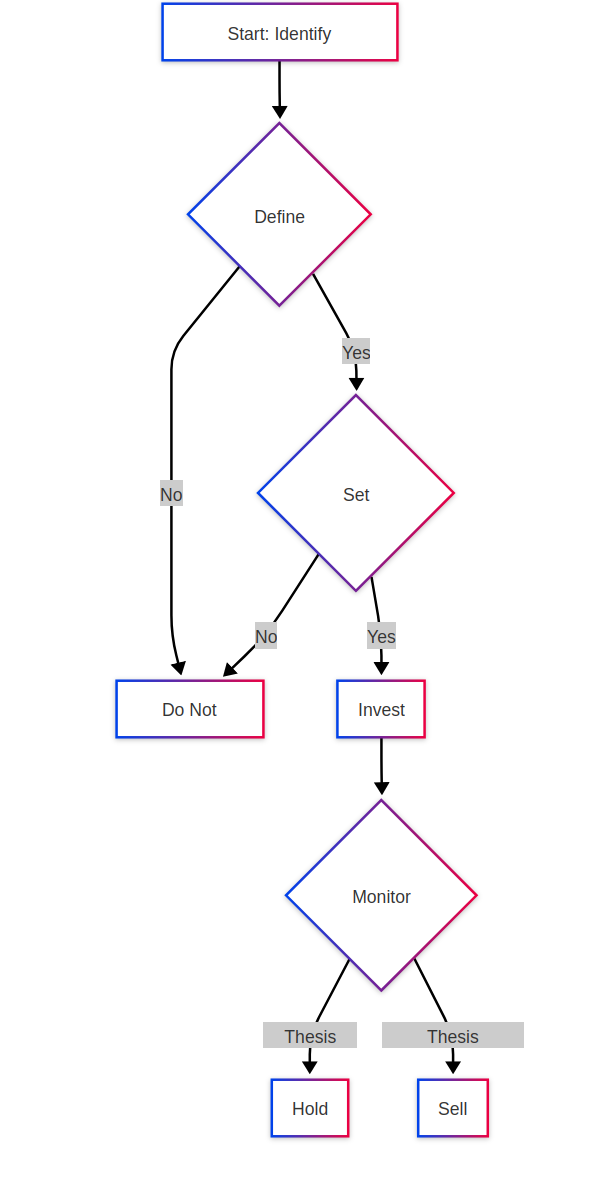
No investment should be a leap of faith. Before putting money into any project — be it stocks, crypto, or startups — establish a clear thesis (why you're investing) and an invalidation plan (when to exit). Without these, you're gambling, not investing.
Your thesis could be based on fundamentals (e.g., a company's strong revenue growth), technical analysis (e.g., a breakout pattern on a chart), or specific events (e.g., a product launch). For example, if you invest in a crypto token expecting a major partnership announcement, your invalidation might be: "If the announcement doesn't happen in two weeks, I sell." Or, if a stock drops below a key support level, like $50, that's your signal to exit.
This approach saved me from a disastrous crypto trade where I expected a token to surge after a rumored Elon Musk tweet. When the tweet didn't materialize, my predefined exit plan limited my loss to 10% instead of a potential 50% plunge.
Below is a chart to visualize the decision-making process for entering and exiting investments:
Concentrate Your Bets with Confidence
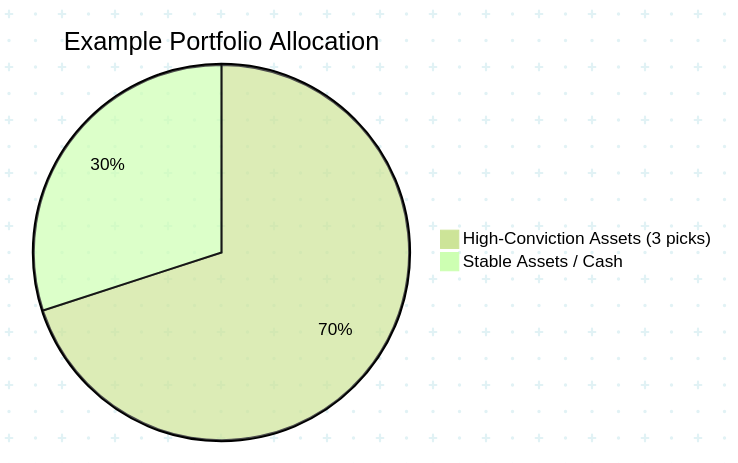
Once you've mastered crafting theses and invalidation plans, your confidence will soar. This is when you shift from scattering small bets across dozens of projects to concentrating capital in high-conviction opportunities.
In crypto, information asymmetry — where retail investors can spot opportunities before institutions — creates unique prospects. For instance, I once identified a project with a strong use case and upcoming catalyst. Instead of my usual $100 bet, I invested $1,000, knowing my thesis supported a potential 3x return with only a 10% downside risk. The trade paid off, doubling my capital. Such opportunities are rarer in traditional markets, where institutional dominance reduces retail edge.
Key Insight: Focus on 3–5 high-conviction investments rather than diversifying into 20+ low-confidence ones. Studies show concentrated portfolios outperform overly diversified ones when backed by robust research (Markowitz, 1952).
Know Your Investor Profile
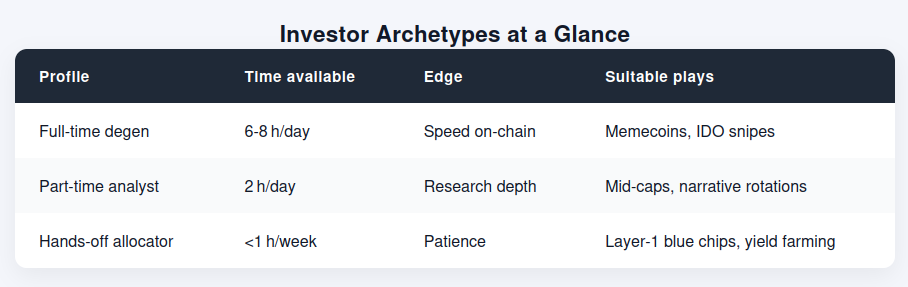
FOMO is the investor's worst enemy, luring us into trendy but unsuitable opportunities. To combat this, define your investor profile — your risk tolerance, time availability, and financial goals.
Are you a busy parent with limited time to track markets? Then chasing the latest Solana-based altcoin or day-trading meme coins isn't for you. Instead, opt for stable, long-term investments like blue-chip stocks or diversified ETFs. Conversely, if you're a young, risk-tolerant investor with hours to research, you might thrive in crypto's high-volatility environment.
I once met a father of two who lost thousands chasing a "hot" crypto token because it didn't match his risk-averse profile. Had he stuck to dividend-paying stocks, he'd have preserved his capital. Define your profile early to filter out noise and focus on opportunities that suit you.
Curious Fact: A 2021 Fidelity study found that 65% of retail investors regret impulsive trades driven by FOMO, with most citing a mismatch with their risk profile.
Embrace Market Momentum, Not Ego
You're not a market oracle, and neither am I. Predicting reversals — like calling a market top during a bull run — is a fool's errand for most. Instead, ride the wave. Markets can stay irrational longer than you can stay solvent, as John Maynard Keynes famously noted.
During the post-COVID bull run, skeptics called Bitcoin and Ethereum overvalued at $20,000 and $1,000, respectively. Yet, Bitcoin hit $69,000, and Ethereum soared past $4,800. Playing against momentum cost naysayers dearly. Focus on short-term gains, building capital while trends are in your favor.
Pro Tip: Use trailing stop-loss orders to lock in profits during uptrends without needing to time the market perfectly.
Bonus Strategy: Detach from Outcomes
Even with the best strategies, you'll make mistakes. The key is to focus on process, not results. If you've defined a thesis, set an invalidation, and managed risk, a losing trade isn't a failure — it's a learning opportunity. Analyze why you erred, refine your approach, and move on.
The goal isn't to win every trade but to ensure your wins outweigh your losses over time. As legendary investor Peter Lynch said, "In this business, if you're good, you're right six out of ten times. You're never going to be right nine out of ten."
Conclusion: Build Wealth with Discipline
Mastering your investment portfolio isn't about being a genius — it's about discipline, self-awareness, and adaptability. By reassessing positions, defining clear theses, concentrating bets, knowing your profile, riding momentum, and learning from mistakes, you'll minimize losses and amplify gains. Start applying these strategies today, and watch your confidence and capital grow.
What's your biggest investing challenge? Share in the comments below — I'd love to hear your story and offer tailored tips!
🏢 Glimmer Finance — The First Real-World Asset Marketplace on Solana
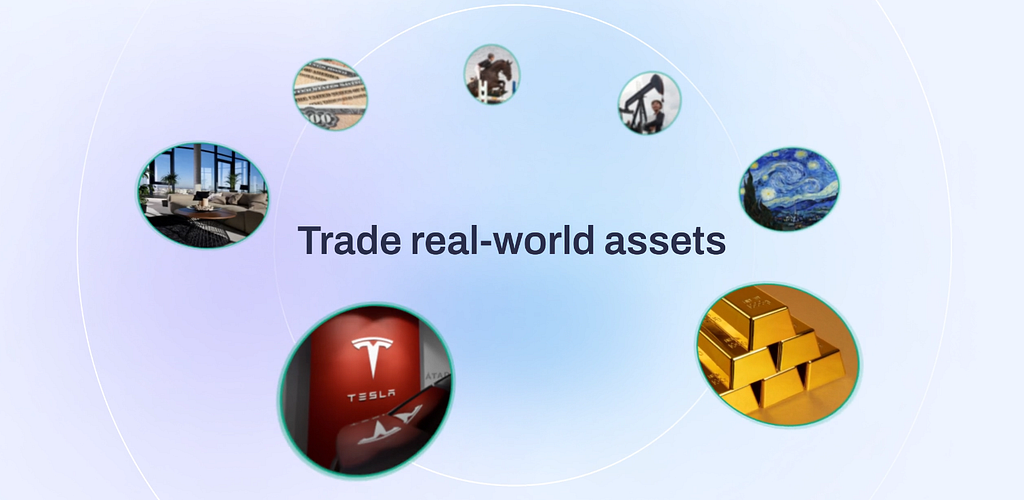
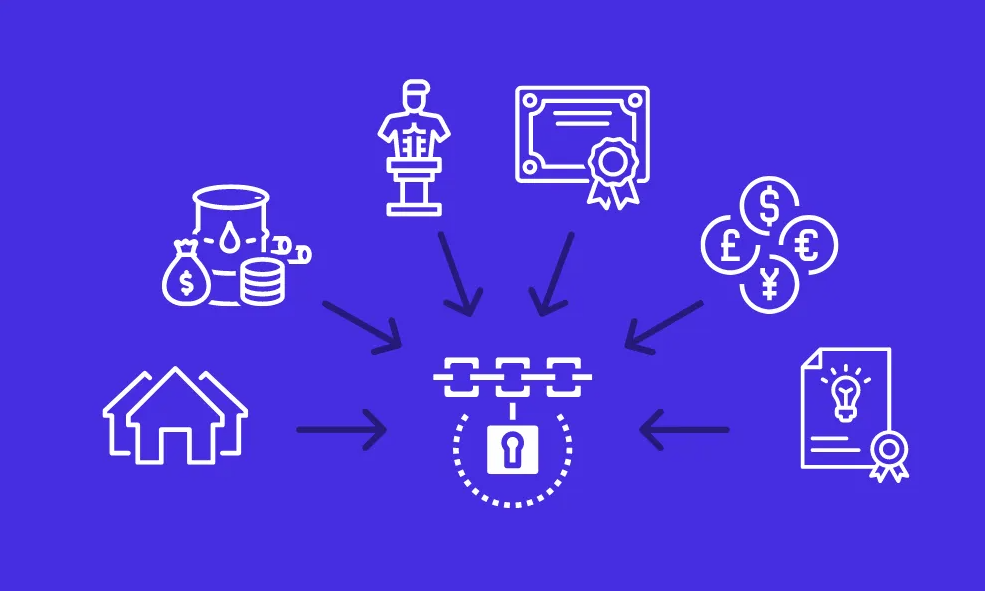
Imagine owning a piece of a Manhattan penthouse, a gold bar, or a vintage Ferrari — all for the price of a coffee. Sounds like a dream, right? Welcome to Glimmer Finance, a decentralized marketplace on the Solana blockchain that's turning this dream into reality by tokenizing real-world assets (RWAs). Whether you're a crypto newbie or a seasoned investor, Glimmer Finance offers a transparent, accessible, and innovative way to invest in assets once reserved for the ultra-wealthy. And with its ongoing $GLIMM token presale — where prices rise as time progresses — now's the perfect moment to dive in.
In this article, we'll explore how Glimmer Finance is revolutionizing asset trading, why Solana is the ideal blockchain for this mission, and how you can join the presale to be part of this groundbreaking ecosystem. Let's break it down.
Why Glimmer Finance Matters
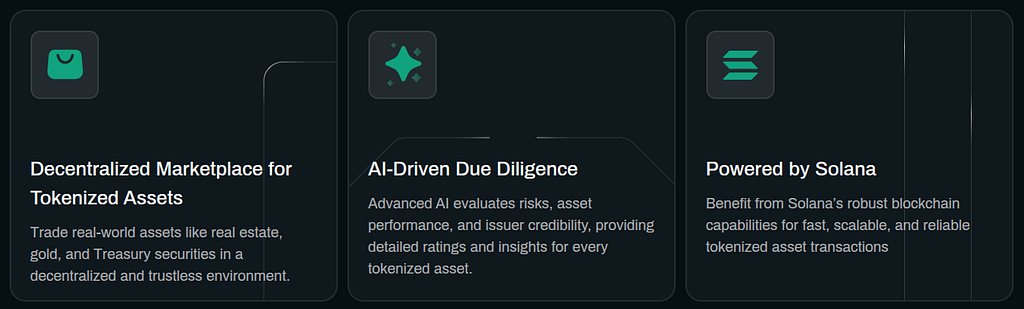
The world of finance is changing. Traditional investments like real estate or commodities often come with high barriers — think million-dollar price tags or complex legal processes. Glimmer Finance tears down these walls by tokenizing RWAs, allowing anyone to own a fraction of high-value assets. Built on Solana, known for its lightning-fast transactions and low fees, Glimmer ensures a seamless experience that's both secure and cost-effective.
What sets Glimmer apart? It's not just about trading tokens; it's about democratizing wealth. By leveraging Solana's scalability and AI-driven tools, Glimmer makes investing inclusive, transparent, and smart. As reported by CryptoPotato, Glimmer Finance is the world's first RWA presale on Solana, marking a pivotal moment in bridging traditional finance with Web3.
How Glimmer Finance Works
Glimmer Finance simplifies the complex world of RWA investment into a user-friendly platform. Here's how it brings tokenized assets to life:
1. Asset Tokenization
Asset owners can onboard their properties, commodities, or luxury goods through a rigorous process:
Submission: Owners provide proof of ownership, valuations, and legal documents.
Verification: Glimmer's AI and compliance teams ensure everything checks out.
Tokenization: Approved assets are converted into digital tokens via smart contracts.
Listing: Tokens are listed on the marketplace for trading.
This process ensures transparency and trust, with all transactions recorded on Solana's immutable blockchain.
2. Fractional Ownership
Glimmer's standout feature is fractional ownership, which lowers the entry barrier for investors. For example:
A $1 million property can be split into 1 million tokens.
You could own a piece for just $1, gaining exposure to real estate appreciation or rental income.
This approach enhances liquidity and diversifies portfolios, making high-value assets accessible to all.
3. AI-Powered Insights
Glimmer integrates artificial intelligence to supercharge decision-making:
Asset Selection: AI identifies high-potential assets for tokenization.
Market Predictions: Real-time analytics provide insights into trends and risks.
Risk Assessment: Tools like the "Average Risk Score" help you evaluate investments.
These features empower users to invest smarter, not harder.
The Power of Solana
Why Solana? It's the backbone that makes Glimmer Finance possible. Solana's architecture, with its Proof-of-History consensus, handles over 50,000 transactions per second, making it the fastest blockchain for RWA trading. Its low transaction costs — often fractions of a cent — ensure that investors keep more of their returns. As noted in a Medium article by the Harkness Institute, Solana's scalability and robust ecosystem make it ideal for RWA projects like Glimmer.
Solana's recent milestones, like Homebase tokenizing a rental property, show its real-world potential. Glimmer builds on this foundation to create a marketplace that's fast, secure, and globally accessible.
The $GLIMM Token and Presale Opportunity
At the heart of Glimmer Finance is its native token, $GLIMM, which powers the ecosystem. With a total supply of 5 billion tokens, $GLIMM offers multiple utilities:
Fee Discounts: Pay lower trading fees by holding $GLIMM.
Staking Rewards: Earn passive income with attractive APYs.
Governance: Vote on platform decisions.
Liquidity Incentives: Get rewards for supporting trading pairs.
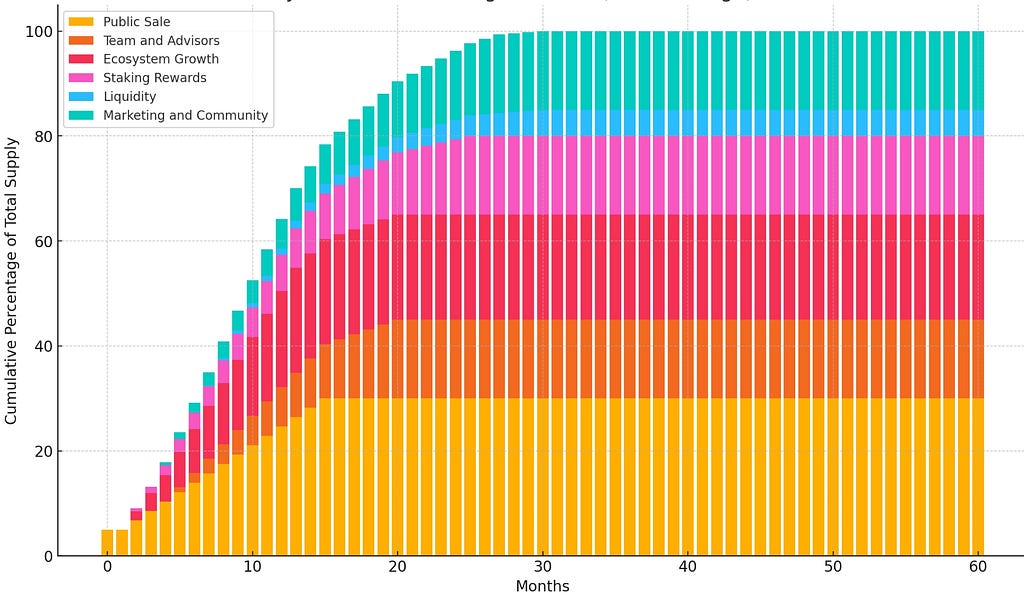
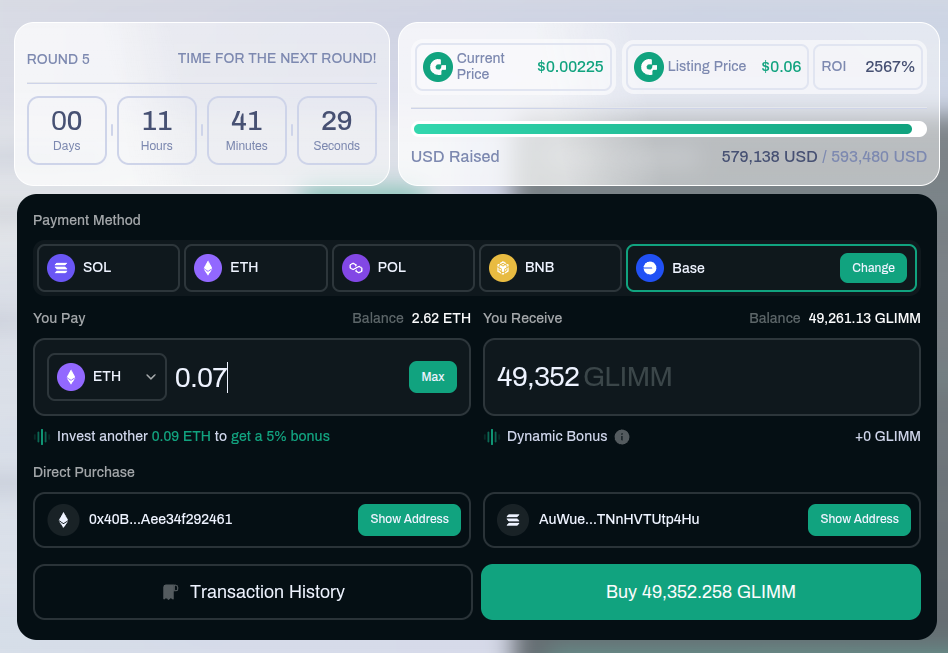
The $GLIMM presale is live now, but act fast — the price increases as the presale progresses. Currently, 30% of the token supply is allocated to the public sale, with 5% unlocked at the Token Generation Event (TGE) and the rest vesting over 14 months. This structure ensures steady growth and long-term value.
Join the presale today using this referral link: https://glimmer.finance/SEXeAPgIZLu7. By participating, you're not just investing in tokens — you're securing a stake in the future of decentralized finance.
$GLIMM presale
Key Features of the Glimmer Marketplace
Glimmer's marketplace is designed for both novice and expert investors. Here are its standout features:
Diverse Assets: Trade real estate, commodities, luxury goods, and more.
Real-Time Liquidity: Buy and sell instantly with AI-driven pricing.
User-Friendly Design: Navigate the platform with ease, regardless of experience.
Blockchain Transparency: Every transaction is recorded on Solana's ledger.
These features make Glimmer a one-stop shop for RWA investing, as highlighted in posts on X praising its accessibility and AI integration.
Security and Compliance
Investing in RWAs requires trust, and Glimmer delivers with robust security and compliance measures:
KYC/AML: Partnered with Parallel Markets for fast, secure identity verification.
Data Protection: AES-256 encryption and GDPR-compliant storage safeguard user data.
Q2 2026: Multi-chain integration with Ethereum and others.
By Q3 2026, Glimmer aims to be the leading RWA marketplace, with deflationary token burns to boost $GLIMM's value.
Why You Should Join Glimmer Finance
Glimmer Finance isn't just another crypto project — it's a movement to make wealth-building accessible to everyone. Whether you're looking to diversify your portfolio, earn passive income through staking, or simply explore the future of finance, Glimmer has something for you. The ongoing $GLIMM presale is your chance to get in early, with prices rising as the campaign advances.
Take action now: Visit https://glimmer.finance/SEXeAPgIZLu7 to join the presale and become part of this revolutionary ecosystem. By using this referral link, you're supporting the community and securing your place in the RWA revolution.
What do you think about tokenized assets? Have you explored RWA platforms before, or is Glimmer Finance your first step into this space? Share your thoughts in the comments below — I'd love to hear your perspective!
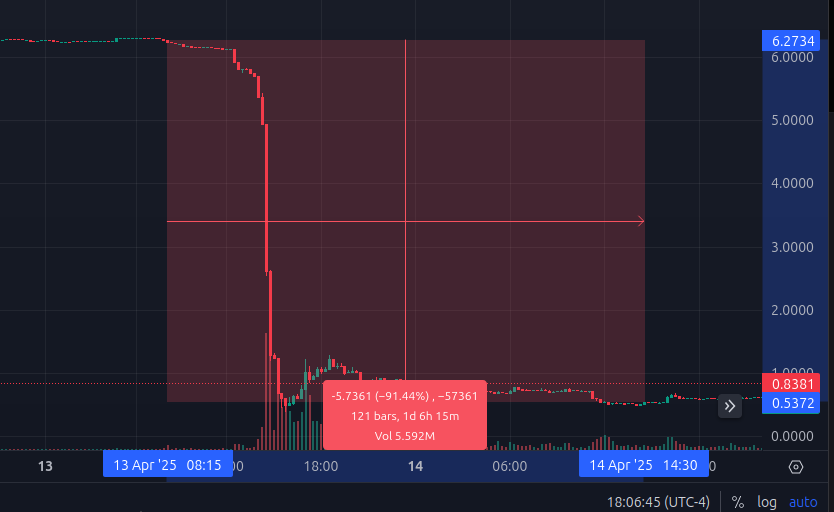
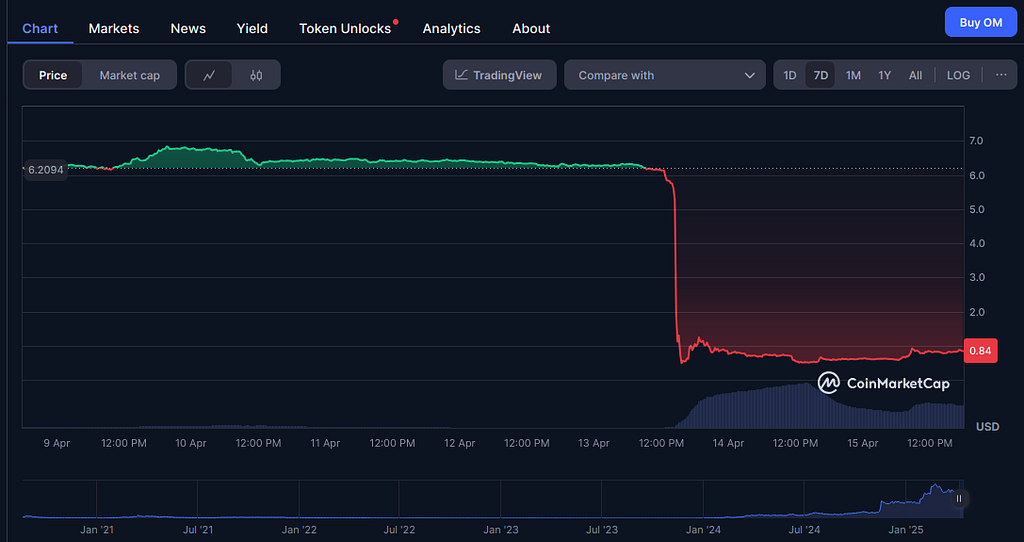
In the volatile world of cryptocurrency, few events have sparked as much controversy and speculation as the dramatic collapse of Mantra's OM token, plummeting from nearly $6 to $0.50 in a single day on April 13, 2025. This catastrophic 90% drop wiped out over $5 billion in market capitalization, leaving investors reeling and the crypto community scrambling for answers. Was it an insider dump, a cascade of reckless liquidations, or something else entirely?, this article dissects the Mantra meltdown, explores competing theories, and reflects on the broader implications for the crypto industry.
A Catastrophic Collapse: The Numbers Tell the Story
On April 13, 2025, Mantra's OM token, which had been trading at a high of nearly $7, experienced a freefall, bottoming out at $0.40 before stabilizing around $0.52. This represented a staggering loss of over 90% of its value in mere hours. For investors, the impact was devastating: a $10,000 investment was reduced to less than $1,000. The speed and scale of the crash raised immediate red flags, prompting intense scrutiny from the crypto community and media outlets alike.
Mantra, a project known for its ambitious plans to tokenize real-world assets (RWA) worth over $1 billion in collaboration with a firm from the United Arab Emirates, had been a darling of the crypto world. Its market cap had propelled it into the top 50 projects, and its community was buzzing with optimism. So, what went wrong?
Theory 1: Insider Dumping and a Potential Rug Pull
The first theory to emerge pointed fingers at insiders. Social media erupted with accusations that team members or early investors orchestrated a massive sell-off, dumping millions of OM tokens onto exchanges like Binance and OKX. This speculation was fueled by data from blockchain analytics platforms Lookonchain and Arkham Intelligence, which identified 17 wallets moving 43.6 million OM tokens — worth approximately $227 million — before the crash. Notably, wallets allegedly linked to Laser Digital, a Nomura-backed investor in Mantra, and Shorooq Partners, another investor, were flagged for transferring significant sums.
The optics were damning: Mantra's social media accounts went silent during the crash, and the token's price tanked in a low-liquidity window on a Sunday afternoon, a time when trading activity is typically minimal. To many, this resembled a classic rug pull — a scenario where insiders cash out, leaving retail investors holding worthless tokens.
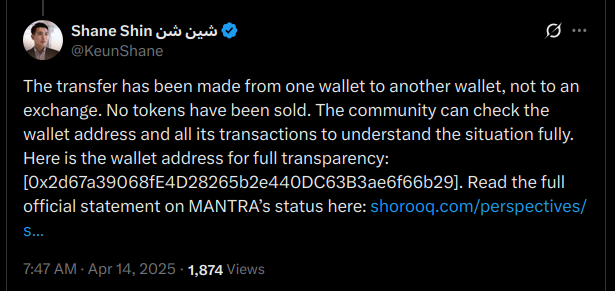
However, Mantra's CEO, John Mullin, swiftly denied these allegations in a Cointelegraph AMA on April 14, 2025. Mullin insisted that neither the Mantra team, its key investors, nor its advisors had sold tokens. He claimed Arkham Intelligence had "mislabeled" the wallets, asserting that the company had provided a transparency report on April 8 detailing its key wallet addresses. Laser Digital and Shorooq Partners echoed Mullin's denials, with Laser stating, "Assertions linking Laser to 'investor selling' are factually incorrect," and Shorooq emphasizing its long-term equity stake in Mantra, not just token holdings.
Theory 2: Cascading Liquidations in a Low-Liquidity Market
The second theory, which gained traction as more details emerged, attributes the crash to a cascade of liquidations triggered by over-leveraged positions in a low-liquidity environment. Mantra's team, in a statement on X, described the event as "reckless liquidations," pointing to exchanges like Binance and OKX. Mullin suggested that a single large sale — possibly not even insider-driven — sparked a domino effect, liquidating leveraged positions and driving prices lower.
Binance's official statement on April 14 supported this narrative, noting that "cross-exchange liquidations" were responsible. The exchange explained that in a low-liquidity window, such as a Sunday afternoon, a single sale can trigger rapid price declines, especially when many traders are using high leverage. For example, a liquidation at $6.50 could push prices to $6.00 in a low-liquidity market, triggering further stop-loss orders and liquidations at $6.10, $6.00, and below.
Adding weight to this theory, Binance revealed it had imposed leverage limits on OM trading since January 2025, suggesting other exchanges may not have been as cautious. OKX, meanwhile, flagged "suspicious activity" across multiple platforms and noted significant changes in Mantra's tokenomics since October 2024, hinting at underlying vulnerabilities.
Curious Fact: The Sunday Effect
The crash's timing on a Sunday afternoon underscores a lesser-known vulnerability in crypto markets. Unlike traditional markets, crypto trades 24/7, but liquidity often dips on weekends, particularly Sundays. A 2023 study by CryptoCompare found that trading volumes on Sundays are, on average, 30% lower than on weekdays, making markets more susceptible to sharp price swings from large orders.
The Regulatory Elephant in the Room
Beyond the immediate causes, the Mantra crash exposes deeper issues in the crypto industry: a lack of standardized regulation and transparency. Unlike traditional markets, where insider trading is heavily monitored and public companies must disclose financial details, crypto projects operate with minimal oversight. Tokenomics, insider allocations, and wallet activities are often opaque, leaving investors vulnerable to manipulation or misinformation.
Noting that while Mantra's high-profile partnerships and top-50 status inspired confidence, the lack of uniform reporting standards made it difficult to assess risks. For instance, the absence of mandatory disclosures about insider token holdings or vesting schedules meant investors had little insight into potential sell-off risks. This opacity contrasts sharply with regulated markets, where such information is public, and insider sales are tracked.
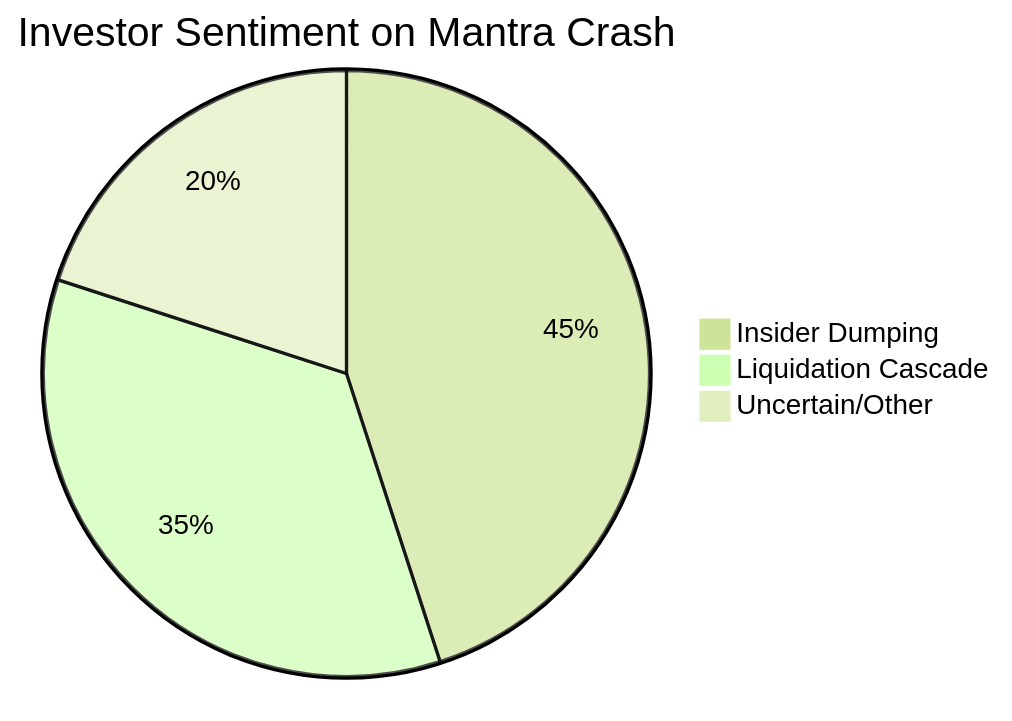
Pie Chart: Investor Sentiment Post-Crash
To capture the community's divided opinions, a pie chart illustrates sentiment based on social media reactions:
Lessons for the Crypto Industry
The Mantra meltdown serves as a wake-up call for the crypto industry. While decentralization is a core tenet, the absence of regulatory frameworks leaves investors exposed to risks that traditional markets have mitigated through decades of oversight. This "uncomfortable conversation" about regulation is inevitable, particularly for projects beyond Bitcoin, which lack a centralized team. Ethereum and other altcoins, with their development teams and token allocations, face similar scrutiny.
Mantra's case also underscores the dangers of over-leveraged trading. High leverage amplifies gains but also magnifies losses, and in low-liquidity scenarios, it can trigger catastrophic cascades. Investors must approach such markets with caution, prioritizing risk management over speculative bets.
Conclusion: A Call for Transparency and Reflection
The Mantra crash of April 13, 2025, remains an unresolved mystery, with investigations ongoing as of April 14. Was it an insider dump, as early data suggested, or a liquidation cascade amplified by low liquidity and reckless leverage? Perhaps the truth lies in a combination of factors. Regardless, the incident highlights the crypto industry's growing pains, from inadequate transparency to the perils of unregulated markets.
As the crypto space matures, stakeholders — projects, exchanges, and investors — must advocate for clearer standards and better risk management. For readers, the question remains: What do you think caused Mantra's collapse? Was it a calculated insider move, a market misstep, or something else? Share your thoughts in the comments below, and let's keep this critical conversation alive.
From Crypto to Coffee: Why Offramp Is the Ultimate Way to Spend Your Crypto in Latin America and Beyond
If you're sitting on a stash of crypto — whether it's USDC, USDT, or something else — and wondering how to actually use it in the real world, let me introduce you to my daily financial sidekick: Offramp.xyz. As someone who uses their Visa card every single day, I can tell you this isn't just another crypto gimmick — it's a game-changer. Whether you're in Latin America, the U.S., or halfway across the globe, Offramp makes spending your crypto as easy as swiping for a coffee. And yes, it even works with PayPal. Intrigued? Stick around — I'm about to break down why this platform is the best bridge between your wallet and the world.
My Crypto Journey Meets Offramp
I first stumbled across Offramp.xyz through a video that promised a seamless way to turn my crypto into real-world spending power. The pitch? Deposit your crypto, get a Visa card, and start swiping — 100% free to set up. Oh, and you could also earn interest and dabble in U.S. Treasury bonds. I'll admit, I was skeptical. Another crypto card promising the moon? But as a daily user now, I can confirm: it delivers. Big time.
The moment I signed up, I was hooked. After a quick KYC process (standard stuff — ID, selfie, address proof), I had a virtual Visa card ready to roll. I linked it to my Google Pay in seconds and started spending my USDT on everything from groceries to Netflix subscriptions. Later, I snagged their physical card too — it's been a total hit, especially for those moments when a virtual card just won't cut it (think ATMs or car rentals). Now, I'm that guy paying for dinner with crypto while my friends are still fumbling with cash.
Why It's Perfect for Latin America — and Everywhere Else
Living in Latin America, I've seen firsthand how tricky it can be to make crypto practical. High inflation, wonky exchange rates, and pricey bank fees are the norm. Offramp flips that script. It's available in over 180 countries, with a massive footprint in Latin America — think Argentina, Brazil, Mexico, and beyond. I've used it to pay in pesos at local stores, and the exchange rate? Shockingly good. One day, I checked, and it was $1197 ARS to the dollar — way better than the official rate of 1100 or the crypto market's 1280. That's real savings, right there.
Globally, it's just as slick. Offramp's Visa card works anywhere Visa is accepted, which is basically everywhere. From a street vendor in Buenos Aires to an online shop in Berlin, your crypto flows effortlessly. And here's a bonus: it supports PayPal. I've linked my Offramp card to my PayPal account and used it for online purchases — no hiccups, no fuss. That's a huge win for flexibility, especially if you're like me and juggle multiple payment methods.
Supports more than 110 countries
How It Works (Spoiler: It's Dead Simple)
Getting started is a breeze. Head to Offramp.xyz, sign up with an email or connect one of 400+ supported Web3 wallets (MetaMask, anyone?), and deposit your crypto. I usually send USDT over the Base network — fast, cheap, and reliable. The platform supports tons of chains like Ethereum, Arbitrum, Polygon, and more, so you're not locked into one ecosystem. Once your funds hit, they're instantly available on your Visa card. No hidden fees, no nonsense — just a 1:1 conversion to USD.
You can fund directly by sending to your wallet, by connecting a wallet and depositing funds or with a bank transferSend Crypto DirectlyDeposit crypto from your wallet
Want to see your spending? The app's transaction history is like a mini home banking dashboard. I can track every purchase, send crypto to other wallets, or even cash out to a bank account (they're rolling out withdrawals in currencies like Argentine Pesos and Brazilian Reais this April — huge for LATAM users). It's all so intuitive, even my non-crypto friends could figure it out.
Beyond Spending: Earning While You Hold
Here's where Offramp gets spicy. Beyond everyday spending, you can park your unused funds in their "savings" option and earn up to 5% annual yield, backed by U.S. Treasury bonds. I deposited 50 USDC via Arbitrum, signed a quick transaction, and bam — my money's now working for me at 5.09% APR. It's not just a card; it's a mini investment hub. They even offer ETFs and stocks if you're feeling fancy, though I'm happy with the savings feature for now. Financial freedom? It's not just a tagline — it's real.
SavingsBuy Stocks
Why Offramp Stands Out
I've tried other crypto cards — Wirex, Crypto.com, you name it — but Offramp beats them all. For one, it's non-custodial, meaning I keep control of my keys. No trusting a third party with my funds. The fees? Minimal. There's a 1.5% foreign transaction fee (standard for Visa) and a 2% ATM withdrawal fee, but that's it — no sneaky charges. Plus, there's no limit on spending or top-ups, which is clutch for power users like me. And did I mention it's free to get started? No card creation fees, no maintenance costs — just ship the physical card if you want it.
The cherry on top? Their support is lightning-fast. I've pinged them on Twitter with questions, and they're back in my DMs within hours. They've even got a Telegram app if you're into that. It's clear they're building this for crypto natives and newbies alike.
Join the Revolution
Look, if you're still hodling your crypto and dreaming of the day it's as spendable as cash, stop waiting. Offramp.xyz is the bridge you've been looking for. I use it daily — coffee runs, online shopping, even splitting bills with friends — and it's never let me down. For Latin Americans, it's a lifeline to dodge inflation and bank hassles. For the world, it's the smoothest way to bring crypto into real life.
Ready to ditch the old financial system? Sign up at Offramp.xyz (pro tip: use my referral link below for a little bonus). Deposit some stablecoins, grab your Visa card, and start spending. Trust me — once you swipe with crypto, you'll never go back.
In the fast-evolving world of technology, AI Agents are emerging as the game-changer in both our daily lives and the crypto ecosystem. Far from being a distant sci‑fi fantasy, these intelligent executors are already automating complex tasks — from managing job applications to executing seamless DeFi operations. As we stand on the brink of a new era in 2025, this article delves deep into the transformative potential of AI agents, exploring their functionality, the different types, and the investment opportunities they present in the blockchain space.
What Are AI Agents?
At their core, AI agents are the executors of artificial intelligence. While traditional AI (like ChatGPT) serves as the "brain" that processes and provides information, AI agents are the "hands" that transform that knowledge into actionable results. Imagine handing over your résumé to a bot that not only scans for the best job openings but also applies to multiple vacancies on your behalf — all automatically. This seamless transformation from thought to action is the essence of AI agents.
The Convergence of AI and Blockchain
The integration of AI agents into the blockchain realm is creating unprecedented opportunities in the crypto market. With the global market cap for AI agent-related tokens hovering around $14 billion, these technologies are still in their infancy relative to giants like Bitcoin or Ethereum. Yet, their potential for growth is enormous.
Consider the scenario where an AI agent handles the entire process of converting Bitcoin to Ethereum and depositing it into your wallet using the most efficient decentralized platforms. This is not merely a hypothetical concept — it's already being developed and refined.
Categories of AI Agents in Crypto
The video script outlines several types of AI agents, each targeting a different niche within the crypto ecosystem:
Infrastructure Agents These projects provide the backbone for AI operations on blockchain platforms. Examples include frameworks and launchpads like Virtuals Protocol, which enables users to create and launch their own AI agents.
Influencer Agents Designed to engage with communities, these agents (e.g., the crypto influencer ixbt) manage social media accounts, provide financial advice, and generate market buzz. While they can drive short-term speculative gains, caution is advised as many of these tokens may lose value over the long term.
Investment DAOs These are AI-managed funds that automate investment decisions by analyzing market sentiment and executing trades based on real-time data. They promise to streamline portfolio management by reducing human error.
Utility Agents Focused on automating practical tasks, these agents can execute functions ranging from trading and staking to complex operations in DeFi ecosystems. Their utility lies in the fact that while the underlying product may be sound, the token value is often driven by market sentiment rather than intrinsic functionality.
Tip for Readers: When evaluating these tokens, always perform in-depth research into tokenomics, utility, and market cap comparisons to distinguish between sustainable projects and speculative bubbles.
Tools and Resources for the AI Agent Ecosystem
For those eager to dive deeper into this revolution, several platforms offer invaluable insights and data:
Elizas World — Discover the open-source framework behind many AI agent innovations.
How AI Agents Operate in DeFi: A Step-by-Step Flow
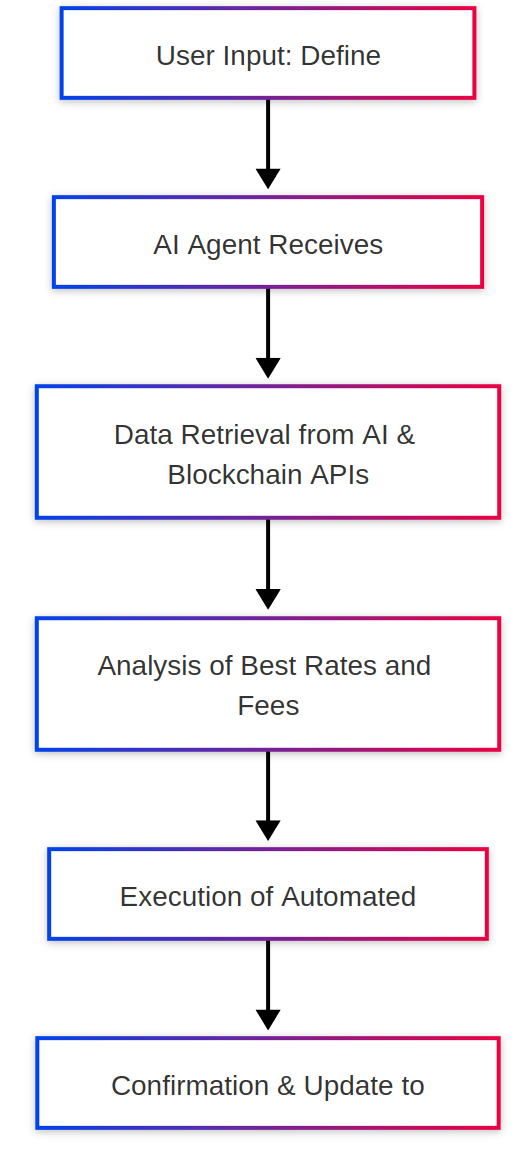
To demystify the process, consider the following flowchart that outlines how an AI agent can automate a DeFi transaction:
This simple diagram illustrates the process — from receiving the initial command to executing the transaction — highlighting the efficiency and precision of AI-driven automation.
Investment Insights and Future Outlook
While the promise of AI agents is undeniable, the landscape is complex and filled with both opportunities and risks. The video emphasizes a speculative approach in the early days:
Short-Term Speculation: Tokens linked to influencer agents might soar due to market hype but could crash once the novelty fades.
Long-Term Sustainability: Infrastructure projects and utility agents are likely to yield more reliable returns as they underpin critical blockchain operations.
The key takeaway is to adopt a cautious yet proactive approach. Engage in thorough research, consider short-term gains versus long-term viability, and always remain updated with the rapid innovations in this sector.
Conclusion
AI agents are not just an emerging trend — they represent a fundamental shift in how technology, finance, and daily tasks intertwine. As 2025 unfolds, their influence will likely redefine the crypto landscape, driving innovation and investment opportunities to new heights.
Are you ready to explore this brave new world? Which type of AI agent excites you the most — the high-octane influencer bots or the robust, long-term infrastructure projects? Share your thoughts and join the conversation in the comments below!
Are you ready for Berachain's most pivotal week yet? With rumors swirling of a Mainnet release in less than seven days, the ecosystem's final countdown is in full swing. This moment is critical for anyone who's tested Berachain, holds NFT collections tied to its ecosystem, or simply wants to dive in right when the network goes live. This article distills the flurry of updates — from Boyco's jaw-dropping liquidity stats to Yeet and Beradrome's refined tokenomics, and even bridging your NFTs into Berachain. Whether you're a seasoned participant or just catching the buzz, these insights will prepare you for the monumental days ahead.
1. Mainnet Countdown: Less Than 7 Days?
The million-dollar question is when Berachain will officially launch. At the time of recording (Saturday, February 1st), speculation suggests Mainnet could drop within a week. Key items to look for include:
Tokenomics Announcements: Expect official parameters soon.
Airdrop Checker: The official tool verifying airdrop eligibility might appear any day.
Final RFA (Request For Application) Details: Projects receiving seed incentives could finalize last-minute.
Insight: Keep an eye on Boyco for real-time announcements; changes can happen overnight.
2. Boyco: Where Liquidity and Hype Converge
Boyco serves as the pre-launch liquidity engine, letting you deposit assets on Ethereum before they transition to Berachain's Mainnet. The objective? Ensure the chain starts with robust TVL (Total Value Locked). Here's the gist:
2.9 Billion USD is already deposited across Boyco and Pre-Boyco vaults, likely exceeding 3 Billion by the final cutoff.
A 2% slice of the total $BERA supply is allocated to reward participants in these vaults.
Pre-Boyco is effectively the same as Boyco. If you contributed earlier, your funds transition automatically.
Note: Boyco has ended as of Sunday/Monday, but the overarching principle remains. If you participated, expect competitive yields and a portion of that 2% $BERA distribution.
3. Yeet: Airdrop Allocation Just Got Better
Yeet's airdrop garnered significant buzz this week. Why? They've updated tokenomics for NFT holders, raising the allocation from 15% to 20%. Key highlights:
25% of Tokens at TGE: A quarter of your airdrop arrives at launch.
75% Linearly Over 3 Months: The remaining tokens unlock daily for 90 days.
Extra Love for 1-of-1 NFTs: Rare items can net 10× more tokens than a normal NFT.
No Snapshot "Rug": Because the 75% is continuous, late NFT buyers still benefit.
How many tokens do you get? Check with Yeet's Official Checker to see if you qualify. Or consult this spreadsheet for details. Some holders stand to receive 36k–40k tokens per NFT, translating to an easy four-figure sum if Yeet hits typical FDV ranges. It's all speculation, but the numbers look promising.
4. Beradrome: More Tokens, More Changes
Beradrome's Airdrop & RFA Listing got a tweak: the share going to its NFT holders (the "Tour de Berance" collection) moved from 15% to 20% of total supply. That's major news for those "bear-on-a-bicycle" NFTs:
20% now earmarked for airdrops.
Rare NFTs and especially the 69 "legendary" ones get a massive share.
Secondary snapshot or time-based criteria? Not applicable — only rarity matters, although rumor suggests a big difference in allocation for top 5% rarities vs. general items.
Pro Tip: This might influence NFT floor prices on marketplaces like OpenSea. Legendary items are fetching 7.5 ETH+ (over $24k).
5. Kingdomly: Bridging NFTs Made Simple
Kingdomly introduces a user-friendly way to bridge NFTs from Arbitrum (or another chain) to Berachain. Ahead of Mainnet, they've launched a bridging quest so you can practice. Here's the process:
Mint Practice NFTs via their test site.
Use Kingdomly's Bridge to move from Arbitrum → Base (test environment).
Post a Screenshot on Discord in the #testnet-bridge-quest channel.
Receive a Role as a "bridge quest" completer.
When Mainnet arrives, you'll apply the same steps to shift real NFTs onto Berachain — particularly crucial if you hold Arbitrum-based Kingdomly assets.
6. Beramonium: Snapshot and Token Presale
Beramonium — the fantasy-like game pegged to Berachain — recently concluded a snapshot for its upcoming token presale. Key points:
Testnet NFT holders get a smaller, yet still meaningful, share.
They also closed a 6.9% private round with multiple backers, reflecting healthy community interest.
7. Roots: RFA Checker
Roots joined the trend by rolling out an RFA eligibility checker. If you tested their dApp or engaged deeply in certain tasks, you might get allocated $BERA from Berachain's official dev grants. Here's your plan:
Input wallet address
If eligible, you'll see your share.
Expect to claim your portion once Mainnet and official distribution contracts go live.
8. Fior & Kingdomly: More Launches Ahead
Finally, keep tabs on:
Fior: Additional presales for upcoming Berachain projects are rumored. Some have concluded, but new listings appear regularly.
Kingdomly: NFT mints queued up right after Mainnet. Projects like "Hunicast," "pffp," "CB Hub," and more will go live. Perfect for NFT enthusiasts wanting an early foothold.
Conclusion
Berachain's imminent launch weaves together massive liquidity events, booming NFT integrations, and potentially rewarding airdrops. Boyco has already cemented over $3B in assets. Yeet and Beradrome are refining tokenomics. Kingdomly solves NFT bridging. And games like Beramonium prepare presales. Whether you're a DeFi strategist or NFT collector, the window to claim a piece of Berachain's next chapter is almost closed.
Ready to level up your strategy?
Review your airdrops and testnet eligibility.
Plan your bridging approach via Kingdomly.
Scope upcoming presales on Fior and Ramen Finance.
Keep an eye on official channels for mainnet timing.
Comment below with your thoughts: Are you bridging NFTs? Stacking stablecoins for boiko? Let us know how you're positioning for launch — your feedback might guide someone else's winning strategy!
The highly anticipated Boyco platform is here, unlocking massive opportunities for early adopters in the Berachain ecosystem. For the first time, users can deposit liquidity pre-mainnet and earn rewards from native protocols like Kodiak, Infrared, and Beraborrow. With millions of dollars in incentives and a structured yield farming mechanism, Boyco is set to position Berachain as a top-tier blockchain from day one.
In this guide, we'll break down how Boyco works, its key protocols, and the best strategies to maximize your rewards. We'll also analyze the current metrics, highlight the most promising pools, and explain the risks associated with liquidity locks.
What is Boyco?
Boyco is a pre-mainnet liquidity platform designed to give Berachain applications a head start by securing liquidity before launch. This allows dApps to avoid the traditional capital-building phase and function optimally from day one.
Key Benefits of Boyco:
Enables users to deposit liquidity on Ethereum before Berachain's launch.
Provides staking rewards in $BERA and native protocol tokens.
Offers a 90-day lock period for most pools, ensuring liquidity stability.
Multiple yield sources including dApp incentives, protocol fees, and governance rewards.
Boyco is built in collaboration with Royco, Enso, LayerZero, and Stargate, ensuring seamless cross-chain compatibility.
How Boyco Works: A Step-by-Step Guide
Choose a liquidity pool (Vault) — Select from pools that offer stablecoins, ETH, BTC, or other assets.
Deposit funds via Ethereum — Liquidity is held until Berachain's mainnet launch.
Receive staking rewards — Earn $BERA, governance tokens, and additional incentives from supported dApps.
Liquidity Migration — Deposits automatically transition to Berachain at mainnet launch.
Unlock and Withdraw — After the 90-day lock, retrieve assets plus rewards.
Boyco Metrics: A Game-Changer for Berachain
As of now, over $2.16 billion is locked in Boyco, showcasing the massive investor interest in Berachain's ecosystem.
Key Statistics:
TVL (Total Value Locked): $2.19 billion
Active Depositors: Over 153,000 wallets
Boyco-Exclusive Liquidity: $53 million locked in just a few hours
Projected Mainnet TVL: Estimated to reach $4–5 billion on launch day
Berachain is already among the top DeFi chains by TVL — even before its official launch!
The Best Boyco Pools: Where to Stake and Earn
Each Boyco vault (BOW) is structured to offer high APRs with different risk profiles. Here's a breakdown of the top vaults:
Boyco presents a rare opportunity to earn high APRs from Berachain's most promising dApps before mainnet launch. With over $2B in deposits and structured liquidity incentives, it is positioned as one of the most significant yield farming events of 2024. However, the 90-day lock and market risks require careful consideration.
Should you participate? If you are looking for stablecoin yields above 50% APR or want exposure to Berachain-native tokens, Boyco is an attractive option. But if you need liquid assets in the short term, it may be best to wait until mainnet launch.
What are your thoughts on Boyco? Will you be staking your assets? Let us know in the comments below!
January 20 marked a historic moment as Donald Trump assumed the presidency of the United States. On the same day, Bitcoin shattered its all-time high, soaring past $109,000. Amidst the excitement, the crypto market was thrown into turmoil when Trump and Melania launched their official memecoins. Within hours, these tokens rocketed into the top rankings, sparking debates and raising red flags.
Is this a golden opportunity or a ticking time bomb for investors? In this article, we dissect Trump's memecoin phenomenon, its tokenomics, and the broader impact on the cryptocurrency ecosystem. Brace yourself for a rollercoaster of insights and analysis.
The Rise of Trump's and Melania's Memecoins
A Lightning-Fast Ascent
Trump announced his official memecoin on Twitter during the early hours of January 20. Initially dismissed as a potential hack, the token's legitimacy was confirmed, and its price skyrocketed from $0.50 to $4 within 12 hours. By Sunday, the memecoin hit $6, ranking 15th among all cryptocurrencies.
Meanwhile, Melania's memecoin launched at $0.70, doubling its value within hours to $1. Both coins captivated the market, but a closer examination reveals troubling signs.
Tokenomics: A Red Flag
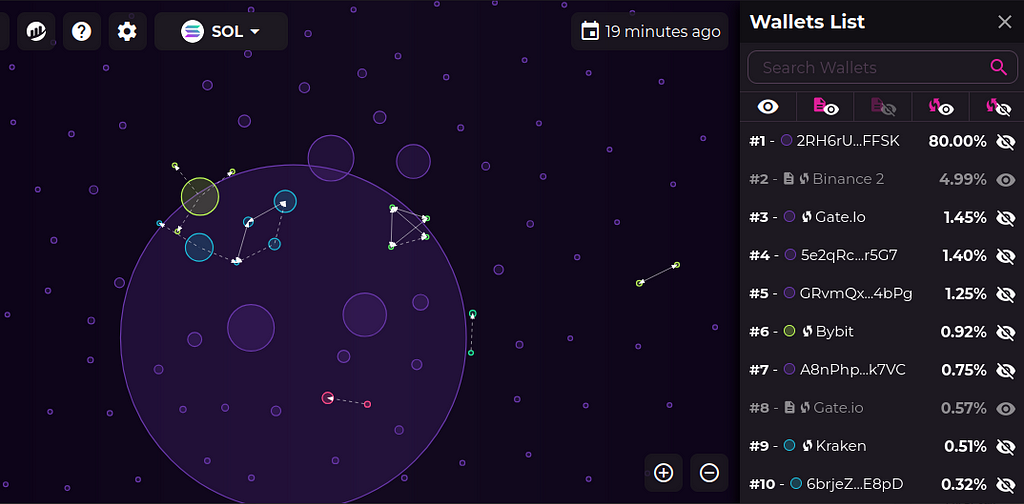
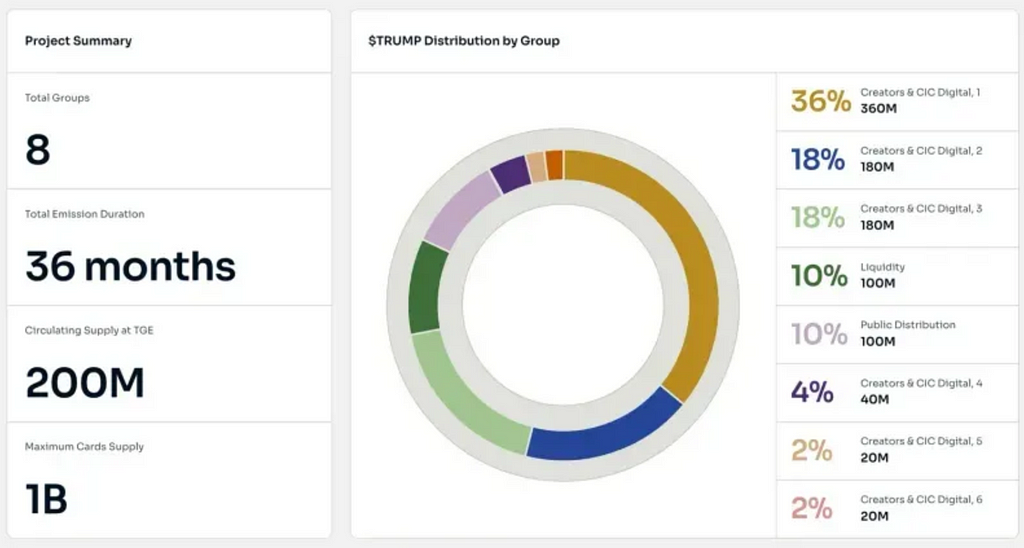
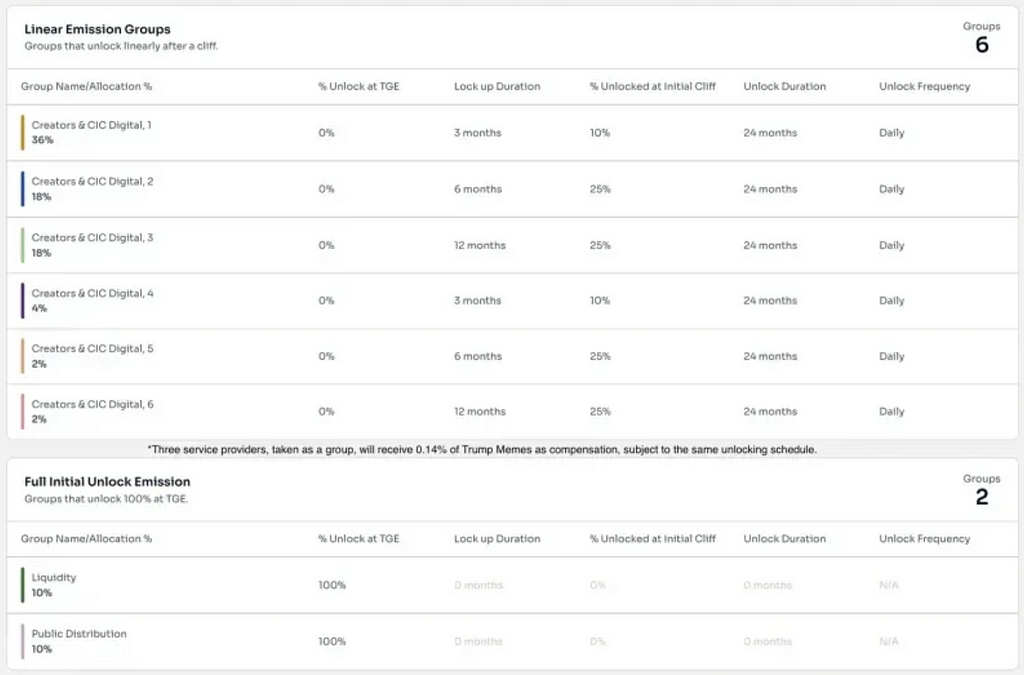
A quick visit to the official website of Trump's memecoin reveals a sleek design, but the most critical section — the tokenomics — is hidden behind small, nearly unreadable text. Upon closer inspection, it's clear why: 80% of the tokens are concentrated in a single wallet. Such centralization poses significant risks for long-term investors.
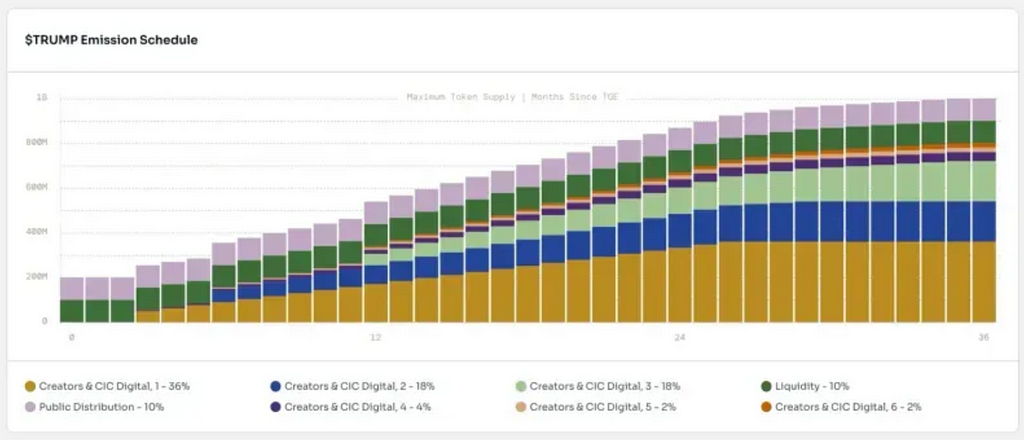
Investors saw massive short-term gains, but the underlying risks are glaring. The aggressive unlocking schedule means liquidity will be drained as tokens flood the market. Historically, such setups have led to price collapses.
Long-Term Implications
Holding Trump's memecoin is akin to funding Trump's initiatives without any guarantees of returns. Unlike traditional projects, there is no reinvestment into the ecosystem. This is a one-way street for profits, flowing directly to the token creators.
Impact on Solana, Ethereum, and DeFi
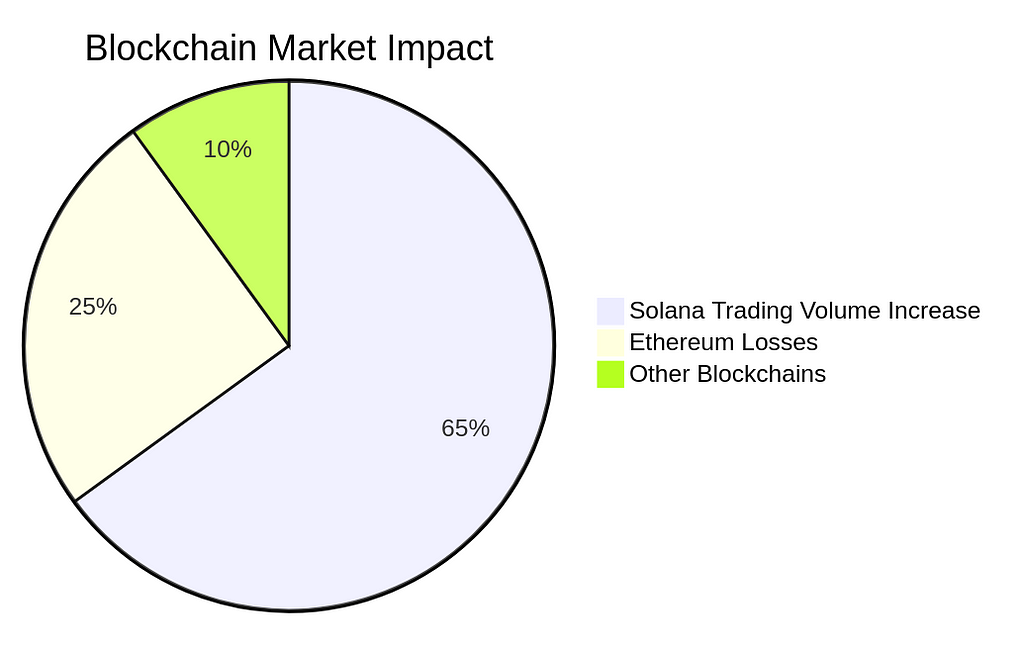
The choice to launch on Solana brought unparalleled attention to the blockchain, with trading volume hitting a record $27 billion in 24 hours. While this solidifies Solana's position as a leader, Ethereum has faced significant challenges, losing 950% of its value relative to Solana since mid-2023. However, Ethereum's resilience and strong fundamentals suggest it could stage a comeback.
Opportunities in Farming and Passive Income
Despite the chaos, opportunities abound for savvy investors:
High-Yield Farming: Pools on Solana are offering up to 850% annual returns, even on stable pairs like Bitcoin and Solana.
Volatility Exploitation: Using wide price ranges (30–40%) in liquidity farming can yield significant profits.
Staking Benefits: Bitcoin and Ethereum pools continue to deliver steady returns, offering a safer alternative.
The Bigger Picture: Pros and Cons
Negatives
Market Reputation: Memecoins undermine the credibility of crypto as a serious financial market.
Liquidity Drain: Funds diverted to memecoins are unlikely to return to other projects.
Centralization Risks: Overconcentration of tokens raises the likelihood of market manipulation.
Positives
Publicity: Trump's massive following introduces millions to crypto.
Potential Policy Shifts: Trump's pro-crypto stance could lead to favorable regulations.
Final Thoughts: To Invest or Not?
Trump's memecoins are a classic case of high risk and high reward. While the short-term gains are undeniable, the long-term outlook is fraught with danger. Investors should approach with caution, armed with thorough research and a clear exit strategy.
What are your thoughts on Trump's memecoin empire? Share your opinions in the comments and let's navigate this crypto jungle together. If this analysis helped you, don't forget to give it a clap and follow for more in-depth crypto insights.
"Put your money to work," "earn passive income," "cryptocurrencies are the future."
Let's cut through the noise. If you're spending hours every day glued to the markets, the one working is you. Frequently managing your portfolio is anything but passive. If you're looking for get-rich-quick schemes or to fall in love with the latest hype projects, this article isn't for you.
Back in 2017, when I first dipped my toes into the crypto world, I bought into all those stories — and lost a significant amount of money. Fortunately, along the way, I learned how the market really works.
In this article, I'll share with you the practical steps to build a profitable and scalable business in the world of decentralized finance (DeFi) by dedicating just one hour a day. You'll provide a valuable service and get paid for it, much like any traditional business. Specifically, we'll focus on offering liquidity — a cornerstone service in the DeFi ecosystem.
Why Read This Article?
The crypto space is rife with myths and misconceptions. Promises of effortless wealth and passive income abound, but the reality is far from it. Managing investments in cryptocurrencies requires time, knowledge, and effort. This article aims to dispel those myths and provide you with concrete tools to build your own DeFi business consciously and effectively.
What You'll Gain
By the end of this article, you will:
Understand the Reality of the Crypto Market: We'll move beyond the typical clichés and dive into how the market truly operates.
Learn How to Create a Profitable DeFi Business: You'll discover how to provide liquidity services and earn returns without relying on the market's upward movements.
Design a Business Plan and Cash Flow: Tailored to your investor profile, objectives, and available time.
Implement an Efficient Routine: Manage your business effectively by dedicating approximately one hour a day.
Avoid Common Pitfalls: I'll share my experiences, including mistakes I've made and how I overcame them, so you can sidestep the same traps.
Who Is This Article For?
This article is intended for those who have some familiarity with the crypto world. You don't need to be an expert, but you should know how to buy cryptocurrencies, perform exchanges, and send them to a wallet. If you're interested in investments, business strategies, and numbers — even if you're not deeply versed in crypto — you'll find this content valuable.
What This Article Is Not
Let's be clear about what you won't find here:
No Magic Methods to Get Rich Quick: There are no shortcuts; success requires time and effort.
No Foolproof Trading Techniques: This isn't a trading guide, nor will it teach you to predict the future.
No Unrealistic Passive Income Strategies: While we'll optimize your time, you'll still need to dedicate a few hours each week.
No Promises of 100x Returns on a Single Investment: We'll focus on realistic and sustainable strategies.
Embarking on Your DeFi Journey
Providing liquidity in DeFi is akin to offering a service in any other business. When a user wants to exchange one cryptocurrency for another — say, Bitcoin for Ethereum — they need liquidity. They require an exchange where they can deposit their Bitcoin and receive Ethereum in return. By supplying this liquidity, you enable these transactions to happen smoothly, and in return, you earn a fee.
Here's a simplified diagram of how this works:
Figure 1: The role of a liquidity provider in a decentralized exchange.
By the end of this article, you'll understand how to position yourself effectively as a liquidity provider, how to manage risks, and how to build a sustainable business model around it.
Let's Get Started
You're about to embark on a journey that will not only provide you with technical knowledge but also a deep understanding of how to navigate the complex world of decentralized finance. Get ready to challenge preconceived notions, learn practical strategies, and, most importantly, build a business that aligns with your goals and values.
Let's dive in!
What You'll Learn from This Article
In this article, I will guide you step by step on how to create your own business in the world of decentralized finance (DeFi), specifically focusing on providing liquidity and earning profits in return. Through a combination of theory and practical insights, you'll learn to design, execute, and optimize a strategy tailored to your needs and objectives.
Learning Objectives
By the end of this article, you will be able to:
Build a Profitable and Scalable DeFi Business: Understand how to provide liquidity services in decentralized exchanges and receive fees for your contribution, much like any other business that offers a service and earns income.
Design a Personalized Business Plan and Cash Flow: Learn how to set your financial goals, assess your investor profile, and create a plan adapted to your available time and capital.
Implement an Efficient Routine: Discover how to manage your business by dedicating approximately one hour a day, without the need to constantly monitor the market.
Comprehend the Reality of the Crypto Market: Move beyond myths and empty promises to focus on how the market truly operates and how you can leverage it intelligently.
Avoid Common Mistakes and Learn from Real Experiences: I will share my own errors and lessons learned since 2017, so you can avoid them and progress more quickly.
1. What This Article Covers
Here is an overview of the main sections and topics we will explore:
1.1. Deep Understanding of the Crypto Market
The Real Functioning of the Market: We'll analyze how cryptocurrencies truly operate, beyond appearances and trends.
Market Cycles Analysis: Understand the phases the market goes through and how they affect your investments.
Factors Influencing Cryptocurrency Prices: Explore what drives price movements and market sentiment.
1.2. Liquidity Pools and Decentralized Exchanges
Basics of Liquidity Pools: Learn what they are and how they function.
Market Maker vs. Automated Market Maker (AMM): Understand the differences and advantages of AMMs.
Uniswap v1, v2, and v3: Explore the features and improvements of each version.
How Swaps and Routing Work: Gain insight into the mechanics behind token swaps and how routing affects liquidity providers.
1.3. Risks and How to Mitigate Them
Impermanent Loss: Grasp this key concept and how to minimize its impact.
Security Risks: Learn about hacks, rug pulls, honeypots, and how to protect yourself.
Emotional Management: Discover how to control emotions that can affect your decisions.
Tools to Analyze and Avoid Risks: Utilize resources to assess potential investments and safeguard your assets.
1.4. Designing Your DeFi Business Plan
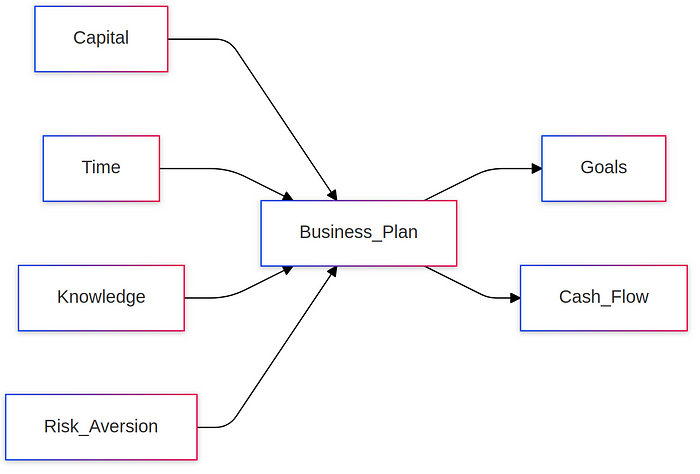
Investor Profile Evaluation: Assess your capital, available time, knowledge level, and risk aversion.
Setting Clear and Achievable Goals: Establish realistic objectives to guide your strategy.
Creating Your Cash Flow Model: Design how money will move within your business.
Figure 2: Elements for Designing Your Business Plan.
1.5. Executing the Plan
Creating and Organizing Wallets: Configure your crypto wallets and structure them for different purposes.
Adding Liquidity: Practical steps to provide liquidity on decentralized exchanges.
Selecting Appropriate Tokens and Pools: Criteria for choosing where to allocate your resources.
Conservative and Advanced Strategies: Adapt your approach based on your profile and objectives.
1.6. Managing and Monitoring Your DeFi Business
Tracking and Analysis Tools: Use applications and platforms to keep control of your investments.
Efficiently Monitoring Your Investments: Strategies to stay updated without consuming excessive time.
Adapting Strategies to Market Conditions: Adjust your tactics according to current trends and data.
Organization and Record-Keeping: Maintain accurate records to assess performance and make informed decisions.
1.7. Continuous Optimization and Improvement
Backtesting: Learn how and why to test your strategies using historical data.
Identifying and Seizing New Opportunities: Stay informed about new projects and trends in DeFi.
Hedging and Advanced Strategies: Explore techniques like delta-neutral strategies to protect your investments.
1.8. Structured Routine and Planning
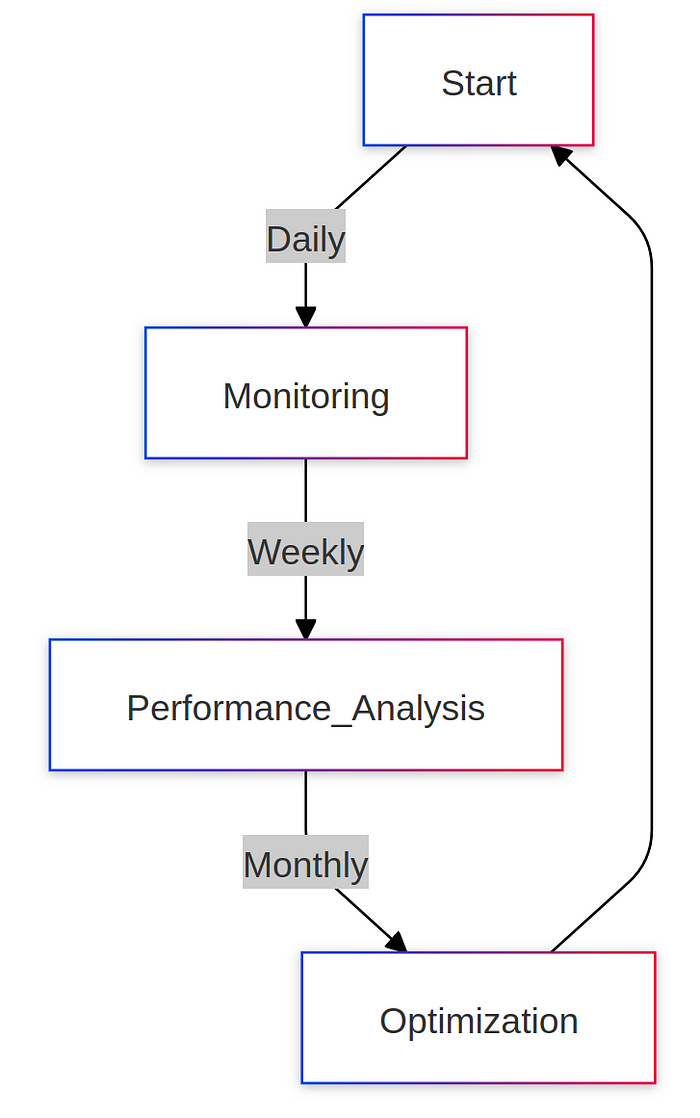
Planning Your Routine: Design a schedule that allows you to manage your business efficiently.
Activity Flow Diagram: Visualize the sequence of tasks to keep everything under control.
Figure 3: Cyclical Routine to Manage and Optimize Your Business.
1.9. Next Steps and Additional Resources
Continuing Education: Guidance on how to further deepen your knowledge in DeFi.
Additional Resources: Access materials and communities to continue growing.
Events and Recommended Conferences: Stay connected with the DeFi community through key events.
What You Will NOT Learn
I want to be clear about what this article does not cover:
Magic Methods to Get Rich Quickly: There are no shortcuts; success requires time and effort.
Foolproof Trading Techniques: This is not a trading guide nor will it teach you to predict the market.
Passive Income without Dedication: While we'll optimize your time, you will need to dedicate a few hours each week.
How to Multiply Your Capital by 100 in One Investment: We'll focus on realistic and sustainable strategies.
2. Introduction to Decentralized Finance (DeFi)
Decentralized Finance, commonly known as DeFi, represents a paradigm shift in the world of finance. By leveraging blockchain technology, DeFi aims to recreate and improve upon traditional financial systems in a decentralized, transparent, and open manner. In this section, we'll explore the origins, principles, and key components of DeFi to provide a solid foundation for building your own DeFi business.
2.1. The Evolution of DeFi
From Traditional Finance to DeFi
Traditional financial systems are centralized, relying on intermediaries like banks, brokers, and clearinghouses to facilitate transactions and manage assets. These intermediaries often introduce inefficiencies, high costs, and barriers to access.
DeFi seeks to eliminate these intermediaries by utilizing smart contracts — self-executing contracts with the terms directly written into code — on blockchain platforms like Ethereum. This allows for:
Transparency: All transactions are recorded on a public ledger.
Accessibility: Anyone with an internet connection can participate.
Security: Cryptographic principles ensure data integrity and authenticity.
Key Milestones in DeFi History
2015: Launch of Ethereum, enabling programmable smart contracts.
2017: Introduction of initial DeFi projects like MakerDAO, offering decentralized lending.
2018–2019: Growth of decentralized exchanges (DEXs) like Uniswap.
2020: "DeFi Summer" — explosive growth in DeFi protocols and total value locked (TVL).
2021 onwards: Expansion into cross-chain interoperability and Layer 2 solutions.
2.2. Core Principles of DeFi
Decentralization
No Central Authority: DeFi protocols operate without a central governing body.
Community Governance: Token holders can participate in decision-making processes.
Transparency and Trustlessness
Open-Source Code: Protocols are often open-source, allowing for public scrutiny.
Immutable Ledgers: Transactions are recorded on blockchains, which are tamper-resistant.
Permissionless Access
Inclusivity: Services are available to anyone, anywhere, without the need for approval.
Interoperability: DeFi applications can interact seamlessly with each other.
Programmability
Smart Contracts: Enable the creation of complex financial instruments and automated processes.
2.3. Key Components of the DeFi Ecosystem
Platforms that allow users to trade cryptocurrencies directly without intermediaries.
Examples: Uniswap, SushiSwap, PancakeSwap.
Mechanism: Utilize Automated Market Makers (AMMs) and liquidity pools.
Lending and Borrowing Platforms
Enable users to lend their assets to earn interest or borrow assets by providing collateral.
Methods for users to earn rewards by staking or providing liquidity to protocols.
Yield Farming: Earning returns through strategic allocation of assets across platforms.
Liquidity Mining: Providing liquidity and receiving protocol tokens as incentives.
Derivatives and Synthetic Assets
Financial instruments whose value is derived from underlying assets.
Examples: Synthetix, Mirror Protocol.
Use Cases: Hedging, speculation, access to traditional assets on the blockchain.
Insurance Protocols
Provide coverage against risks like smart contract failures or hacks.
Examples: Nexus Mutual, Cover Protocol.
Mechanism: Pooling funds to insure against specific risks.
2.4. Advantages of DeFi Over Traditional Finance
Lower Costs: Reduced fees due to the elimination of intermediaries.
Greater Control: Users retain custody of their assets.
Innovation: Rapid development of new financial products and services.
Global Accessibility: Financial services available to the unbanked and underbanked.
2.5. Challenges and Considerations
While DeFi offers significant benefits, it's important to be aware of the challenges:
Security Risks: Smart contract vulnerabilities can lead to loss of funds.
Regulatory Uncertainty: Legal frameworks are still evolving.
Scalability Issues: Network congestion can result in high transaction fees.
Complexity: Steep learning curve for new users.
2.6. The Role of Liquidity Providers in DeFi
As a liquidity provider (LP), you play a crucial role in the DeFi ecosystem:
Facilitating Trades: By supplying tokens to liquidity pools, you enable others to trade seamlessly.
Earning Fees: In return for your contribution, you earn a portion of the trading fees.
Market Efficiency: Increased liquidity leads to tighter spreads and better prices for traders.
How Liquidity Pools Work
Figure 4: Interaction between Liquidity Providers, Traders, and Liquidity Pools.
2.7. Getting Started in DeFi
To participate effectively:
Educate Yourself: Understand the protocols and platforms you plan to use.
Assess Risks: Be aware of potential losses, including impermanent loss and smart contract risks.
Start Small: Begin with a manageable amount to get comfortable with the processes.
Stay Informed: DeFi is rapidly evolving; continuous learning is essential.
2.8. The Future of DeFi
DeFi is poised to revolutionize the financial industry by:
Bridging Traditional and Decentralized Finance: Integrating real-world assets into DeFi.
Improving Scalability: Adoption of Layer 2 solutions and alternative blockchains.
Enhanced Interoperability: Seamless interaction between different blockchain networks.
Mainstream Adoption: As usability improves, more users will enter the DeFi space.
3. Deep Understanding of the Crypto Market
To succeed in the world of cryptocurrencies and DeFi, it's essential to have a deep understanding of how the crypto market truly operates. This section will demystify the market's inner workings, shedding light on the factors that influence it, and help you navigate it more effectively.
3.1. The Real Functioning of the Crypto Market
Market Dynamics Beyond the Hype
The crypto market is often perceived as a mysterious and unpredictable space driven by hype, speculation, and rapid price swings. While volatility is inherent, there are underlying factors and mechanisms that govern market movements.
Supply and Demand: Like any market, prices are influenced by the balance between buyers and sellers.
Market Sentiment: Public perception, news, and social media can significantly impact investor behavior.
Technological Developments: Upgrades, forks, and innovations can affect a cryptocurrency's utility and value.
Regulatory Environment: Laws and regulations can either hinder or promote market growth.
Market Participants
Understanding who is participating in the market helps in anticipating movements:
Retail Investors: Individual traders and investors, often influenced by market sentiment.
Institutional Investors: Hedge funds, corporations, and financial institutions with significant capital.
Whales: Individuals or entities holding large amounts of cryptocurrency that can sway market prices.
Market Makers: Entities providing liquidity by continuously buying and selling assets.
3.2. Market Cycles Analysis
Cryptocurrency markets tend to move in cycles, often more pronounced than traditional markets due to their speculative nature.
The Four Phases of a Market Cycle
1. Accumulation Phase
Occurs after a market has bottomed out.
Prices are relatively stable; smart money begins to enter.
Low volume and minimal public interest.
2. Markup Phase
Prices start to rise as confidence returns.
Increasing volume and media coverage.
More investors enter the market.
3. Distribution Phase
Market sentiment shifts from optimism to greed.
Prices reach a peak; signs of overvaluation appear.
High volume as early investors start taking profits.
4. Markdown Phase
Prices decline rapidly due to selling pressure.
Panic and negative sentiment dominate.
Cycle completes and may start anew with accumulation.
Figure 5: The Four Phases of a Market Cycle.
Applying Cycle Analysis
Timing Entry and Exit: Recognize which phase the market is in to make informed decisions.
Risk Management: Adjust your strategies according to the cycle to mitigate risks.
Emotional Control: Avoid falling prey to FOMO (Fear of Missing Out) or panic selling.
3.3. Factors Influencing Cryptocurrency Prices
Fundamental Analysis
Evaluating the intrinsic value of a cryptocurrency based on:
Utility and Use Case: The practical applications of the cryptocurrency.
Development Activity: Progress and innovation within the project's ecosystem.
Adoption Rates: Number of users, transactions, and partnerships.
Economic Models: Tokenomics, including supply mechanisms and incentives.
Technical Analysis
Using historical price data and charts to predict future movements:
Trend Analysis: Identifying patterns and trends over time.
Support and Resistance Levels: Price points where the market historically reacts.
Indicators: Tools like Moving Averages, RSI (Relative Strength Index), and MACD (Moving Average Convergence Divergence).
Market Sentiment
Public perception can drive prices up or down:
News and Media: Positive or negative coverage influences investor behavior.
Social Media Trends: Platforms like Twitter, Reddit, and Telegram can amplify sentiments.
Influencer Opinions: Statements from prominent figures can cause significant market reactions.
Regulatory News
Changes in laws and regulations can impact:
Market Access: Restrictions or bans in certain countries.
Investor Confidence: Clarity or uncertainty in legal frameworks.
Institutional Participation: Regulations can either encourage or deter large-scale investment.
3.4. The Role of Bitcoin and Market Correlation
Bitcoin as a Market Indicator
Dominance: Bitcoin often sets the trend for the entire crypto market.
Correlation: Many altcoins move in tandem with Bitcoin's price movements.
Market Sentiment: Bitcoin's performance can influence overall investor confidence.
Understanding Correlations
Positive Correlation: Assets move in the same direction.
Negative Correlation: Assets move in opposite directions.
No Correlation: Assets move independently.
Diversification Considerations
Asset Allocation: Diversify across assets with low or negative correlations to reduce risk.
Portfolio Management: Monitor correlations as they can change over time.
3.5. Market Manipulation and Its Impact
Common Manipulation Tactics
Pump and Dump Schemes: Coordinated efforts to inflate a coin's price before selling off.
Wash Trading: Artificially inflating trading volumes to create a false sense of activity.
Spoofing and Layering: Placing large orders without the intention of executing them to influence prices.
Protecting Yourself
Due Diligence: Research thoroughly before investing.
Avoid Illiquid Markets: Thinly traded assets are more susceptible to manipulation.
Stay Informed: Follow reputable news sources and be cautious of sensational claims.
3.6. Psychological Factors and Behavioral Economics
Cognitive Biases in Trading
Confirmation Bias: Favoring information that confirms existing beliefs.
Herd Mentality: Following the crowd without independent analysis.
Overconfidence: Overestimating one's ability to predict market movements.
Emotional Discipline
Fear and Greed Index: A tool to gauge market emotions.
Developing a Plan: Stick to predefined strategies to minimize emotional decisions.
Mindfulness Practices: Techniques to remain calm and focused.
3.7. Importance of Fundamental Research
Evaluating Projects
Team and Advisors: Assess the credibility and experience of the team.
Whitepapers and Roadmaps: Review the project's vision and planned developments.
Community Engagement: Active and supportive communities can indicate a healthy project.
Red Flags to Watch For
Lack of Transparency: Opaque information about the team or technology.
Unrealistic Promises: Guarantees of high returns with little risk.
Poor Communication: Infrequent updates or evasive answers to questions.
3.8. Utilizing Data and Analytics Tools
On-Chain Analysis
Blockchain Explorers: Tools like Etherscan to view transactions and wallet activities.
Whale Watching: Monitoring large transactions that could signal market moves.
Network Metrics: Analyzing data like hash rate, active addresses, and transaction volumes.
Market Data Platforms
Price Trackers: Websites like CoinMarketCap and CoinGecko for real-time data.
Analytics Tools: Platforms offering advanced charts and market insights.
3.9. Staying Informed and Continuing Education
Reputable News Sources
Industry Publications: Coindesk, Decrypt, The Block.
Official Announcements: Follow project blogs and official channels.
Community Engagement
Forums and Discussion Groups: Participate in Reddit, Telegram, and Discord communities.
Webinars and Podcasts: Stay updated with expert opinions and analyses.
Regulatory Updates
Government Releases: Monitor official statements from regulatory bodies.
Legal Analysis: Consult summaries and interpretations from legal experts in the crypto space.
3.10. Practical Steps to Apply Your Understanding
Define Your Strategy: Based on your understanding of the market, create a clear investment plan.
Set Realistic Expectations: Aim for sustainable growth rather than quick wins.
Risk Management: Use stop-loss orders, diversify, and only invest what you can afford to lose.
Continuous Learning: The crypto market evolves rapidly; staying informed is crucial.
4. Liquidity Pools and Decentralized Exchanges
n the decentralized finance (DeFi) ecosystem, liquidity pools and decentralized exchanges (DEXs) play a pivotal role in enabling seamless trading and financial operations without intermediaries. Understanding how these components function is essential for anyone looking to participate as a liquidity provider and build a profitable DeFi business.
4.1. Understanding Liquidity
What Is Liquidity?
Liquidity refers to the ease with which an asset can be bought or sold in the market without affecting its price. High liquidity implies that there are ample buyers and sellers, allowing for smooth transactions.
Importance in Markets: Liquidity ensures that traders can enter and exit positions easily.
In DeFi: Liquidity is crucial for the functioning of DEXs, where users rely on liquidity pools to execute trades.
4.2. Introduction to Decentralized Exchanges (DEXs)
What Are DEXs?
Decentralized exchanges are platforms that facilitate peer-to-peer trading of cryptocurrencies without the need for intermediaries. They operate through smart contracts on blockchain networks.
No Central Authority: Users maintain control of their funds at all times.
Transparency: All transactions are recorded on the blockchain.
Accessibility: Anyone with a compatible wallet can participate.
Advantages of DEXs
Security: Reduced risk of exchange hacks since users hold their own keys.
Privacy: No need for extensive personal information or KYC processes.
Censorship Resistance: Difficult for any entity to restrict access or manipulate markets.
4.3. Automated Market Makers (AMMs)
From Order Books to AMMs
Traditional exchanges use order books to match buy and sell orders. DEXs introduced Automated Market Makers (AMMs) to facilitate trading without order books.
Order Books: Require matching orders, which can be inefficient in low-liquidity markets.
AMMs: Use mathematical formulas to price assets based on the ratio of tokens in a liquidity pool.
How AMMs Work
AMMs rely on liquidity pools where users supply pairs of tokens.
Pricing Algorithm: Commonly the Constant Product Formula x×y=k, where x and y are the quantities of two tokens, and k is a constant.
Trade Execution: Swaps adjust the token ratios, changing the price according to the formula.
Liquidity Providers (LPs): Users who supply tokens to pools and earn a share of trading fees.
Figure 6: Operation of an Automated Market Maker.
4.4. Uniswap and Its Evolution
Uniswap is one of the most prominent DEXs, pioneering the AMM model.
Uniswap v1
Launched: November 2018.
Features: Simple pools with ETH and a single ERC-20 token.
Limitations: Required ETH as one side of every pair, less efficient.
Uniswap v2
Improvements:
Direct ERC-20 Pairs: Allowed any two ERC-20 tokens to form a pool.
Price Oracles: Introduced time-weighted average prices for external use.
Functionality: Enhanced flexibility and utility.
Uniswap v3
Liquidity Concentration: LPs can allocate liquidity within specific price ranges.
Multiple Fee Tiers: Choose between different fee levels based on risk.
Capital Efficiency: Improved returns for LPs by focusing liquidity where it's most needed.
Key Concepts in Uniswap
Constant Product Formula: x×y=k ensures that trades adjust prices smoothly.
Slippage: The difference between expected and executed trade prices due to liquidity constraints.
Impermanent Loss: Temporary loss relative to holding tokens due to price divergence.
4.5. Providing Liquidity
Becoming a Liquidity Provider
To provide liquidity:
Select a Pool: Choose a token pair and platform (e.g., Uniswap v3).
Deposit Tokens: Supply equal value amounts of both tokens to the pool.
Define Price Range (Uniswap v3): Specify the price range where your liquidity will be active.
Earn Fees: Collect a proportion of the trading fees generated in your price range.
Considerations for LPs
Impermanent Loss: Understand the risks if token prices move significantly.
Fee Earnings: Higher fees can offset impermanent loss in volatile markets.
Capital Allocation: Concentrated liquidity can increase capital efficiency but may require active management.
4.6. Fees and Earnings
Fee Structures
Fixed Fees: Common fee tiers are 0.05%, 0.3%, and 1% per trade.
Distribution: Fees are distributed proportionally to LPs based on their share of the pool.
Calculating Returns:
APR (Annual Percentage Rate): Estimates yearly returns based on current fees and liquidity.
Factors Influencing Earnings:
— Trading Volume: More volume equals more fees.
— Liquidity Depth: Less liquidity can mean a higher share of fees but may increase slippage.
— Price Range: Concentrated liquidity can enhance returns within active ranges.
4.7. Managing Risks
Impermanent Loss
Definition: Loss compared to holding tokens outside the pool due to price changes.
Mitigation Strategies:
— Stablecoin Pairs: Less volatile pairs reduce impermanent loss.
— Active Management: Adjusting positions as market conditions change.
— Earning Fees: High fees can compensate for impermanent loss over time.
Smart Contract Risks
Vulnerabilities: Bugs or exploits can lead to loss of funds.
Safety Measures:
— Reputable Platforms: Use well-established DEXs with audited contracts.
— Diversification: Spread liquidity across multiple pools or platforms.
4.8. Slippage and Price Impact
Understanding Slippage
Definition: The difference between the expected price of a trade and the price at which it is executed.
Causes:
— Low Liquidity: Insufficient liquidity leads to larger price movements per trade.
— Large Trade Sizes: Big orders relative to pool size increase slippage.
Reducing Slippage
Trade in High-Liquidity Pools: Larger pools can handle bigger trades with minimal price impact.
Break Up Trades: Execute large trades in smaller increments.
Set Slippage Tolerance: Use DEX settings to limit acceptable slippage.
4.9. Routing and Aggregators
Trade Routing
Multiple Pools: DEXs may route trades through several pools to find the best price.
Impact on LPs: Being part of popular routes can increase fee earnings.
DEX Aggregators
Function: Platforms that search across multiple DEXs to find the best trading rates.
Examples: 1inch, Matcha, Paraswap.
Benefits:
— Better Prices: By splitting orders across platforms.
— Increased Volume: Can bring more trades to pools, benefiting LPs.
4.10. Participating Effectively as an LP
Research and Selection
Token Analysis: Evaluate the tokens in the pool for potential risks and returns.
Platform Choice: Consider fees, user interface, and community support.
Monitoring and Adjusting Positions
Track Performance: Use tools to monitor earnings and impermanent loss.
Rebalance as Needed: Adjust liquidity ranges or amounts based on market movements.
Passive Income Potential: Earn fees without active trading.
Support DeFi Ecosystem: Facilitate trading and contribute to market efficiency.
Capital Efficiency: Especially with concentrated liquidity, maximize returns on your capital.
4.13. Challenges and Considerations
Active Management: Concentrated liquidity may require more frequent adjustments.
Market Volatility: Price swings can lead to impermanent loss.
Regulatory Risks: Stay informed about legal developments affecting DeFi activities.
5. Risks and How to Mitigate Them
While decentralized finance (DeFi) offers exciting opportunities for earning and innovation, it also comes with its share of risks. Understanding these risks is crucial for protecting your investments and making informed decisions. In this section, we'll explore the common risks associated with DeFi and provide strategies to mitigate them.
5.1. Impermanent Loss
What Is Impermanent Loss?
Impermanent loss occurs when the value of tokens deposited in a liquidity pool changes compared to simply holding them in your wallet. It's the difference in value between holding tokens versus providing them as liquidity.
Cause: Price divergence between the two tokens in a pool.
Effect: Potential loss relative to holding, which may be offset by trading fees earned.
Example Scenario
Initial Deposit: 1 ETH (worth $2,000) and 2,000 USDC (worth $2,000).
Price Change: ETH increases to $3,000.
Outcome: The pool rebalances, and you end up with less ETH and more USDC, resulting in a lower total value compared to simply holding.
Mitigation Strategies
Choose Stablecoin Pairs: Less volatile pairs reduce the risk of significant price divergence.
Active Management: Monitor and adjust your positions as market conditions change.
Fee Optimization: High trading fees can offset impermanent loss over time.
Use Impermanent Loss Calculators: Tools to estimate potential losses before committing funds.
5.2. Smart Contract Risks
Vulnerabilities and Exploits
Smart contracts are immutable once deployed, and bugs or vulnerabilities can be exploited by malicious actors.
Examples of Risks:
— Reentrancy Attacks: Exploiting contract functions to drain funds.
Stay Informed: Keep abreast of legal developments in your jurisdiction.
Consult Professionals: Seek advice from legal and tax experts specialized in crypto.
Compliance Practices: Adhere to best practices even if not currently mandated.
5.4. Market Volatility
Price Fluctuations
Cryptocurrencies are known for their high volatility, which can impact the value of your investments.
Risks Include:
— Rapid Price Drops: Leading to significant losses.
— Liquidation Risks: In leveraged positions or collateralized loans.
— Slippage: Larger-than-expected price changes during trades.
Mitigation Strategies
Risk Management: Only invest what you can afford to lose.
Use Stop-Loss Orders: Automatically sell assets at predetermined price points.
Diversification: Spread investments across different assets and sectors.
Stablecoins: Allocate a portion of your portfolio to stable assets to reduce overall volatility.
5.5. Platform and Protocol Risks
Centralization Points
Despite the decentralized nature of DeFi, some platforms have centralized elements that pose risks.
Examples:
— Admin Keys: Developers holding keys that can alter contracts.
— Oracles: Reliance on single sources of data can lead to manipulation.
— Governance Risks: Majority token holders can make decisions that affect the protocol.
Mitigation Strategies
Research Decentralization Level: Evaluate how decentralized a platform truly is.
Community Governance: Prefer protocols with distributed governance models.
Oracle Security: Use platforms that implement decentralized or multiple oracles.
5.6. Phishing and Scams
Social Engineering Attacks
Attackers may attempt to deceive users into revealing private keys or seed phrases.
Common Tactics:
— Fake Websites: Imitating legitimate platforms to steal credentials.
— Phishing Emails: Urging urgent action to secure your account.
— Impersonation: Fraudulent support agents offering assistance.
Mitigation Strategies
Verify URLs: Double-check website addresses before entering sensitive information.
Never Share Private Keys: No legitimate platform will ask for your private keys or seed phrases.
Use Bookmark Links: Save official sites to avoid typosquatting domains.
Enable Security Features: Use hardware wallets and enable two-factor authentication where possible.
5.7. Liquidity Risks
Low Liquidity Pools
Participating in pools with low liquidity can pose challenges.
Risks:
— High Slippage: Price impact is greater when trading volumes are low.
— Difficulty Exiting Positions: Harder to withdraw funds without affecting prices.
Mitigation Strategies
Assess Pool Depth: Check total value locked (TVL) before participating.
Prefer Established Pools: Larger pools generally offer better liquidity.
Monitor Activity: Regularly check trading volumes and liquidity changes.
5.8. Front-Running and MEV (Miner Extractable Value)
Understanding MEV
Miners or validators may prioritize or reorder transactions for profit.
Risks:
— Front-Running: Someone sees your transaction and executes a similar one before you.
— Sandwich Attacks: Transactions placed before and after yours to manipulate prices.
Mitigation Strategies
Use Private Transactions: Some platforms offer ways to submit transactions privately.
Set Slippage Tolerance: Adjust settings to limit the impact of front-running.
Be Mindful of Gas Fees: Higher fees can sometimes help prioritize your transaction.
5.9. Collateral Risks in Lending Platforms
Over-Collateralization Requirements
Lending platforms require collateral to secure loans, but fluctuations can lead to liquidation.
Risks:
— Margin Calls: If collateral value drops, additional funds may be needed.
— Forced Liquidation: Collateral sold off if value falls below thresholds.
Mitigation Strategies
Monitor Collateral Ratios: Keep an eye on the health factor of your positions.
Maintain Buffer: Provide extra collateral to cushion against price swings.
Set Alerts: Use tools to notify you of critical changes in collateral value.
5.10. Time Risks and Gas Fees
Network Congestion
High demand can lead to increased transaction fees and delays.
Risks:
— Failed Transactions: Due to insufficient gas fees.
— Higher Costs: Eats into profits from liquidity providing.
Mitigation Strategies
Plan Transactions: Execute during off-peak times when fees are lower.
Layer 2 Solutions: Utilize platforms built on Layer 2 networks with lower fees.
Monitor Gas Prices: Use tools like ETH Gas Station to find optimal times.
5.11. Strategies for Overall Risk Management
Education and Research
Continuous Learning: Stay updated on the latest developments and best practices.
Community Engagement: Participate in forums and discussions to share knowledge.
Diversification
Asset Allocation: Don't put all your funds into a single platform or token.
Portfolio Balance: Mix high-risk and low-risk investments.
Use of Reputable Platforms
Track Record: Prefer platforms with a proven history and strong community support.
Audits and Security Measures: Check for third-party audits and robust security protocols.
Set Clear Investment Goals
Define Risk Tolerance: Understand how much you're willing to lose.
Exit Strategies: Plan when to take profits or cut losses.
5.12. Insurance Options in DeFi
DeFi Insurance Protocols
Some platforms offer insurance products to protect against specific risks.
Examples: Nexus Mutual, Cover Protocol, InsurAce.
How It Works
Purchase Coverage: Pay a premium to cover potential losses.
Claims Process: In the event of a loss, submit a claim for compensation.
Considerations
Coverage Scope: Understand what is and isn't covered.
Cost vs. Benefit: Weigh the premiums against potential risks.
5.13. Emotional and Psychological Risks
Fear and Greed
Emotions can lead to irrational decisions.
Risks:
— Overtrading: Frequent buying and selling based on emotions.
— Holding Losses: Reluctance to sell losing positions due to attachment.
Mitigation Strategies
Stick to Your Plan: Follow your predefined strategy.
Set Realistic Expectations: Avoid get-rich-quick mentality.
Mindfulness Practices: Techniques to maintain emotional balance.
Conclusion of Part One
We've journeyed through the foundational aspects of building a successful DeFi business. By exploring the reality of the crypto market, understanding the principles of decentralized finance, delving into the mechanics of liquidity pools and decentralized exchanges, and examining the various risks and how to mitigate them, you're now equipped with the essential knowledge to navigate the DeFi landscape confidently.
What's Next?
In the next article, we'll transition from foundational knowledge to practical application. We'll cover:
Designing Your DeFi Business Plan: Evaluating your investor profile, setting clear and achievable goals, and creating a personalized cash flow model.
Executing the Plan: Setting up and organizing your wallets, adding liquidity to chosen pools, and selecting appropriate tokens and platforms.
Managing and Monitoring Your DeFi Business: Utilizing tools and strategies to track performance, adjust your positions, and maintain effective records.
Optimizing and Improving: Implementing backtesting methods, identifying new opportunities, and exploring advanced strategies such as hedging and delta-neutral positions.
Building a Structured Routine: Planning your daily, weekly, and monthly activities to efficiently manage and grow your business.
Stay tuned for these actionable insights and step-by-step guides that will empower you to turn your knowledge into a thriving DeFi business.
Annex: Useful Links from This Article
Below is a compilation of all the useful links mentioned throughout this article to aid you in further exploration and understanding.
By leveraging these resources, you can deepen your knowledge, stay informed, and make more educated decisions as you build and manage your DeFi business. Remember, the DeFi landscape is dynamic and rapidly evolving, so continuous learning and vigilance are key to success.
Thank you for joining us on this journey through the foundational elements of DeFi. We look forward to guiding you further in the next article, where we'll turn knowledge into action and help you build a thriving DeFi business.
I am the wife to a wonderful man named Will, and Mom to 5 amazing kids. Both Will and I were widowed before we met. We had 3 children between us when we married. We welcomed a new addition 1 1/2 years later. The pregnancy and birth were wild, so we decided to be "done". God had a different plan. We were introduced to international adoption, and started that process 11/04. We brought our 5th child home from Ethiopia 4/06. You could say our kids are Your's, Mine, Our's and Someone Else's. 8^) We are just grateful that they are all OUR'S! Someday, we will adopt from Ethiopia again. We know there is an "older child" that is meant to be part of our family. We trust that God will let us know when the time is right. Parenting is the hardest and most rewarding thing I have ever taken on. I am not an expert, but I'm happy to share any insights I gain along the way. I also appreciate any tips I can glean from my readers. After all, it takes a village, right?!